


Many legal professionals assume that translating a contract or privacy notice into another language is sufficient for cross-border compliance. It is not. Legal localisation goes several steps further, adapting both the language and the legal substance of a document to fit the specific regulatory, cultural, and jurisdictional requirements of each target market. For European legal professionals operating across multiple jurisdictions, the distinction carries very real consequences, from invalid contracts to significant regulatory fines and damaged client relationships.
Key Takeaways
| Point | Details |
|---|---|
| Definition and scope | Legal localisation adapts both wording and legal substance to match the target jurisdiction’s laws and expectations. |
| EU compliance needs | Proper localisation is crucial to meet GDPR, RODO, EMA, MDR, and Data Act requirements for legal documents and policies. |
| Critical risk reduction | Ignoring localisation can lead to unenforceable contracts, substantial fines, and reputational damage. |
| Not just translation | Translation alone is not enough; legal localisation addresses local legal systems, terms, and formalities. |
| Practical workflow tips | Successful localisation uses a careful framework and expert resources, not just off-the-shelf templates. |
What is legal localisation?
With the confusion highlighted, let us outline what legal localisation truly means and why European professionals should pay attention.
Legal localisation is the process of adapting legal documents so that they are linguistically accurate and legally valid within a specific jurisdiction. This goes well beyond word-for-word rendering, which is what most people understand as translation versus interpretation. Localisation requires adjusting clause structures, adopting jurisdiction-specific terminology, applying appropriate formality levels, and ensuring alignment with local statutes and regulatory frameworks.
Consider the difference in practical terms:
| Aspect | Legal translation | Legal localisation |
|---|---|---|
| Language accuracy | Yes | Yes |
| Jurisdiction-specific clauses | No | Yes |
| Regulatory terminology alignment | Partial | Full |
| Cultural and legal system adaptation | No | Yes |
| Enforceability assurance | Limited | Strong |
Key regulatory areas that demand proper localisation in Europe include:
- GDPR and RODO (the Polish equivalent of GDPR)
- EMA guidelines for medical and pharmaceutical documentation
- EU MDR (Medical Device Regulation)
- The EU Data Act, which governs data sharing obligations
As noted in further legal compliance insights, compliance expectations vary significantly across member states, even when the underlying EU regulation is shared. EU compliance demands plain language, consistent terminology across all 24 official EU languages, and jurisdiction-specific alignment for privacy notices, cookie policies, and contracts, to avoid fines and document invalidation.
“Legal localisation is not simply translation. It is a strategic, legally informed adaptation that makes documents enforceable and compliant in their target jurisdiction.”
Treating localisation as an afterthought risks undermining the very documents your clients depend on.
Why does legal localisation matter in the EU?
Now that we have defined legal localisation, it is crucial to understand the real-world consequences of overlooking it.
The EU legal landscape is uniquely complex. Twenty-seven member states share overarching regulations but retain distinct national implementations, court traditions, and linguistic norms. A privacy notice that meets GDPR standards in Germany may fail RODO requirements in Poland, simply because the local terminology, clause order, or language register differs.
The risks of neglecting proper localisation are both immediate and lasting:
- Invalid contracts that cannot be enforced in the target jurisdiction
- Regulatory fines under GDPR, RODO, or sector-specific frameworks
- Client disputes arising from ambiguous or legally inconsistent terminology
- Reputational damage that erodes trust with cross-border clients and partners
- Document rejection by local regulatory authorities or courts
Proper localisation requires plain language standards and consistent terminology across all 24 EU official languages, with jurisdiction-specific clauses for privacy notices, cookie policies, and contracts. This is not optional guidance. It reflects the practical enforcement reality across EU member states.
Multi-jurisdictional work also demands careful attention to local variants. Cookie disclaimers may need different consent language in France versus Denmark. Employment contracts require very different termination clauses in Spain compared to the Netherlands. Every jurisdiction has its own formalities, and cross-border compliance support becomes essential when operating at scale.

For practical guidance, our legal localisation checklist outlines the key steps to verify before finalising any cross-border legal document.
Pro Tip: Always match local regulatory terminology precisely. In Poland, always use “RODO” rather than “GDPR” in client-facing documents. Using the wrong term signals unfamiliarity with local law and can undermine your credibility with regulators and clients alike.
“Consistency in terminology is not a stylistic choice. In legal localisation, it is a compliance requirement.”
The financial stakes are significant. GDPR fines alone can reach €20 million or 4% of global annual turnover. For any legal professional advising international clients, that figure makes localisation a priority, not a luxury.
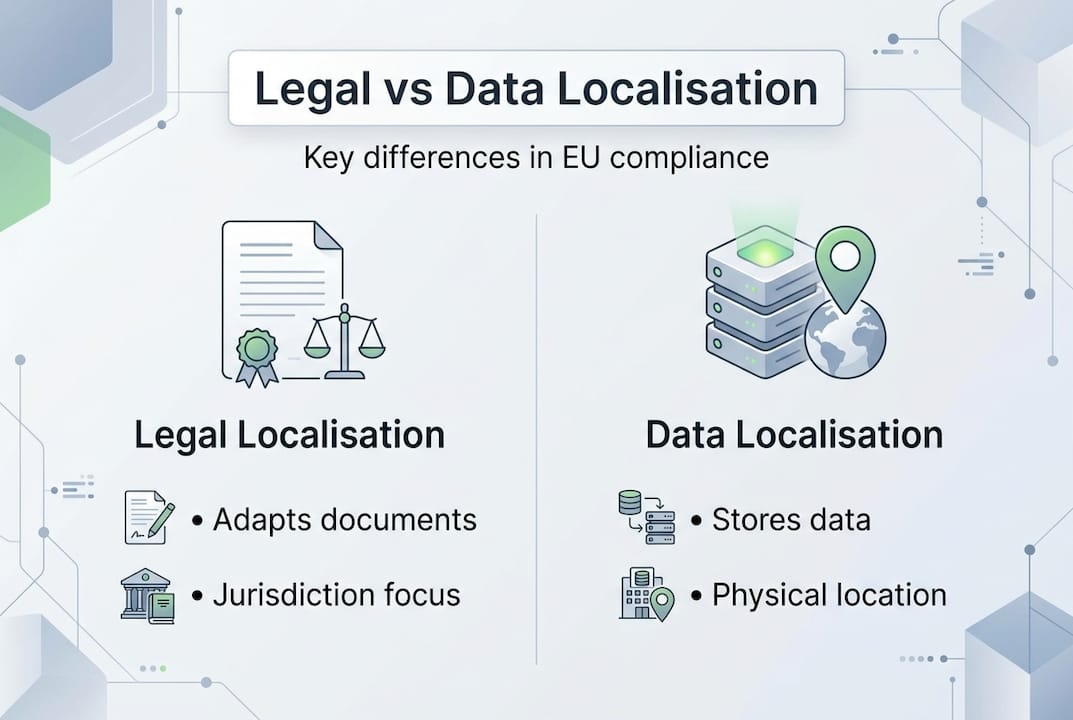
Legal localisation vs data localisation: What’s the difference?
With the risks established, it is vital to distinguish legal localisation from another compliance priority: data localisation.
These two concepts are frequently confused, and the confusion can lead to misaligned compliance strategies. They address entirely different regulatory concerns.
| Concept | Definition | Example |
|---|---|---|
| Legal localisation | Adapting legal documents for jurisdictional enforceability | Adapting a GDPR privacy policy for Poland’s RODO framework |
| Data localisation | Requirements to store or process data within a specific geography | Health data stored within national servers |
Document adaptation versus data storage are distinct compliance obligations. Data localisation refers to storing data in-country, which is strict in countries like China and Russia, while the EU generally takes a risk-based approach without blanket mandates.
The EU generally favours transfer mechanisms for data movement. EU cloud and sector rules show that the EU prefers Standard Contractual Clauses (SCCs) over strict data borders, though certain sectors such as health and finance may impose de facto localisation requirements through sector-specific regulation.
Here is a practical breakdown of how both apply across key sectors:
- Healthcare: Medical device documentation must undergo legal localisation under EU MDR, while patient data storage may also require geographic restrictions under national health law.
- Banking and fintech: Client-facing contracts need full legal localisation across each jurisdiction, while financial transaction data may face sector-specific residency rules.
- Technology and SaaS: Terms of service and data processing agreements require legal localisation, while data transfers to third countries must comply with SCC requirements.
- Pharmaceutical: EMA submissions demand localised documentation aligned with member state regulatory language, separate from any data storage considerations.
AI tools are increasingly being explored for both legal and data localisation workflows, though their use in regulated content remains a subject of active debate. Explore how AI in compliance adaptations is developing within the legal sector.
Pro Tip: Always confirm whether your compliance obligation is about the document (legal localisation) or the data (data localisation) before selecting your approach. Conflating the two leads to gaps in both.
How to implement legal localisation: A practical framework
Understanding the distinction leads to the pressing question: how should legal professionals put localisation into practice?
The process requires a structured, disciplined approach. Ad hoc translation with minor edits is not sufficient. Here is a practical framework used by experienced localisation professionals:
- Assessment: Identify all documents requiring localisation, including contracts, privacy notices, cookie policies, disclaimers, and regulatory submissions. Prioritise by risk level and jurisdictional exposure.
- Terminology management: Build or access a jurisdiction-specific glossary covering regulatory terms, defined phrases, and required formalities. This ensures consistency across all documents for a given market.
- Regulatory analysis: Map each document’s content against the applicable laws of the target jurisdiction. This includes national implementations of EU directives, sector-specific rules, and any recent regulatory updates.
- Adaptation: Rewrite clauses, adjust structure, and update terminology so that the document is both linguistically clear and legally sound. This is where EU compliance requirements for GDPR, RODO, EMA, EU MDR, and the Data Act must be reflected in full.
- Expert review: Have a qualified legal reviewer with jurisdiction-specific expertise verify both the legal accuracy and the language quality of the adapted document.
- Version control: Maintain clear records of all localised versions, update cycles, and the regulatory basis for each adaptation.
| Step | Common pitfall | How to avoid it |
|---|---|---|
| Assessment | Missing low-risk documents that later cause issues | Use a full document audit |
| Terminology | Inconsistent terminology across documents | Use a centralised glossary |
| Regulatory analysis | Relying on outdated regulatory mapping | Schedule regular reviews |
| Adaptation | Reusing templates without full clause review | Adapt each document individually |
| Expert review | Using generalist translators for legal review | Engage legal-sector specialists |
For a structured approach to managing the full process, our localisation workflow guide covers proven methods for cutting errors across EU sectors. You can also explore optimising localisation process strategies to improve efficiency without compromising accuracy.
Pro Tip: Never reuse an existing localised template without a full clause-by-clause review. Regulations change, jurisdictions update their requirements, and a template that was compliant eighteen months ago may now carry legal risk.
A deeper view: Why legal localisation is the unsung engine of trust
Most legal professionals view localisation as a compliance box to tick. That framing undersells its strategic value considerably.
When a client in Warsaw or Madrid receives a contract that uses the correct local terminology, references the right local statutes, and reads clearly in their own legal tradition, it signals something important: that their legal counsel understands their world. That recognition builds confidence. It turns a transactional document into a trust-building moment.
The localisation benefits for cross-border legal work extend well beyond compliance. Properly localised documentation reduces renegotiation cycles, lowers the risk of client disputes, and shortens time to contract execution. In a competitive market for international legal services, that is a measurable differentiator. Combining experienced human legal expertise with intelligent AI tools delivers the precision and consistency that regulated legal environments demand.
Explore localisation solutions for compliant, effective legal work
For those ready to put best practice into action, professional localisation partners can help you move ahead securely. Glocco® brings together EU compliance expertise, specialist legal linguists, and tailored localisation workflows to support legal professionals across Europe and beyond. Whether you need help with a single jurisdiction or a multi-market rollout, the business localisation benefits are accessible with the right partner. Start with our language localisation guide to understand the full scope of what a strategic localisation programme can deliver for your practice.
Frequently asked questions
What are the consequences of skipping legal localisation in the EU?
Contracts, policies, and disclaimers may be unenforceable or trigger regulatory fines if not properly localised for each jurisdiction, as localisation prevents fines and document invalidation across EU member states.
Does legal localisation include only language or also legal system adaptation?
Legal localisation adapts both language and legal substance, fitting local laws, terms, and formalities. Jurisdiction-specific alignment for privacy notices, cookie policies, and contracts is a core component of the process.
How is legal localisation different from data localisation?
Legal localisation adapts documents for legal enforceability, while data localisation controls where data is physically stored and processed. Document adaptation versus data storage are separate compliance obligations requiring distinct strategies.
Is legal localisation mandatory for all European documents?
Compliance requirements vary by country and document type, but legal localisation is essential for most public-facing contracts, privacy notices, and regulatory submissions, given that jurisdiction-specific clauses are required to avoid fines and invalidation across EU markets.


