


Many marketing and localisation professionals invest heavily in written translation yet treat voiceover as an optional extra. That oversight is costly. Multimedia content now drives the majority of global digital engagement, and audiences who cannot understand the spoken word in a video are far less likely to trust, complete, or act on that content. This article explains exactly what voiceover means within the localisation process, why it carries genuine strategic weight, and how you can integrate it effectively into your international content workflow.
Key Takeaways
| Point | Details |
|---|---|
| Voiceover defined | Voiceover in localisation adds spoken content in other languages to multimedia, beyond simple translation. |
| Business impact | Professional voiceover increases user engagement, accessibility, and trust for global brands. |
| Workflow integration | Effective localisation budgets for voiceover throughout script adaptation, talent choice, recording, and QA. |
| Solution selection | Evaluate voiceover based on project type, budget, language needs, and audience expectations. |
What is voiceover in localisation?
With a broad understanding of localisation in mind, we can drill down to where voiceover fits into the mix. Language localisation explained covers the wider picture, but voiceover occupies a very specific and important position within that framework.
In localisation, voiceover refers to the process of recording a spoken translation of source audio or script so that the new language track is layered over or replaces the original sound in a piece of multimedia content. It is not simply translation. Translation converts written text from one language to another. Voiceover takes that translated content and delivers it through a human voice, timed and adapted to fit the visual and audio context of the original recording.
It is also worth distinguishing voiceover from dubbing. In a standard voiceover, the original speaker’s voice is often kept at a lower volume beneath the new recording, particularly in documentary or news formats. Dubbing, by contrast, fully replaces the original voice and requires precise lip-sync matching. Voiceover is generally faster to produce and more cost-effective, making it the preferred choice for many corporate and educational applications.
Common scenarios where localised voiceover is used include:
- eLearning and training modules where learners need to follow narrated instruction in their native language
- Corporate explainer videos aimed at international employees or clients
- Television and online advertising targeting regional markets
- Product demonstration videos in e-commerce and SaaS
- Legal and compliance content where precise comprehension is critical
- Medical and pharmaceutical communications requiring accuracy and cultural sensitivity
Voiceover is also distinct from voice interpretation, which is a live service used in real-time multilingual settings such as conferences or legal proceedings. Localised voiceover, by contrast, is a pre-recorded, post-production process.
Pro Tip: Choose a professional voice artist who understands both the target language and the cultural nuance of the audience. A technically accurate recording delivered in the wrong regional accent or tone can still undermine audience trust.
Why voiceover matters for global audiences
Having defined what voiceover in localisation is, let us now understand why it is so crucial for businesses operating across borders.

When a viewer encounters video content in a language they do not speak fluently, comprehension drops sharply. Subtitles help, but they divide attention between reading and watching, reducing retention. A well-localised voiceover allows audiences to absorb visual information fully while processing the spoken message naturally. The result is stronger engagement, higher completion rates, and better recall.
The localisation benefits for business extend well beyond user experience. Research consistently shows that consumers are significantly more likely to purchase from websites and platforms that communicate in their native language. When that native language experience extends to video, the effect is amplified. Studies indicate that multilingual video content can increase viewer engagement by as much as 40% compared to subtitled alternatives in certain markets.
“Localised voiceover transformed our eLearning completion rates across our European offices. Learners who previously skipped modules were suddenly engaging fully with the content.” This kind of outcome is not unusual when voiceover is done well.
The business case becomes even stronger in specific sectors. Key benefits of quality voiceover localisation include:
- Increased conversion rates on product videos and advertising content in target markets
- Improved brand reputation through consistent, culturally appropriate communication
- Greater accessibility for audiences with lower literacy levels or visual impairments
- Higher training completion rates in corporate and compliance eLearning
- Stronger regulatory compliance in legal, medical, and financial communications, where misunderstanding carries real risk
Trust is a particularly important factor. Audiences in markets such as Germany, Japan, and France have historically shown a strong preference for content in their own language. Delivering voiceover that sounds local, rather than translated, signals genuine commitment to those markets and builds the kind of trust that drives long-term customer loyalty.
How voiceover fits into the localisation workflow
Understanding its importance, let us see how voiceover is actually implemented in practical localisation projects. A structured localisation workflow is essential to maintaining quality and avoiding costly rework.
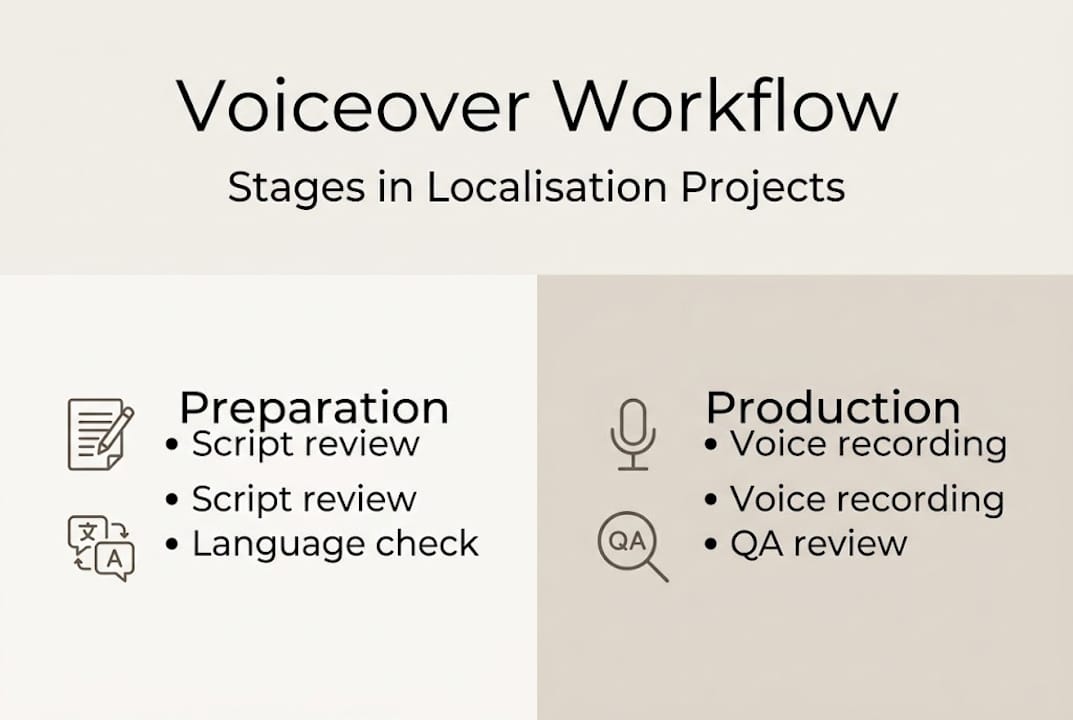
The voiceover localisation process follows a clear sequence of stages, each with defined responsibilities:
- Source content analysis — Review the original video, audio, and script to assess length, tone, technical terminology, and any cultural references that may require adaptation.
- Script translation and adaptation — Translate the source script, then adapt it for spoken delivery. This is not a word-for-word exercise. Spoken language flows differently from written text, and the adapted script must fit the timing of the original recording.
- Voice talent selection — Identify and audition native speakers with the appropriate accent, tone, and industry knowledge for the target audience.
- Recording — Conduct professional studio or remote recording sessions, ensuring consistent audio quality and accurate delivery.
- Synchronisation — Align the new voiceover track with the visual content, adjusting pacing where necessary.
- Post-production QA — Review the final output for linguistic accuracy, audio quality, timing, and cultural appropriateness before release.
| Workflow stage | Primary responsibility |
|---|---|
| Source content analysis | Project manager and linguist |
| Script translation and adaptation | Specialist translator |
| Voice talent selection | Casting director or localisation lead |
| Recording | Voice artist and audio engineer |
| Synchronisation | Post-production editor |
| QA and sign-off | Linguist, subject matter expert, and client |
Two common pitfalls undermine voiceover projects. First, teams skip the script adaptation stage and send a direct translation to the voice artist. The result is stilted, unnatural delivery that audiences immediately recognise as foreign. Second, subject matter experts are excluded from the QA stage, allowing technical errors in specialised content to slip through to final release. Both mistakes are avoidable with proper workflow planning.
Post-production QA deserves particular emphasis for global releases. A voiceover that passes linguistic review but contains audio inconsistencies, mistimed pauses, or background noise will still damage your brand’s credibility in the target market.
Choosing the right voiceover solution
Now you know the process, let us look at how to select the right approach for your organisation’s needs. The choice between in-house and outsourced voiceover depends on several factors, and getting this decision right has a direct impact on quality, speed, and budget.
| Factor | In-house voiceover | Outsourced voiceover |
|---|---|---|
| Cost | Higher upfront investment | Flexible, project-based pricing |
| Quality control | Direct oversight | Dependent on provider standards |
| Scalability | Limited by internal capacity | Scales with project demand |
| Language range | Restricted to internal skills | Access to broad language pairs |
| Speed | Can be slower without dedicated team | Faster with specialist providers |
| Cultural expertise | Variable | High, with specialist providers |
When evaluating an external provider, look for demonstrated expertise in your industry, a roster of native-speaking voice artists across your target languages, a transparent quality assurance process, and a technology stack that supports remote recording and file management at scale. References and case studies from comparable projects are a strong indicator of reliability.
AI-generated voiceover has improved considerably and can be a practical choice for high-volume, low-stakes content such as internal system notifications or rapidly updated product catalogues. However, for brand-sensitive campaigns, eLearning with complex emotional or motivational content, or any communication where nuance matters, human voiceover remains the stronger choice. AI voices still struggle with regional dialect, emotional inflection, and the subtle pacing that makes spoken content feel natural to a local audience.
Pro Tip: Always request voice samples in your target language and, where possible, have a native speaker from the target market review them before you commit to a voice artist. What sounds right to a project manager in London may feel entirely wrong to an audience in Warsaw or Riyadh.
Thinking about optimising content localisation more broadly will also help you position voiceover within a wider content strategy rather than treating it as a standalone task.
Why voiceover is localisation’s secret global differentiator
Having completed the main guide, it is time for a candid industry perspective. At Glocco®, we see the same pattern repeatedly. Organisations invest months in translating written content for a new market, then allocate two weeks and a minimal budget to voiceover, treating it as a finishing touch rather than a strategic asset.
The brands that outperform their regional competitors almost always take the opposite approach. They plan voiceover from the content creation stage, brief voice artists as carefully as they brief copywriters, and treat the spoken word as a core expression of brand identity. Localisation success examples from European markets consistently show that companies investing in authentic, strategically aligned voiceover see measurably stronger audience connection and retention than those relying on subtitles or generic voice solutions.
The uncomfortable truth is that a poorly voiced localisation can actually damage brand perception more than no localisation at all. Audiences notice when a voice does not feel right for their market. The competitive advantage belongs to organisations that treat voiceover as a first-class investment from day one.
Expert support for voiceover in localisation
If you are ready to act on what you have learned and want effective localisation support, here is where to turn. At Glocco®, we provide end-to-end voiceover localisation services, from script adaptation and voice talent casting to post-production QA and delivery. Whether you need voice interpretation services for live events or fully produced voiceover for multimedia campaigns, our specialist teams work across Europe, the Middle East, North America, and Asia. Explore our business localisation solutions or speak with one of our experts to build a voiceover strategy tailored to your markets.
Frequently asked questions
What is the difference between voiceover and dubbing in localisation?
Voiceover typically retains the original audio at a reduced volume while adding a new language track on top, whereas dubbing fully replaces the original voice with synchronised new dialogue matched to the speaker’s lip movements.
Which industries most benefit from localised voiceover?
Sectors including eLearning, healthcare, advertising, and legal services rely heavily on voiceover to communicate accurately and engagingly with multilingual audiences across different markets.
How do you ensure quality in localised voiceover?
Quality voiceover requires proper script adaptation for spoken delivery, native-speaking voice artists, professional recording standards, and thorough QA checks covering both linguistic accuracy and audio integrity before international release.
Is AI voiceover good enough for localisation?
AI voice can be cost-effective for simple or high-volume content, but human voiceover remains the preferred choice for brand-sensitive, emotionally nuanced, or technically complex projects where authentic audience connection is essential.


