TL;DR:
- Voice interpretation involves real-time spoken translation, essential for legal, business, and international negotiations. Different modes like simultaneous, consecutive, and whispered serve specific operational contexts, requiring specialized equipment and expertise. Technology supports but does not replace qualified human interpreters, whose skills ensure accuracy, cultural nuance, and risk mitigation.
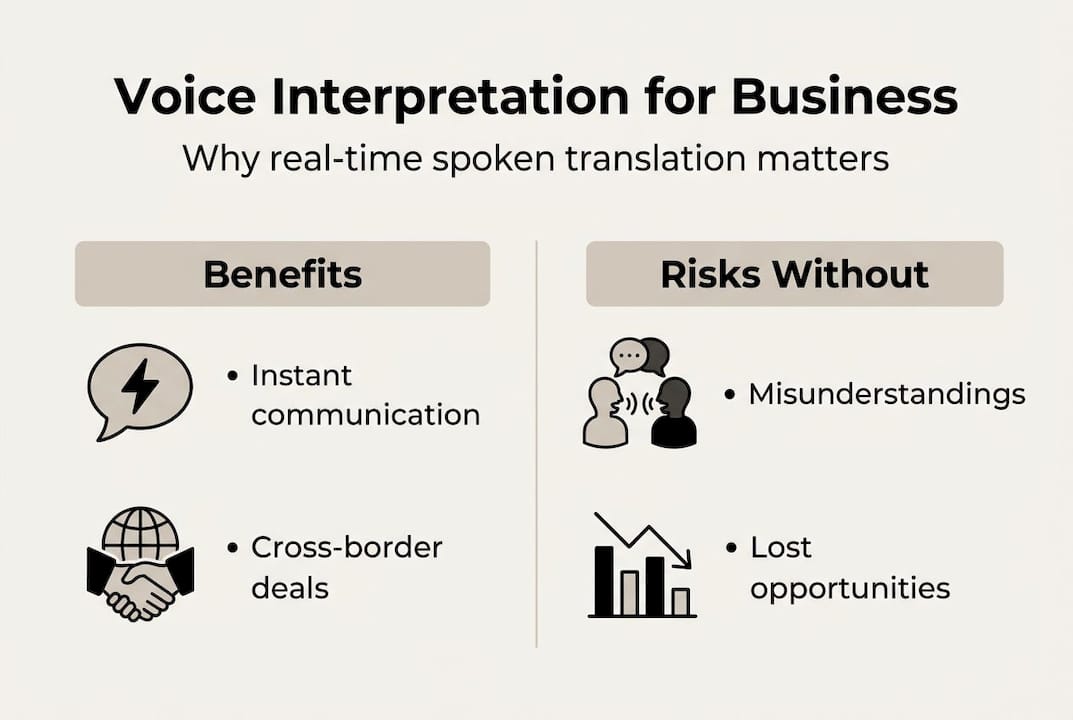
Many businesses confuse voice interpretation with translation and interpretation, treating them as interchangeable services when they serve entirely different purposes. Voice interpretation is a real-time, spoken discipline that keeps multilingual conversations flowing without pause, making it essential for legal proceedings, international negotiations, and global business events. Without it, critical details get lost, compliance risks increase, and costly misunderstandings become far too likely. For organisations operating across borders, understanding what voice interpretation actually is, and how to source it correctly, is not optional. It is a strategic necessity.
Key Takeaways
| Point | Details |
|---|---|
| Voice interpretation defined | It involves real-time, spoken communication between languages during live business events or meetings. |
| Business-critical solution | High-quality voice interpretation prevents errors, ensures compliance, and drives cross-border success. |
| Skills and credentials matter | Professional interpreters need formal certification, sector familiarity, and excellent language skills. |
| Technology is a support | Remote and AI-powered tools help, but cannot replace human expertise in complex scenarios. |
Defining voice interpretation in professional contexts
Voice interpretation is the real-time, spoken transfer of meaning from one language to another. As noted in translation vs interpretation, voice interpretation delivers spoken, real-time communication between languages, unlike translation, which works with written texts. This distinction matters enormously in practice. A translator works offline, carefully crafting written content with time to revise. A voice interpreter works live, converting spoken words instantly under pressure, with no opportunity to pause and reconsider.
There are three primary forms of voice interpretation that businesses encounter:
- Simultaneous interpretation: The interpreter speaks at the same time as the source speaker, typically from a soundproofed booth using specialist equipment. This is standard at large conferences and international summits.
- Consecutive interpretation: The speaker pauses after each segment, allowing the interpreter to render the message. This is common in legal proceedings, depositions, and smaller business meetings.
- Whispered interpretation (chuchotage): The interpreter sits beside one or two listeners and whispers the interpretation quietly. It suits small delegations or VIP briefings where booth equipment is impractical.
Each mode serves a different operational context. Choosing the wrong one can disrupt proceedings, slow negotiations, or introduce confusion at the worst possible moment.
| Mode | Setting | Equipment needed |
|---|---|---|
| Simultaneous | Conferences, summits | Booth, headsets, receivers |
| Consecutive | Legal, medical, negotiations | None required |
| Whispered | Small meetings, VIP briefings | None required |
For a fuller breakdown of types of interpretation and when each applies, it is worth reviewing the specific requirements of your event or engagement before booking.
Pro Tip: Always confirm which interpretation mode your venue can support before finalising logistics. Simultaneous interpretation requires specialist audio infrastructure that many standard meeting rooms do not have.
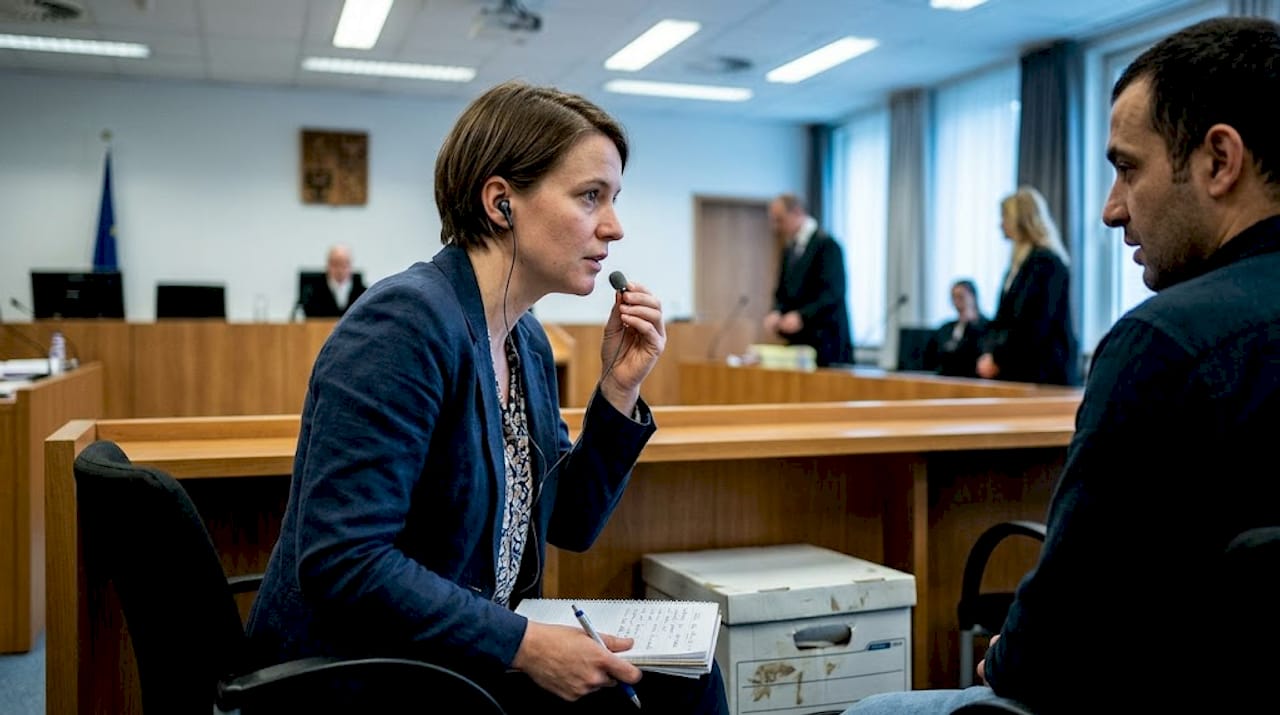
Voice interpretation is required wherever spoken multilingual communication must happen in real time. That includes court hearings, international arbitration, cross-border business negotiations, product launches, and multilingual conferences. In each of these environments, accuracy is not just desirable. It is legally and commercially critical.
The importance of voice interpretation for businesses
Once you understand what voice interpretation is, the business case for investing in it becomes clear. Across sectors, the ability to communicate precisely in multiple languages during live interactions directly affects outcomes, relationships, and compliance.
Interpreters in business bridge linguistic gaps that would otherwise derail deals, delay proceedings, or create regulatory exposure. Consider three sectors where this is most acute:
- Legal: Depositions, court proceedings, and cross-border arbitration require certified voice interpreters. A single misinterpreted term in a legal deposition can alter the record and affect case outcomes.
- Finance: Multinational mergers and acquisitions involve complex terminology, sensitive disclosures, and tight timelines. Voice interpretation keeps all parties aligned without ambiguity.
- Technology: Global product launches, technical briefings, and international partner meetings demand precise communication of product specifications and contractual terms.
The risks of getting this wrong are significant. Certified interpreters can reduce costly misunderstandings and compliance risks, particularly in regulated sectors like law and finance. In practical terms, that means fewer disputes, stronger regulatory standing, and more productive international relationships.
“Effective voice interpretation is not simply a communication tool. It is a risk management strategy for any business operating across language boundaries.”
| Sector | Common use case | Risk without interpretation |
|---|---|---|
| Legal | Court hearings, depositions | Inaccurate legal record |
| Finance | M&A negotiations, investor calls | Misaligned terms, compliance failure |
| Technology | Product launches, partner briefings | Miscommunicated specifications |
For businesses involved in legal interpreting in the EU, the stakes are particularly high. EU directives mandate the right to interpretation in criminal proceedings, meaning non-compliance is not just a reputational risk. It is a legal one.
Beyond risk mitigation, voice interpretation also creates competitive advantage. Businesses that communicate fluently across languages build stronger international partnerships, close deals faster, and project professionalism in markets where competitors may stumble over language barriers.
Key skills and credentials of professional voice interpreters
Recognising the value of voice interpretation is one thing. Knowing how to identify a truly qualified interpreter is another. Not all interpreters are equal, and in high-stakes environments, the difference between competent and exceptional can be significant.
Here is what to look for when assessing professional voice interpreters:
- Bilingual fluency: True command of both source and target languages, including register, formality, and idiomatic expression. Fluency alone is not enough; interpreters must convey tone and intent accurately.
- Cultural competence: Understanding idioms, cultural references, and contextual nuance. A technically correct interpretation that misses cultural subtext can still mislead.
- Sector specialisation: Legal, financial, and technical interpreting each require specialist vocabulary. An interpreter without sector knowledge may produce accurate words but incorrect meaning.
- Certification and accreditation: Look for internationally recognised credentials. For certified interpreter credentials, certification and sector-specific knowledge are essential to ensure accurate and compliant business interpretation.
- Ethical standards: Professional interpreters adhere to strict codes of conduct, including impartiality and confidentiality. This is non-negotiable in legal or financial contexts.
- Experience under pressure: Live interpretation is cognitively demanding. Experienced interpreters maintain accuracy even in fast-paced or emotionally charged situations.
For interpreters in court, additional requirements often apply, including judicial accreditation and familiarity with procedural terminology specific to the jurisdiction.
Pro Tip: When briefing an interpreter ahead of a complex assignment, share glossaries, agendas, and background documents in advance. Preparation significantly improves accuracy, particularly for technical or sector-specific content.
When evaluating vendors, ask specifically about their vetting process for interpreters. Reputable language service providers will be transparent about the qualifications, testing, and ongoing professional development they require from their interpreters.
Technology and trends in voice interpretation
Technology is reshaping how voice interpretation is delivered, and businesses need to understand both the opportunities and the limitations this creates.
The most significant shift in recent years has been the growth of remote interpretation. Video remote interpreting (VRI) and over-the-phone interpreting (OPI) allow businesses to access qualified interpreters anywhere in the world without requiring physical presence. This has expanded access dramatically, particularly for smaller organisations or those operating in regions where specialist interpreters are scarce.
Here is how technology is currently influencing voice interpretation:
- Remote platforms: Cloud-based interpretation platforms now support simultaneous interpretation at virtual and hybrid events, removing the need for physical booths.
- AI-assisted tools: Machine translation and speech recognition tools can support interpreters by providing terminology suggestions and reference material in real time. As noted, AI tools are enhancing but not replacing the need for human voice interpreters in nuanced business communication.
- Secure remote workflows: For sensitive legal or financial matters, remote interpreting workflow protocols ensure confidentiality and data security across digital channels.
- Quality monitoring: Recording and review tools allow agencies to assess interpreter performance and maintain quality standards across remote assignments.
Pro Tip: For high-stakes virtual events, always test your remote interpretation platform with the interpreter at least 24 hours before the session. Technical issues during live proceedings can be extremely disruptive and, in legal contexts, may invalidate proceedings.
That said, technology has clear limits. Automated speech translation tools struggle with accents, overlapping speech, domain-specific jargon, and the subtle interpersonal dynamics that shape meaning in negotiations. For routine, low-risk communications, automation may suffice. For anything where accuracy, trust, or compliance is on the line, human expertise remains essential.
A fresh perspective on voice interpretation for business leaders
Here is an uncomfortable truth that many technology vendors prefer not to highlight: speed is not the same as accuracy, and efficiency is not the same as effectiveness.
Automated interpretation tools are impressive in controlled conditions. They are fast, scalable, and increasingly affordable. But business communication rarely happens in controlled conditions. Negotiations involve subtext. Legal proceedings involve precision. Cross-border deals involve cultural dynamics that no algorithm currently handles reliably.
Businesses who invest in qualified human interpreters consistently outperform those relying solely on automated solutions for critical discussions. That is not sentiment. It reflects the reality that human interpreters bring judgement, adaptability, and interpersonal skill that technology cannot replicate.
The smartest approach is not choosing between technology and human expertise. It is using technology to support human interpreters, not replace them. Certified interpreters working with well-designed digital tools deliver better outcomes than either alone. For business leaders, the question should never be “can we automate this?” It should be “what level of risk are we willing to accept?”
Professional voice interpretation services for your business
If your business operates across languages, the right interpretation partner makes a measurable difference to outcomes. At Glocco®, we provide tailored voice interpretation solutions for legal, financial, technology, and corporate clients across Europe, the Middle East, North America, and Asia. Whether you need simultaneous interpreting for a major conference or consecutive interpretation for a sensitive negotiation, our certified interpreters bring sector expertise and professional rigour to every assignment. Explore interpretation types to find the right fit for your event, or review our full range of language services for business to see how we support multilingual communication at scale. Contact us to discuss your requirements.
Frequently asked questions
What is the difference between voice interpretation and translation?
Voice interpretation provides instant spoken conversion during live events, whilst translation involves producing written content from a source text, typically with time for review and revision.
Which business sectors need voice interpretation most?
Sectors like law, finance, and tech require certified voice interpreters most frequently, given the precision, compliance requirements, and high-stakes nature of their multilingual communications.
Can AI fully replace human voice interpreters?
AI tools support human interpreters by improving efficiency, but they cannot match human judgement, cultural nuance, or accuracy in complex or sensitive business situations.
How do I choose a qualified voice interpreter?
Prioritise accreditation and sector knowledge alongside demonstrated language fluency and a clear professional code of conduct, particularly for legal or financial assignments.
Recommended
- Types of interpretation services for European businesses
- The role of interpreters in business: boost global reach
- Certified interpreters: ensuring accuracy and compliance
- What is legal interpreting? Essential guide for EU professionals
- Voice Search Optimisation for South African SMEs
- Voice Search Optimization: Top Tips To Rank For ‘Near Me’ Queries