


A single mistranslated clause in a contract can trigger a legal dispute worth thousands. A poorly localised product description can cost an e-commerce brand its credibility in an entire market. As AI’s role in B2B market expansion becomes ever more prominent, businesses in Europe and North America are turning to AI-powered translation workflows to operate at scale. But speed without structure is a liability. This guide walks through everything you need to set up, execute, and continuously improve a translation process that is both efficient and reliable.
Key Takeaways
| Point | Details |
|---|---|
| Hybrid approach wins | AI-driven translation tools deliver speed and scale, but human review is crucial for quality and compliance. |
| Tool and workflow fit | Select machine translation engines and platforms according to your sector, language pairs, and integration needs. |
| Always verify output | Systematic checking and continuous improvement are vital to avoiding costly translation errors. |
| Adapt for legal and tech | Fine-tune AI models and processes for high-stakes domains like legal and technology to manage risk. |
What you need for an effective AI-powered translation process
After understanding why translation accuracy matters, it is crucial to gather the right tools and expertise before building any workflow.
The foundation of any strong AI-powered translation process is choosing the right engine for your specific needs. Not all tools perform equally across languages, domains, or document types. According to translation benchmark data, DeepL excels in European languages and formal content, Google Translate offers broader language coverage, and large language models (LLMs) handle nuanced text well but require domain fine-tuning for legal or technical use. Knowing these differences saves considerable time and budget.
Beyond the choice of engine, you also need to think about architecture. Should you use a dedicated machine translation (MT) tool, an LLM, or a hybrid of both? Dedicated MT tools like DeepL tend to perform better for consistent, structured content. LLMs shine when the source material is complex or conversational. A hybrid model often delivers the best balance for businesses operating across multiple sectors.
Integration is the next critical step. Most enterprise-grade workflows rely on APIs to connect translation engines with existing content management systems, e-commerce platforms, or legal document management tools. Explore our overview of AI tools for translators for a practical guide to the current landscape.
Essential elements at a glance:
- A primary MT engine suited to your language pairs and content domain
- API access for seamless integration into your tech stack
- A translation memory ™ system to store and reuse approved translations
- A terminology database or glossary to enforce brand and sector-specific language
- Qualified linguists for post-editing and human review
- Subject-matter experts (SMEs) for legal, medical, or technical content
| Tool type | Best use case | Key limitation |
|---|---|---|
| Dedicated MT (e.g. DeepL) | Formal, European language content | Limited nuance for complex domains |
| General LLM | Nuanced, conversational text | Needs fine-tuning for specialised sectors |
| Hybrid MT + LLM | Mixed content across multiple markets | Higher setup complexity |
| TMS with API | Enterprise-scale, automated pipelines | Requires technical integration expertise |
Pro Tip: Always test your chosen engine against a representative sample of your actual content before committing to a full integration. Generic benchmarks rarely reflect sector-specific performance.
Step-by-step: Setting up your AI-powered translation workflow
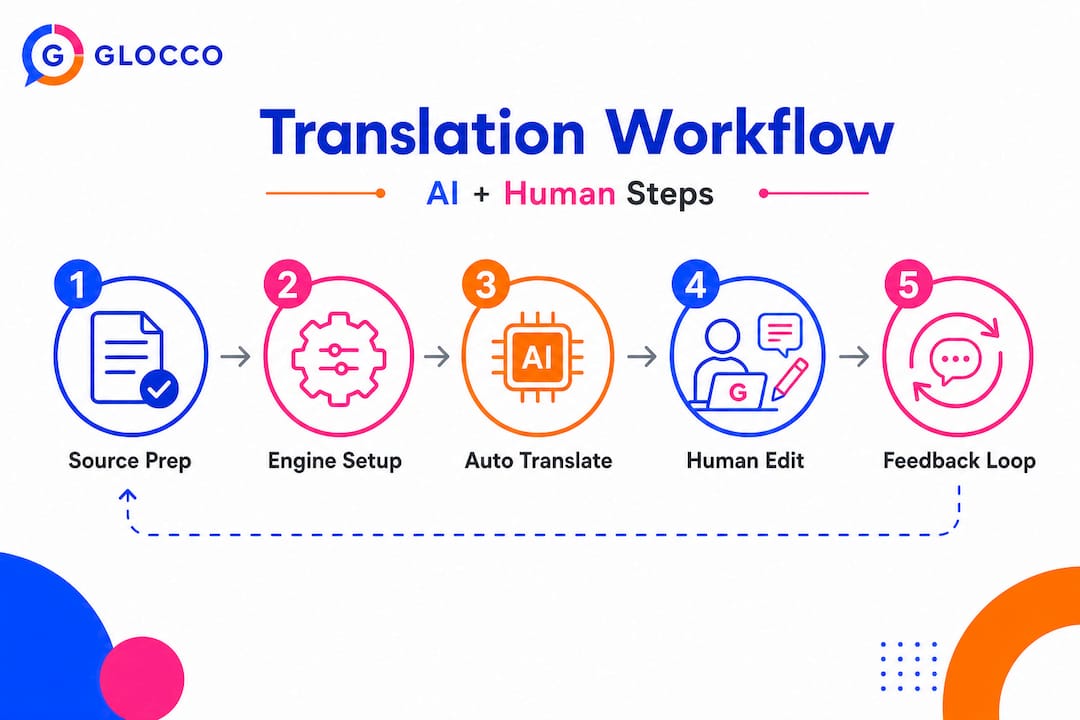
With everything in place, you are ready to create a robust workflow. Here is how to structure the process from start to finish.
1. Prepare your source materials
Clean, consistent source content is the single biggest driver of translation quality. Remove ambiguous phrasing, ensure correct grammar, and flag any terms that require specific localisation treatment. Structured content in formats such as XML or XLIFF tends to process far more smoothly through MT engines.

2. Configure your MT engine and select domain settings
Most professional MT platforms allow domain selection, meaning you can instruct the engine to prioritise legal, medical, technical, or marketing language. This step is frequently skipped and frequently regretted. Spend time configuring your engine to match your sector.
3. Run the automated translation pass
Once your engine is configured, process the source content. This initial pass handles volume efficiently and provides a baseline for human reviewers to work from rather than translating from scratch.
4. Apply human post-editing
This is where a professional linguist reviews and refines the MT output. Post-editing is not proofreading. It involves structural, semantic, and cultural adjustments that machines consistently miss. Research confirms that AI pre-processing with human fine-tuning delivers the strongest results in e-commerce settings, with ROI measured in time and cost savings rather than word price alone.
5. Integrate translation memory and terminology databases
Feed approved translations back into your TM system. This creates a growing asset that improves consistency, reduces future costs, and speeds up turnaround times across projects.
6. Build feedback loops
Structured feedback between reviewers, project managers, and end users is essential for continuous improvement. Businesses that implement these loops see measurable gains over time. Documented evidence shows 40% latency reduction and a 20% accuracy improvement when AI and TMS integration is paired with systematic feedback.
Review your localisation workflow regularly to identify bottlenecks and refine your process at each stage.
| Workflow stage | Automation level | Human input required |
|---|---|---|
| Source preparation | Medium | High |
| MT engine configuration | High | Medium |
| Initial translation pass | Full automation | None |
| Post-editing | Low | High |
| TM and glossary update | Medium | Medium |
| Feedback and improvement | Low | High |
Pro Tip: Treat your translation memory as a business asset. Regular audits of your TM ensure outdated or incorrect entries do not propagate errors at scale.
Common pitfalls and how to avoid them in AI translation
Even robust workflows can falter without awareness of the errors that most commonly undermine AI translation quality.
Domain mismatch is perhaps the most widespread issue. A general-purpose MT engine applied to specialised legal or engineering content will produce fluent-sounding but unreliable output. Research from the University of Edinburgh confirms that neural machine translation (NMT) systems sacrifice accuracy for fluency when operating outside their training domain. Long sentences further degrade performance, and low-resource languages carry significantly higher error rates.
Negation errors are particularly dangerous in legal and compliance contexts. A misplaced “not” can reverse the meaning of an obligation or restriction. Testing on 500 contracts found that DeepL achieved 87.6% accuracy overall, but produced negation errors in 12.4% of cases, and only 43.2% of documents passed without reservations. These figures make sole reliance on AI untenable for binding documents.
Jurisdiction-specific terminology is another consistent failure point. Legal systems differ significantly across countries, and terms that appear equivalent often carry different legal weight. AI engines are not trained to understand jurisdictional nuance.
Low-resource languages present an additional challenge. Languages with limited training data produce notably more errors, making human oversight even more important for businesses operating in emerging markets.
“Binding documents must always involve human review. No MT engine, regardless of headline accuracy figures, can reliably handle the full range of legal, cultural, and jurisdictional complexity required for enforceable contracts.”
The role of human translators in law remains irreplaceable precisely because the stakes of an error are so high.
Verifying quality: Reviewing and improving AI-driven translations
Once you know the most likely trouble spots, it is vital to implement rigorous quality verification and ongoing learning.
A structured review process covers three dimensions:
1. Linguistic accuracy checks that the target text correctly reflects the meaning of the source, including syntax, grammar, and terminology.
2. Technical correctness verifies that sector-specific terms, product names, units, and regulatory language are handled appropriately.
3. Cultural appropriateness ensures tone, register, and cultural references are suitable for the target market and audience.
| Review dimension | What to check | Who should review |
|---|---|---|
| Linguistic accuracy | Meaning, grammar, syntax | Professional linguist |
| Technical correctness | Terminology, units, regulations | Subject-matter expert |
| Cultural appropriateness | Tone, idioms, market fit | Native-speaker reviewer |
Building improvement into the process:
- Record every post-editing change and categorise it by error type.
- Feed patterns back to your MT configuration team for model adjustment.
- Update your terminology database and TM after each project cycle.
- Schedule quarterly reviews of your overall error rate by language pair and content type.
Even advanced MT tools struggle with rephrasing, cultural registers, and low-resource languages, making sector-specific fine-tuning consistently preferable to relying on general LLMs. Sustainable quality improvement comes from treating verification not as a final checkpoint but as an integral part of every project cycle.
For regulated industries, aligning your review process with formal standards is essential. Our resources on translation quality compliance and certified translation professionals provide detailed guidance for businesses operating in legally sensitive contexts.
Pro Tip: Segment your quality checks by content type. Marketing copy and legal contracts require very different review criteria. A single generic review process will inevitably under-serve both.
Why the real edge is in hybrid human-AI workflows
Here is an uncomfortable truth about AI translation: the businesses most confident in their automation are often the ones most exposed to risk. Sole reliance on machine output, even from market-leading tools, is a strategic misstep for any content that carries legal, regulatory, or reputational weight.
The most effective translation operations we see are not the ones with the most sophisticated AI. They are the ones with the clearest division of labour between automation and human expertise. AI handles volume, consistency, and speed. Humans handle judgement, nuance, and accountability.
Data supports this directly. When comparing tools, dedicated MT outperforms LLMs on BLEU scores for European language pairs, whilst LLMs score higher on COMET and human evaluations for diverse or nuanced content. Neither wins every category. A hybrid approach captures the strengths of both.
Custom domain tuning is where organisations genuinely pull ahead of competitors. A legal services firm that has invested in fine-tuned models and a curated terminology database will consistently outperform one using off-the-shelf tools, regardless of which engine either chooses. The same principle applies to e-commerce, fintech, and medical content.
For businesses handling accurate legal translation or complex technical localisation, the hybrid model is not optional. It is the standard that protects both quality and legal standing.
How Glocco supports your AI-powered translation process
Having mapped out a robust AI-powered approach, here is how Glocco can support your next step towards multilingual business excellence.
At Glocco, we combine the speed of advanced AI translation tools with the precision of experienced linguists and sector-specific subject-matter experts. Our workflows are tailored for e-commerce, legal, technology, and fintech clients across Europe, North America, the Middle East, and Asia. Whether you need seamless API integration into your content stack or fully managed translation with human review built in, we design solutions that scale without sacrificing accuracy. Explore our full range of language services for global business and find out how we can help you grow confidently across borders.
Frequently asked questions
How accurate is AI-powered translation for legal documents?
AI tools can reach over 87% accuracy on contracts, but with negation errors affecting over 12% of documents, human review remains essential for any binding legal content.
What are the main risks in relying solely on AI for translation?
The primary risks include domain mismatch errors, failures with negation and jurisdiction-specific terms, and significantly reduced quality for low-resource language pairs.
How can you improve the quality of AI-driven translations for e-commerce?
Pair AI for initial volume translation with human post-editing and feedback loops to achieve higher precision and genuine local relevance across product and marketing content.
Does AI translation work equally well for all languages?
No. AI translation performs strongest with European and widely-used language pairs. Broader coverage tools help with less common languages, but low-resource pairs consistently produce more errors and require greater human oversight.


