


The video subtitle translation market was valued at USD 1.5 billion in 2024 and is projected to reach USD 4.2 billion by 2033, growing at a CAGR of 12.5%. Those figures tell a story that goes well beyond entertainment. Businesses across Europe, the Middle East, and North America are actively adopting audiovisual translation (AVT) as a core content strategy, not an afterthought. If your organisation produces video content for training, marketing, or compliance, understanding AVT is no longer optional. This article covers what it is, how the main types differ, what the market data shows, and how to apply it effectively.
Key Takeaways
| Point | Details |
|---|---|
| Definition clarified | Audio visual translation covers subtitling, dubbing, voiceover, and more for multi-language content. |
| Types compared | Subtitling, dubbing, and voiceover serve distinct business needs and regional preferences. |
| Business opportunities | Adopting audio visual translation expands market reach and aligns with accessibility laws. |
| Market growth | The industry is projected to nearly triple between 2024 and 2033, driven by regulatory and business demand. |
| Strategic adoption | Integrating AV translation early improves impact, saves costs, and ensures effective global communication. |
What is audio visual translation?
Audio visual translation refers to the transfer of spoken or written language content embedded within multimedia formats, such as video, film, e-learning modules, webinars, and live events. Unlike document translation, AVT accounts for synchronisation, timing, and the visual relationship between speech and on-screen content.
For businesses, this means AVT is relevant far beyond cinema. Voice interpretation in business settings, corporate video content, and internal training programmes all fall within its scope. Practical applications include:
- Employee onboarding and training videos for multilingual workforces
- Marketing and product launch videos adapted for regional audiences
- Compliance and health-and-safety content required in local languages by law
- Investor relations presentations and recorded shareholder communications
- Customer support video content hosted on websites or apps
- Live and recorded webinars for international clients or partners
The dubbing and subtitling market forms a significant portion of the broader language industry, which reached USD 31.7 billion in 2025. North America accounts for 31% of the dubbing and subtitling segment, with Europe at 27% and the Middle East and Africa at 13%.
Accessibility and compliance are no longer separate concerns. Businesses that invest in well-produced audiovisual translation protect themselves legally, widen their audience, and signal cultural respect to target markets. These are measurable strategic advantages.
Core types of audio visual translation
Not all AVT is the same. Each format carries specific advantages, costs, and cultural expectations. Understanding the differences allows you to allocate budget appropriately and match the format to your audience’s preferences.
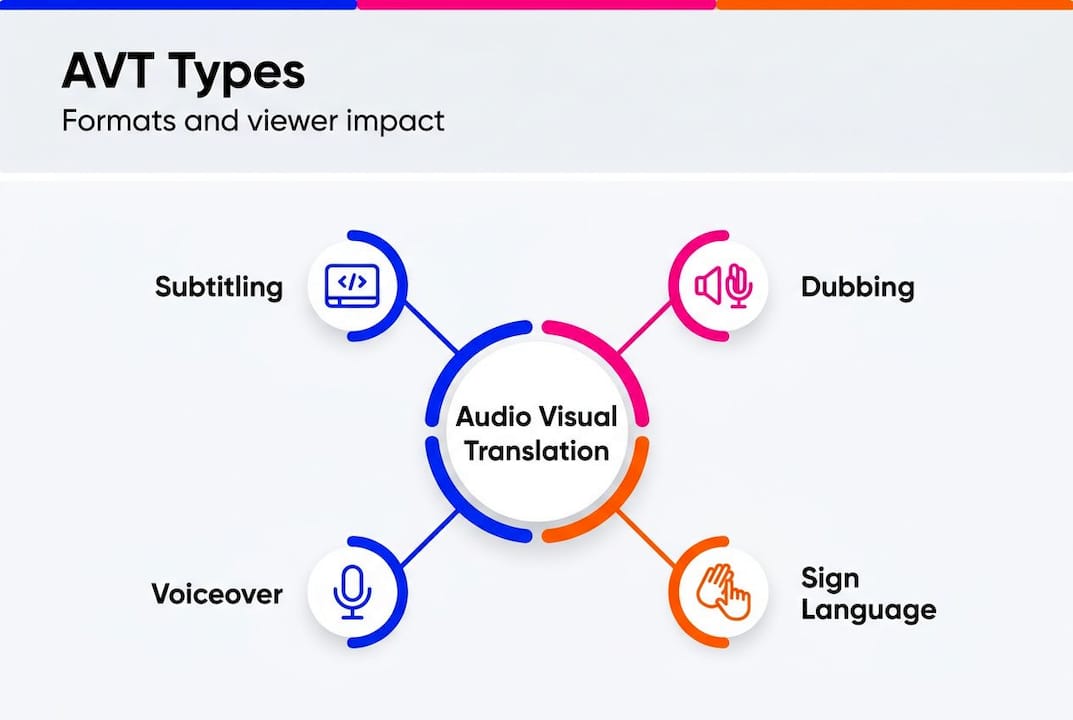
Subtitling displays translated text at the bottom of the screen in time with the audio. It is cost-effective, preserves the original voice, and is widely favoured in North America and Scandinavia for both accessibility and language learning benefits.
Dubbing replaces the original audio entirely with voice acting in the target language. It produces a seamless viewing experience but requires skilled voice talent, careful lip-sync work, and significantly more production time. Dubbing is the preferred format across much of continental Europe and Latin America.
Voiceover involves a translated narration recorded over the original audio, which is often lowered in volume rather than removed. This is common for documentaries, corporate videos, and instructional content. It is faster and more affordable than full dubbing. Find out more about voiceover in localisation and where it delivers the greatest return.

Sign language interpretation translates spoken audio into sign language, either through an on-screen interpreter or through avatar technology. This format addresses hearing-impaired audiences and is increasingly mandated by accessibility legislation in Europe and North America.
| Type | Relative cost | Production speed | Viewer experience | Accessibility impact |
|---|---|---|---|---|
| Subtitling | Low | Fast | Minimal disruption | High (hearing-impaired) |
| Dubbing | High | Slow | Fully immersive | Moderate |
| Voiceover | Medium | Medium | Natural for instructional content | Moderate |
| Sign language | Medium to high | Medium | Essential for deaf viewers | Very high |
The W3C DAPT standard establishes empirical benchmarks for subtitle readability and timing, and compliance with these specifications is a measurable driver of viewer comprehension and content quality. Streaming platform regulations and accessibility laws in the EU and North America are tightening requirements across all of these formats.
Pro Tip: Before selecting a format, check whether your target market has a legal accessibility obligation. In the EU, the European Accessibility Act (effective June 2025) broadens requirements for digital content providers significantly. Early planning with your interpretation services provider will prevent costly revisions later.
Market trends and regional dynamics
The AVT market is expanding rapidly, and the growth is not uniform across regions. Understanding where adoption is highest, and why, informs smarter investment decisions for global content teams.
| Region | Market share (dubbing and subtitling) | Notable trend |
|---|---|---|
| North America | 31% | Strong subtitling demand; captioning mandated by law |
| Europe | 27% | Dubbing dominant in Germany, France, Spain, Italy |
| Middle East and Africa | 13% | Fast-growing demand for Arabic localisation |
| Asia Pacific | Remaining share | Subtitling prevalent; rapid e-learning growth |
The video subtitle translation market is projected to grow from USD 1.5 billion in 2024 to USD 4.2 billion by 2033 at a CAGR of 12.5%. The dubbing and subtitling segment adds further weight to this picture within a language industry valued at USD 31.7 billion in 2025.
Key drivers behind this growth include:
- Streaming regulation: Platforms operating in the EU are now required to ensure a minimum proportion of European content, much of which requires local-language dubbing or subtitling
- Accessibility legislation: The European Accessibility Act and the Americans with Disabilities Act continue to expand their scope to include digital video content
- Business internationalisation: E-commerce and SaaS companies expanding into new markets must localise training, support, and marketing video assets
- Remote work and e-learning: Distributed global teams require multilingual video content at scale
Businesses should consider AI tools for audiovisual translation to understand where automation can support speed and cost efficiency without compromising quality. AI-assisted transcription and subtitle generation are now viable for first-pass drafts, but human review remains essential for accuracy and cultural nuance.
Applying audio visual translation for business impact
Market understanding only creates value when translated into action. Here is how businesses in Europe, the Middle East, and North America are applying AVT strategically:
- Multilingual training and onboarding: Large organisations with offices across multiple countries localise onboarding videos into regional languages to reduce misunderstanding, improve retention, and meet local labour compliance requirements.
- International marketing campaigns: Product launch videos and brand content are adapted not just linguistically but culturally, accounting for tone, visual references, and local regulatory standards.
- Live events and webinars: Real-time remote interpreting for business events ensures that multilingual audiences participate fully, rather than passively receiving content in a second language.
- Compliance and safety materials: Regulated industries including pharmaceuticals, manufacturing, and finance must provide safety and procedural content in employees’ native languages, making localised AVT a legal necessity.
- E-commerce and product videos: Product demonstration videos localised for regional markets consistently outperform generic content in conversion rate testing.
Pitfalls to avoid when implementing AVT:
- Ignoring regional subtitle specifications, such as characters per line, reading speed, and font standards
- Assuming machine translation output is broadcast-ready without professional review
- Selecting dubbing for content that would be more cost-effective as voiceover
- Underestimating lead times for high-quality dubbing projects, particularly for multiple language pairs
The W3C DAPT framework provides technically grounded guidelines for subtitle presentation that align with readability research. Following these standards protects your content quality across platforms and regions.
Pro Tip: Involve your AVT provider at the scriptwriting stage, not after production. Videos designed with localisation in mind, through controlled vocabulary, clear diction, and adequate pausing, cost significantly less to translate and produce far better results.
Why audio visual translation is no longer optional for global business
Here is a perspective that decision-makers rarely hear: treating AVT as a compliance checkbox or a line item to minimise is precisely the mindset that costs businesses the most in the long term.
The conventional argument is that AVT is an expense justified only by audience size or legal obligation. That framing is outdated. Businesses that integrate AVT from the earliest stage of content planning report faster market entry, stronger brand perception in local markets, and measurably higher engagement from international customers.
The role of interpreters in global communication is well-documented, but the same logic applies to all AVT formats. When your audience watches a video in their native language, with accurate cultural adaptation, the cognitive load decreases and trust increases. That is not sentiment. It is measurable in dwell time, conversion rate, and customer satisfaction scores.
The businesses we see struggle most with AVT are those who approach it reactively, adding subtitles after a poor market reception or subtitling a compliance video days before an audit. The businesses that gain a genuine edge treat AVT as a publishing standard, the same way they treat visual design or data security.
The shift in thinking required here is simple. AVT is not a translation task. It is a content accessibility strategy. And like any strategy, it delivers returns proportional to how deliberately it is planned and executed.
How Glocco supports your audio visual translation needs
Glocco® has been delivering tailored language solutions since 2014, supporting clients across e-commerce, fintech, legal, and manufacturing sectors in Europe, the Middle East, and North America. Our audiovisual translation services span subtitling, voiceover, dubbing, and live interpretation, all managed by experienced linguists who understand both technical standards and cultural context. Whether you are starting your localisation journey or scaling an existing programme, our language services checklist is a practical starting point. To understand the full commercial case for investing in language access, explore our guide on localisation for growth. Get in touch with the Glocco® team to discuss a solution tailored to your content, your markets, and your timelines.
Frequently asked questions
What is the difference between subtitling and dubbing?
Subtitling displays translated text on screen while the original audio remains, whereas dubbing replaces the original spoken audio with a new voice recording in the target language. Each dubbing and subtitling format serves different regional preferences and budget requirements.
Why is audio visual translation important for businesses?
It expands audience reach, improves content accessibility for diverse linguistic and hearing-impaired audiences, and ensures regulatory compliance across multiple markets. The subtitle translation market growth to USD 4.2 billion by 2033 reflects how central this function has become to international business operations.
How can businesses choose the right audio visual translation service type?
Consider your audience’s regional preferences, the nature of your content, your production budget, and the accessibility standards required in your target markets. Subtitling specifications from W3C provide a reliable technical reference for readability and compliance.
What drives the growth of the audio visual translation market?
Streaming service regulations, expanding accessibility legislation, and the accelerating internationalisation of digital business are the primary growth drivers. The video subtitle market CAGR of 12.5% through to 2033 reflects sustained structural demand rather than a short-term trend.


