


Many EU businesses treat translation as a straightforward task: swap one language for another, and the job is done. In practice, the reality is far more demanding. Document translation for regulated business contexts involves maintaining legal intent, meeting certification requirements, and navigating sector-specific terminology that even advanced AI models can mishandle. This guide walks you through everything your organisation needs to know: what document translation actually means, which type suits your situation, how the process works in practice, and what quality standards protect your business from costly errors.
Key Takeaways
| Point | Details |
|---|---|
| More than word swapping | Document translation for EU businesses demands understanding of legal, regulatory, and industry context. |
| Accuracy is non-negotiable | Errors or literal translations can threaten compliance, legal status, and business reputation. |
| Choose the right translation type | Identify when standard, certified, or sworn/legal translation is needed based on document purpose. |
| Human expertise matters | Specialist translators and robust review processes outperform automation for business-critical content. |
| Prepare for success | Clear briefs and understanding of requirements ensure smooth, compliant translation workflows. |
What is document translation?
Document translation is the process of converting written content from one language into another while preserving its meaning, context, tone, and, where applicable, its legal intent. For EU businesses, this goes well beyond basic language conversion.
The European Commission Knowledge Centre makes clear that document translation for EU businesses ranges from standard multilingual translation to legally attested and certified translation, and in court-like contexts, translation executed under legal-professional standards. That spectrum matters enormously when you are choosing the right service.
Translators operating in business contexts fall into several distinct categories:
- Generalist translators handle everyday content such as internal communications, marketing copy, and website text.
- Specialist translators focus on a defined field, such as legal, medical, or technical translation, and bring domain-specific knowledge that generalists typically lack.
- Certified or sworn professionals provide translations with a formal declaration of accuracy or hold an official appointment recognised by courts or regulatory bodies.
Common use cases for EU businesses include commercial contracts, regulatory filings, HR policies, compliance documentation, tender documents, technical manuals, and marketing collateral targeted at foreign markets.
Translation is not the act of substituting words. It is the act of transferring meaning, responsibility, and context across languages. For business-critical documents, anything less is a liability.
Understanding this distinction between everyday translation and business-critical translation is the foundation of every smart translation decision your company makes.
Why accuracy and standards matter for EU businesses
Poor translation carries consequences that extend well beyond a grammatical embarrassment. Mistranslated contracts have been declared legally invalid in EU member states. Regulatory filings submitted with inaccurate terminology have triggered compliance investigations. Marketing materials that miss cultural nuance have damaged brand reputation in new markets.

The stakes become even higher when you factor in how modern AI systems perform: state-of-the-art tools still struggle with non-standard input and domain-specific terminology, which means automated translation alone is not a reliable solution for regulated or legally binding documents. Human expertise and structured quality assurance remain essential.
Key standards every business-critical translation must uphold include:
- Accuracy: The translated text must faithfully reflect the source document’s meaning without omission or distortion.
- Faithfulness: The tone, register, and intent of the original must be preserved.
- Terminological consistency: Sector-specific language must be applied consistently throughout and verified by a subject-matter expert.
- Confidentiality: Documents containing commercially sensitive or personal data require providers with robust data protection practices.
- Certification where required: Some documents demand a signed declaration or sworn certification to be accepted by authorities or courts.
Sector-specific examples illustrate why these standards are non-negotiable. A legal contract translated without precise terminology can expose your company to dispute. A technical manual with inaccurate safety instructions can create liability. A regulatory submission containing mistranslated figures can delay product approvals.
Learning how to ensure legal translation quality is an investment that pays dividends across every international transaction your business undertakes. When operating across multiple jurisdictions, multilingual legal support becomes a strategic asset rather than a back-office function.
Pro Tip: Before commissioning any translation, confirm with the receiving authority or legal partner whether a certified or sworn professional is required. Many businesses only discover this after submitting a document and facing rejection.
Types of document translation: Standard, certified and legal
Understanding which type of translation your document requires is one of the most practical decisions you will make. The three main categories differ in who provides them, what they cost, and whether they are accepted for official purposes.
| Type | Who provides it | When required | Typical sectors | Legal acceptance |
|---|---|---|---|---|
| Standard | Generalist or specialist translator | Everyday and commercial use | Marketing, HR, internal comms | Not for official submission |
| Certified | Translator with declaration of accuracy | Official documents, contracts | Legal, finance, public sector | Accepted by many institutions |
| Sworn or legal | Court-appointed or officially authorised | Courts, regulatory bodies | Legal, immigration, compliance | Mandatory in judicial contexts |
As confirmed by the European Commission, EU businesses may need any of these levels depending on document type, target country, and the authority or body receiving the translation. Working with certified translation professionals ensures your documents meet the standards required for official acceptance.
Before commissioning any translation service, follow these steps to assess your needs:
- Identify the document type and its intended purpose.
- Determine the country and authority receiving the document.
- Confirm whether that authority requires certified or sworn translation.
- Check the sector-specific terminology requirements.
- Establish your deadline and any formatting requirements.
If you are uncertain whether your situation demands sworn translation, our sworn translation guide provides a thorough breakdown of European requirements by jurisdiction.
Pro Tip: Always request written confirmation from the receiving authority about the required translation standard before placing your order. Assumptions in this area are expensive.
How the process works: From request to delivery
Understanding the workflow helps your team prepare the right materials, set realistic timelines, and build in the quality checkpoints your documents require.
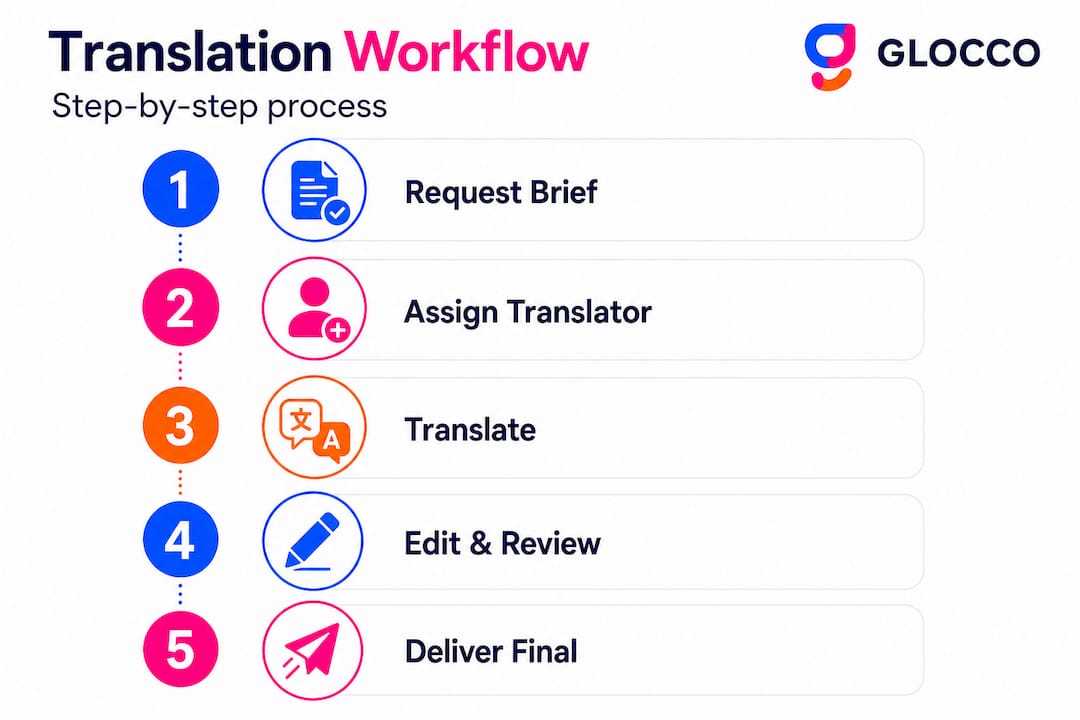
| Stage | Activity | Responsible party |
|---|---|---|
| 1. Request | Submit document and project brief | Client |
| 2. Scoping | Assess word count, type, and complexity | Project manager |
| 3. Brief | Confirm terminology, style guide, and regulatory requirements | Client and project manager |
| 4. Translation | Source text converted by specialist | Translator |
| 5. Review | Proofreading and quality assurance check | Reviewer or second linguist |
| 6. Delivery | Final document returned in required format | Project manager |
As research into translation quality consistently demonstrates, domain-specific terminology creates the greatest risk of error, which is precisely why the briefing and review stages are not optional extras but essential safeguards for business-critical content.
To commission a business translation effectively, follow this sequence:
- Prepare the source document in its final version.
- Write a project brief that includes the intended use, target country, and any regulatory context.
- Supply any existing glossaries or terminology lists.
- Confirm the required translation type (standard, certified, or sworn).
- Agree on turnaround times and quality review stages with your provider.
- Review the delivered translation against the brief before submission.
When evaluating providers, ask these questions:
- Do you use specialist translators for this subject area?
- What quality assurance process do you follow?
- Can you provide certified or sworn translation where required?
- How do you handle confidential or regulated data?
- What project management support is available for multi-language projects?
Reviewing a reliable language localisation workflow gives your team a structured template for managing translation projects efficiently. For businesses exploring how technology fits into this picture, understanding AI tools for translation helps set realistic expectations about where automation adds speed and where human oversight is irreplaceable.
A fresh perspective: Why process quality outperforms automation alone
Here is something most articles on translation do not say plainly: the rush to adopt AI translation tools has, in many cases, created a false sense of confidence. Businesses see fast outputs and assume quality. They are wrong.
The evidence is unambiguous. AI models continue to struggle with non-standard input, domain-specific terminology, and the kind of contextual nuance that defines legal and technical documents. A contract term mistranslated by an AI tool looks entirely plausible on the surface. It takes a specialist to catch it before it costs you.
Even the most advanced AI solutions struggle with non-standard input and sector terminology. Speed without accuracy is simply a faster route to error.
We have seen EU businesses in fintech, engineering, and legal services submit AI-generated translations to regulators, only to have them returned or, worse, acted upon incorrectly. The fix is rarely the translation tool itself. It is the absence of a structured review process involving qualified human translators.
The businesses that manage translation best are those that treat it as a workflow problem, not a language problem. They build quality gates into every stage: at briefing, at translation, and at review. They work with providers who combine technology with human translators in law and other specialist disciplines. They document their terminology preferences and regulatory requirements upfront.
Pro Tip: Build quality assurance into your translation workflow at every stage, not just at the final output. Catching errors early is always cheaper than correcting them after submission.
The result is not just more accurate documents. It is faster turnaround, fewer revision cycles, and genuine confidence that what you submit represents what you intended.
Professional translation services for EU business success
With the full scope of document translation clarified, the next step is finding a provider that delivers across every stage of the process. Glocco® combines specialist human expertise with technology-assisted workflows to support EU businesses across legal, compliance, technical, and commercial translation needs. Our translators work in sector-specific teams, ensuring the right knowledge is applied to every document type. Explore our language localisation guide to understand the broader framework behind high-quality multilingual output, or go directly to our solutions for legal document translation to discuss your specific requirements with our team.
Frequently asked questions
What is the difference between certified and sworn document translation?
Certified translation includes a signed declaration of accuracy from the translator, while sworn translation is completed by an officially authorised professional whose work is accepted in legal and court contexts across EU jurisdictions.
Can AI translation tools be used for legal or compliance documents?
AI can assist with initial drafts, but specialist human review is essential for legal or compliance documents due to the risks posed by domain-specific terminology errors.
What documents commonly require translation for EU businesses?
Contracts, employee policies, regulatory filings, tenders, marketing materials, and product manuals are among the documents most frequently translated by EU companies operating across multiple markets.
How do I know if my translated document will be legally valid?
Confirm with the receiving authority whether a certified or sworn translation is required, and ensure your provider meets those professional standards before commissioning the work.
What details should I provide to get the best translation outcome?
Supply the final source document, describe the intended use clearly, and specify the target country, receiving authority, and any applicable regulatory requirements upfront.


