


TL;DR:
- Accurate medical translation is essential for patient safety, regulatory compliance, and organizational reputation.
- Combining AI tools with expert human review reduces critical errors and ensures precision in medical documents.
- A structured workflow including verification, back-translation, and patient testing is crucial before publication.
A single mistranslated dosage instruction can send a patient to hospital. A poorly rendered consent form can expose a pharmaceutical company to regulatory action across multiple jurisdictions. Medical translation errors carry direct human and legal costs that no organisation in healthcare can afford to ignore. This guide is built for healthcare professionals and pharmaceutical teams who need more than good intentions. You’ll find evidence-based methods, practical workflows, and verification frameworks that protect both patients and your organisation’s standing with regulators.
Key Takeaways
| Point | Details |
|---|---|
| Start with high-quality input | Accurate medical translation starts with clear documents and defined terminology for translators. |
| Use hybrid AI-human workflows | AI increases speed but must be combined with human oversight to reduce patient risk and meet standards. |
| Validate for compliance and safety | Final translations require regulatory, clinical, and patient review to guarantee accuracy. |
| Prioritise context and intent | Error-prone phrases and culture-specific meanings should always be checked by native speakers. |
Understanding the risks of inaccurate medical translation
Poor medical translation is not simply a linguistic inconvenience. It is a patient safety issue, a regulatory liability, and a reputational risk all at once. When a translated drug label misrepresents a contraindication, or a clinical trial consent form loses its meaning in another language, the consequences can be severe and irreversible.
Consider the categories of documents most vulnerable to error:
- Dosage instructions: Misplaced decimal points or ambiguous frequency terms (“once daily” versus “once” in some languages) can lead to overdose or under-treatment.
- Informed consent forms: Patients must genuinely understand what they are agreeing to. A translation that is grammatically correct but culturally opaque fails this standard entirely.
- Discharge summaries and patient communications: These often contain abbreviations and clinical shorthand that, when translated literally, become meaningless or dangerous.
- Regulatory submissions: Agencies such as the EMA and FDA require precise terminology. Inconsistency across a dossier can trigger rejection or delay.
The empirical picture is sobering. Machine translation accuracy reaches 90 to 97% for common language pairs such as English to Spanish or Chinese, but drops to 80 to 89% for languages like Russian. Human-led processes, by contrast, aim for near-zero critical errors. In a document containing 500 clinical sentences, even a 3% error rate means 15 potentially dangerous mistranslations.
“Accuracy in medical translation is not a quality aspiration. It is a patient safety obligation.”
Cultural context compounds the risk further. Symptoms described in one culture may carry entirely different connotations in another. Abbreviations like “QID” or “PRN” are standard in English clinical settings but can be misread or omitted in translation. Understanding complex medical needs translation challenges makes clear that linguistic competence alone is never sufficient.
Regulatory bodies are acutely aware of these risks. The EMA’s guidelines on translation of product information, for instance, require that translations be performed by qualified professionals and validated for comprehension. Non-compliance is not a minor infraction. It can halt product launches and trigger recalls. Protecting patient safety in medical translation must sit at the centre of every translation project, not as an afterthought.
Preparation: Setting up for accurate medical translation
Now that you’ve seen the risks, let’s walk through how to set up translation projects for accuracy from the very beginning.
The first decision is whether to use a professional human translator, an AI-assisted service, or a hybrid approach. Each has its place, but the choice must be informed by the document type, the language pair, and the regulatory environment.
| Tool or approach | Best use case | Accuracy range | Human oversight needed |
|---|---|---|---|
| GPT-4 (AI only) | High-resource languages, first drafts | 89 to 97% | Always |
| DeepL Pro | European languages, structured content | 88 to 95% | Always |
| Human translator only | Low-resource languages, high-risk docs | Near-zero critical errors | Inherent |
| AI plus human hybrid | Volume work with quality control | 95%+ with review | Yes, final stage |
GPT-4 achieves 97% accuracy for English to Spanish sentence-level translation, but drops to 89% for English to Russian. Professional oversight is not optional. It is the mechanism that catches the errors AI cannot see.
Before translation begins, document preparation is essential:
- Build a terminology glossary: Every project should have an approved list of terms, particularly for drug names, anatomical references, and procedural language. This ensures consistency across a multi-document submission.
- Flag abbreviations and eponyms: Identify these before translation starts. Decide whether to translate, transliterate, or retain them in the source language with an explanation.
- Assess readability: If the source document uses complex clinical language, consider whether the target audience in the destination language will need a simplified register.
- Plan the workflow: Define who reviews what and when. A workflow without clear handoff points is a workflow that produces errors.
Exploring AI tools for medical translation can help you identify which platforms suit your volume and language requirements. Equally, a well-designed language localisation workflow can reduce errors by up to 60% in regulated sectors.
Pro Tip: Always verify the specific language pair before selecting an AI tool. A platform that performs brilliantly for Spanish may produce unreliable output for Haitian Creole or Swahili. Match the tool to the task, not the other way around.
Step-by-step: How to execute a precise medical translation
Once your project is set up, a structured workflow is what separates reliable translations from risky ones.
- Initial translation: Use your chosen method, whether AI, human, or hybrid, to produce the first draft. For AI-assisted work, use a validated model with medical terminology support.
- Terminology check: Cross-reference all key terms against your approved glossary. Flag any deviations immediately.
- Back-translation: Have a second, independent translator render the translated document back into the source language. Compare it against the original to identify meaning drift.
- Subject matter expert review: A qualified clinician or pharmacist in the target language reviews the translation for clinical accuracy and contextual sense.
- Patient or user validation: For patient-facing documents, test comprehension with representative users from the target population. This is especially important for consent forms and medication guides.
The choice of workflow matters enormously. Here is how the three main approaches compare:
| Workflow type | Speed | Risk level | Best for |
|---|---|---|---|
| Human only | Slower | Lowest | Low-resource languages, high-risk docs |
| AI only | Fastest | Highest | Internal drafts, low-stakes content |
| AI plus human hybrid | Moderate | Low with oversight | Regulatory submissions, patient materials |
AI performs best where human experts can review the final output. For low-resource languages, such as Haitian Creole where error rates can reach 33%, human-only translation remains the safest option. Never rely on AI alone for clinical documents in these language pairs.
Common pitfalls at the execution stage include using ambiguous source text as the basis for translation, skipping back-translation to save time, and failing to account for regional variation within a language. Spanish spoken in Mexico differs meaningfully from Spanish in Spain. Both matter.
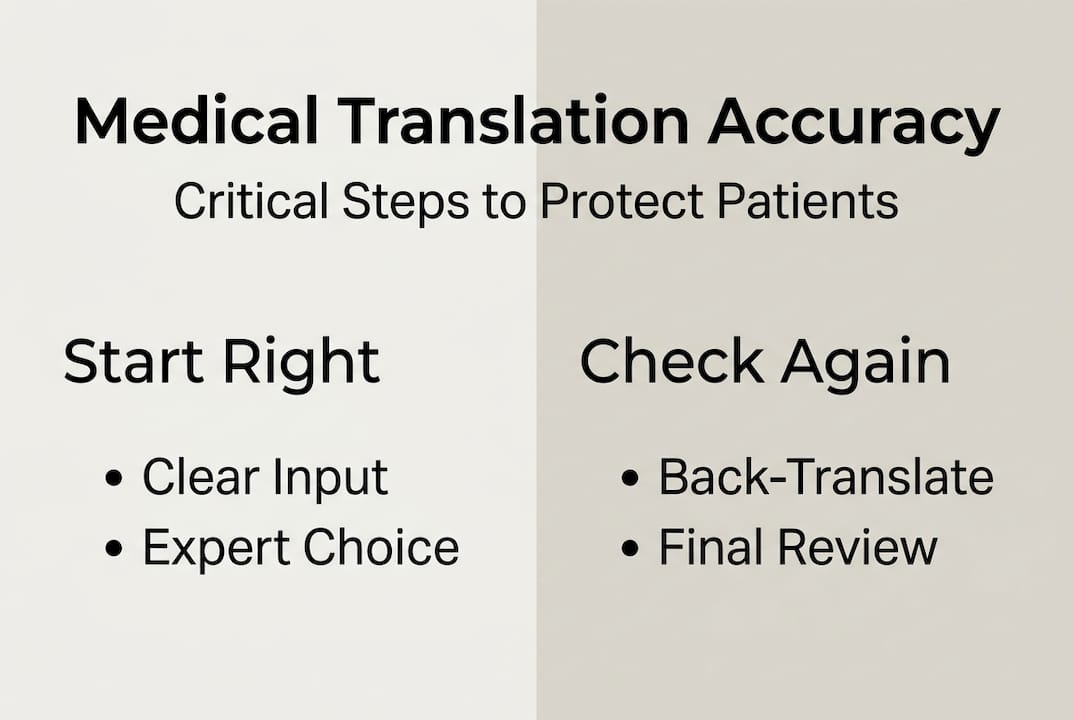
Pro Tip: For any document that could directly affect patient treatment decisions, always run a back-translation. It takes time, but it is the single most effective method for catching meaning drift before a document reaches a patient or regulator. You can find structured guidance on medical translation workflows to support this process.
Verification and compliance: Final checks before publication
A careful translation process is not complete without the right checks to ensure compliance and patient safety.
Verification is not a single step. It is a structured sequence of reviews, each targeting a different type of risk:
- Regulatory review: Confirm the translation meets the specific requirements of the target jurisdiction. EMA, FDA, and MHRA guidelines differ in their expectations. Know which applies.
- Clinical expert validation: A qualified professional in the target language must confirm that clinical meaning is preserved. This is non-negotiable for prescribing information, clinical trial materials, and patient safety communications.
- Patient comprehension testing: For lay-facing documents, test with real users. Native speakers who are not clinicians are ideal for this step. They reveal gaps that experts often miss.
- Terminology and consistency audit: Cross-check the entire document against the approved glossary. Inconsistency in drug names or dosage terminology is a common regulatory red flag.
- Documentation and audit trail: Record every stage of the process, who reviewed what, when, and what changes were made. Regulators expect this evidence.
Abbreviations, eponyms, and low-readability text significantly increase error risk, as do culturally specific descriptions of symptoms. These edge cases must be validated with patients, not assumed to be correct because the grammar is sound.
“Patient safety must always take precedence over speed. No deadline justifies skipping clinical review.”
High-risk terminology deserves particular attention. A term like “stat” (meaning immediately) has no direct equivalent in many languages. Translating it incorrectly could delay urgent treatment. Ambiguous cases should always be resolved by a subject matter expert, not left to linguistic judgement alone.
For teams managing multiple regulatory markets, exploring quality checks for compliance and understanding the role of language service providers in EU compliance can significantly reduce the burden of multi-jurisdiction submissions.
Why accuracy in medical translation demands more than technology
The industry conversation around medical translation has shifted heavily towards automation in recent years. AI tools are faster, cheaper, and increasingly capable. But the data tells a more cautious story, and experience confirms it.
Even a 1% error rate in a clinical document is not a minor quality issue. It is a potential harm event. Technology cannot fully account for intent, cultural nuance, or the way a patient in a specific community understands their own body and symptoms. These are human dimensions that require human judgement.
The value of expert human translators lies not in their ability to replace machines, but in their capacity to catch what machines miss. Experienced medical linguists understand that a technically accurate translation can still be clinically misleading. That distinction is what protects patients.
Organisations that build cultures of oversight, rather than cultures of automation, consistently produce safer, more compliant translations. Technology should accelerate the process. Human expertise must validate the outcome. This is not a conservative position. It is the only defensible one.
Where to find expert support for flawless medical translation
If you’re looking for a partner to ensure your medical translations meet the highest standards, expert help is available. Glocco® specialises in medical translation for patient safety, offering both hybrid and human-only solutions tailored to your regulatory environment and language requirements. Our team combines AI tools for accurate translation with rigorous human review to deliver results that hold up under regulatory scrutiny. Whether you need a single document validated or a full multilingual submission managed end to end, our hybrid translation solutions are designed to protect both your patients and your compliance record. Get in touch to explore case studies and book a consultation.
Frequently asked questions
What is the safest process for translating medical documents?
The safest process combines AI for consistency with human expert review at every critical stage, always including back-translation and clinical validation before publication.
How accurate are AI medical translation tools alone?
AI tools reach 90 to 97% accuracy for common language pairs but fall to 80% or lower for less common ones, making human review essential in all medical contexts.
What common errors occur in medical translation?
Typical errors include misinterpreted abbreviations and eponyms, ambiguous dosage instructions, and loss of cultural context in patient-facing symptom descriptions.
How can I verify a translated medical text is compliant?
Verification requires regulatory review against the relevant jurisdiction’s guidelines, clinical expert validation in the target language, and patient comprehension testing with representative lay readers.


