


Localisation is not simply a translation exercise. Many organisations invest in multilingual e-learning, only to find that learners disengage because the content feels foreign rather than familiar. E-learning localisation goes far beyond converting text, incorporating cultural, technical, and contextual adaptation that makes learning feel native and natural. European businesses are discovering this distinction matters enormously, with empirical data showing measurable rises in course completion rates when content is genuinely localised rather than merely translated.
Key Takeaways
| Point | Details |
|---|---|
| Localisation drives engagement | Adapting digital training for cultural and linguistic relevance increases learner completion and retention. |
| Beyond translation | True localisation involves contextual changes such as visuals, tone, and formats—not just words. |
| Design for scalability | Start with modular, localisation-ready content to reduce costs and simplify updates. |
| Hybrid approaches yield results | AI and human collaboration ensures both speed and quality for global e-learning initiatives. |
Defining e-learning localisation: Beyond translation
Localisation and translation are frequently used interchangeably, but they describe fundamentally different processes. Understanding this distinction is the starting point for any business serious about global training effectiveness.
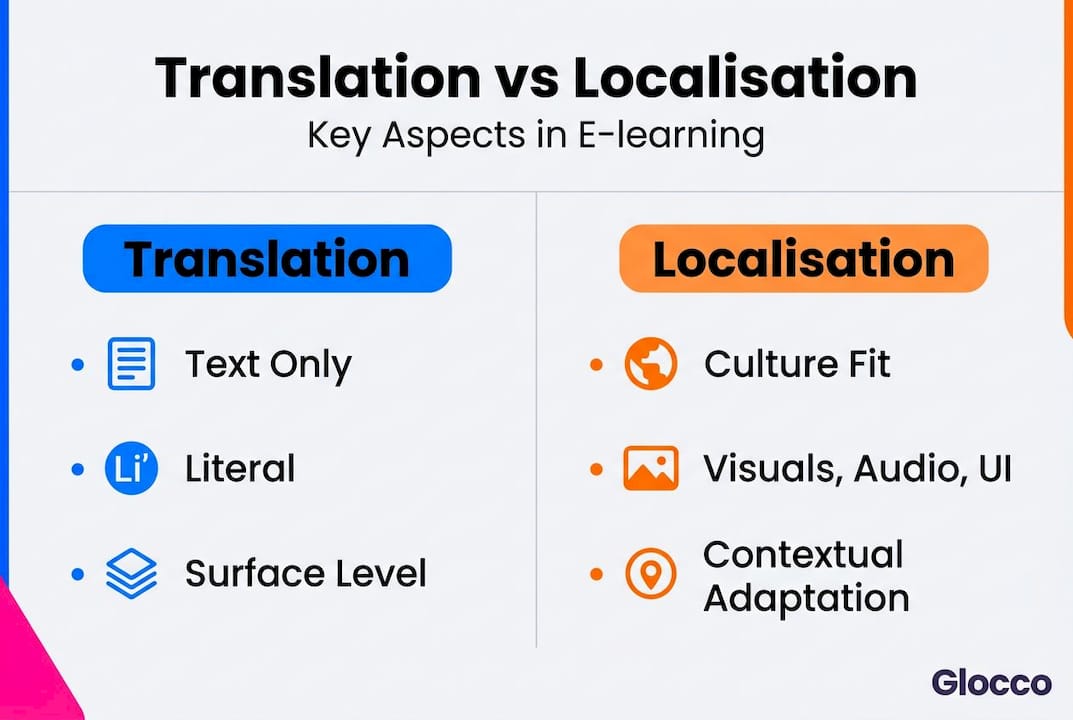
Translation converts words from one language to another. It is a precise, necessary step, but it addresses only the surface layer of content. Localisation, by contrast, adapts content for cultural connection, reshaping the entire learner experience to feel native to the target audience. This includes idioms, humour, formality levels, date and currency formats, and even the visual design of a course.
Consider a compliance training module built for a UK audience. Translated into German, the words may be accurate, but a scenario featuring a British office culture, a reference to pounds sterling, or an informal conversational tone may alienate German learners immediately. Localisation would replace those scenarios with culturally relevant equivalents, adjust the tone to match German professional norms, and reformat dates and figures accordingly.
A useful language localisation guide frames this well: localisation is about making content feel as though it was created specifically for the target audience, not adapted from somewhere else.
Here is a clear comparison of the two processes:
| Aspect | Translation | Localisation |
|---|---|---|
| Scope | Text only | Text, visuals, audio, UI, tone |
| Cultural adaptation | None | Full cultural relevance |
| Formats | Unchanged | Dates, currencies, units adjusted |
| User experience | Often awkward | Seamless and natural |
| Business impact | Limited | Higher engagement and retention |
Localisation adapts visuals, audio, UI, and tone for cultural relevance, addressing every layer that shapes how a learner experiences content. This is why businesses that invest in true localisation consistently outperform those that rely on translation alone. A practical localisation checklist can help teams audit their content against each of these dimensions before launch.
For organisations navigating digital transformation, localised e-learning is increasingly a strategic asset rather than an optional enhancement.
Key elements of successful e-learning localisation
With this foundation, it becomes essential to understand what successful localisation actually entails. Effective localisation is not a single task but a structured process covering several interconnected elements.
Linguistic adaptation goes beyond vocabulary. It means selecting the right dialect, using local idioms where appropriate, and matching the formality register expected by the target audience. A training module for Brazilian Portuguese learners, for example, requires different linguistic choices than one for European Portuguese speakers, even though both are technically the same language.

Cultural relevance is equally critical. Visuals, audio, UI, formats, and scenarios must all be adapted for a natural learner experience. This means replacing stock images that reflect one cultural context with imagery that resonates locally, adjusting feedback tone to match regional expectations, and rewriting case studies with region-specific business practices.
Technical fit covers the structural requirements of localisation. Languages such as Arabic and Hebrew read right to left, requiring a complete layout reversal. German and Spanish text typically expands by 20 to 30 per cent compared to English source content, demanding flexible design. Accessible formats, appropriate font choices, and audio synchronisation are all part of this layer.
Contextual adjustments address the practical details that learners notice immediately. Currencies, measurement units, legal references, and date formats must all reflect local conventions. A module that references “Q1 starting in January” may need adjustment for markets where the financial year begins differently.
Key elements to address in every localisation project:
- Local dialect and formality level selection
- Region-specific visuals and imagery
- Cultural scenarios and feedback tone
- Right-to-left language support
- Text expansion allowances in layout
- Currency, date, and unit formatting
- Audio re-recording or voiceover adaptation
Understanding the localisation business benefits associated with each of these elements helps justify the investment to stakeholders. Reviewing proven localisation strategies used by European businesses provides a practical framework for prioritising these components. A detailed localisation comparison between translation and full localisation further illustrates why each element is non-negotiable.
Pro Tip: Conduct a cultural review with a native speaker from the target market before finalising any localised module. Native reviewers catch nuances that even experienced translators can overlook.
Designing e-learning content for seamless localisation
Understanding core localisation elements, the next step is designing content that adapts with ease. The most costly localisation mistakes occur when source content is built without future adaptation in mind. Retrofitting a poorly designed course for multiple languages is significantly more expensive and time-consuming than building for localisation from the start.
Follow these steps to design localisation-ready e-learning content:
- Write neutral source content. Avoid region-specific idioms, culturally loaded examples, and humour that does not travel well. Neutral, clear language reduces the complexity of adaptation significantly.
- Avoid embedded text in images. Text baked into graphics cannot be extracted for translation without redesigning the image. Use text layers that can be replaced independently.
- Build flexible layouts. Source content should support flexible layouts for text expansion and right-to-left languages. Allow at least 30 per cent extra space in all text containers.
- Use modular content structures. Break courses into discrete modules that can be updated or replaced independently. This makes it far easier to refresh localised content when source material changes.
- Establish feedback loops. Collect learner feedback from each localised market and use it to refine content iteratively. Localisation is not a one-time task; it requires ongoing maintenance as language, culture, and business context evolve.
“Designing for localisation from the outset reduces rework costs by a significant margin and ensures that every market receives content of equal quality.”
Exploring AI localisation tools can further accelerate the design and adaptation process, particularly for organisations managing content across many languages simultaneously.
Pro Tip: Create a localisation style guide for each target market. Document approved terminology, tone guidelines, and visual standards so that every team member and vendor works from the same reference point.
Business impact: Outcomes and empirical evidence
Finally, it is crucial to see how these strategies translate into business results, as shown through research and case studies.
The evidence is compelling. Articulate’s 90-day study found that completion rates rose from 77.4% to 83.4%, while median completion time dropped by approximately 50% following localisation. These are not marginal gains. A 6-percentage-point rise in completion rates across a workforce of thousands represents a substantial return on investment.
Corporate case studies reinforce this picture. Localisation produced 32% higher completion rates and a 41% enrolment boost in one study, while corporate training programmes recorded 18% faster completion and 15 to 20% better quiz scores following localisation. These figures demonstrate that localised content does not just feel better; it performs measurably better.
| Metric | Before localisation | After localisation |
|---|---|---|
| Course completion rate | 77.4% | 83.4% |
| Median completion time | Baseline | ~50% reduction |
| Enrolment rates | Baseline | +41% |
| Quiz scores | Baseline | +15 to 20% |
| Completion speed | Baseline | +18% faster |
Understanding the broader localisation impact in EU markets adds further context to these figures. A well-structured localisation workflow ensures these results are achievable consistently, not just in isolated projects.
A fresh perspective on localisation: What most guides miss
Most guides treat localisation as a project with a clear start and end point. The reality is quite different, and businesses that fail to recognise this pay for it repeatedly.
Localisation is a continuous process. Markets evolve, regulations change, and learner expectations shift. A module localised for the French market in 2023 may already feel dated by 2026 if business practices or compliance requirements have changed. Organisations that treat localisation as a one-time investment consistently find themselves rebuilding content from scratch rather than maintaining it efficiently.
The second overlooked factor is the hybrid approach. Experts recommend hybrid AI and human workflows, combining modular content structures and feedback loops for sustainable localisation at scale. AI tools accelerate the initial adaptation process significantly, but human reviewers remain essential for cultural accuracy, tone calibration, and nuanced contextual judgement. Neither approach alone delivers the quality and speed that modern businesses require.
The third gap is measurement. Most organisations track completion rates but fail to connect localisation quality to specific learner outcomes. Building market-specific metrics into your evaluation framework from the start reveals which adaptations drive results and which require refinement. Investing in AI for localisation without a measurement strategy is a missed opportunity to continuously improve.
Take the next step with advanced localisation tools
To put these strategies into practice, leverage expert tools and guidance for localisation success. Glocco® offers AI-driven translation and localisation services designed to help European businesses scale their training programmes across multiple markets without sacrificing quality. Explore our AI translator tools to accelerate your localisation workflow, or use our proven localisation checklist to audit your current content against best practice standards. For a broader view of how localisation drives measurable business growth, our guide on global localisation benefits provides the strategic context your team needs to build a compelling business case.
Frequently asked questions
What is the primary difference between e-learning localisation and translation?
Translation is word-for-word text conversion, while localisation adapts idioms, scenarios, formats, and visuals to create a culturally relevant and engaging learner experience.
Which elements should I prioritise when localising e-learning content?
Prioritise visuals, UI, examples, formats, and tone first, as these have the greatest impact on whether learners feel the content was created for them specifically.
How does effective localisation impact learner outcomes?
Empirical studies show higher completion rates and better scores consistently result from well-executed localisation, with some programmes recording up to 41% higher enrolment alongside improved quiz performance.
What are best practices for designing localisation-ready content?
Source content should avoid region-specific idioms and use flexible layouts that accommodate text expansion and right-to-left language support from the outset.


