


Assume for a moment that a bilingual nurse steps in to interpret for a distressed patient who speaks no English. The intention is helpful. The outcome, however, can be catastrophic. Medical interpretation is not simply bilingual conversation — it is a specialised clinical skill with direct consequences for patient safety, informed consent, and care quality. For healthcare professionals and administrators, understanding the precise nature of medical interpretation is not a matter of professional courtesy; it is a fundamental requirement for safe, equitable practice.
Key Takeaways
| Point | Details |
|---|---|
| Real-time language bridge | Medical interpretation ensures that patients and clinicians can understand each other instantly in care settings. |
| Modality matters | Choosing the right interpretation delivery mode is crucial for clinical effectiveness and patient comfort. |
| Certification ensures quality | Accredited interpreters follow standards that protect safety, confidentiality, and legal compliance. |
| Workflows reduce risk | Structured interpreter-clinician collaboration and preparation help avoid miscommunication. |
Defining medical interpretation in clinical practice
With the risks of ad hoc communication clearly at stake, it is vital to understand exactly what medical interpretation is and what it is not.
Medical interpretation is the real-time conversion of spoken or signed messages between a patient and clinician who do not share a language, and it is entirely distinct from translation of written text. Translation applies to documents — discharge summaries, consent forms, referral letters. Interpretation applies to live encounters. The distinction is not semantic; it determines the skills, training, and professional standards required.
This distinction matters deeply for clinical governance. Poor medical translation and patient safety are closely linked, and so are the risks of inadequate interpretation at the point of care. Translation accuracy in healthcare is a separate challenge, but both areas demand dedicated expertise and cannot be improvised.
Medical interpretation is essential across a wide range of clinical scenarios, including:
- Emergency department assessments where speed and precision are both critical
- Informed consent discussions before surgery or invasive procedures
- Mental health consultations where cultural nuance and emotional accuracy are paramount
- Medication counselling where misunderstood dosage instructions carry serious risk
- Paediatric appointments where the parent or guardian is the primary communicator
- Oncology consultations where sensitive diagnoses require careful, precise language
“Medical interpretation is the real-time conversion of spoken (or signed) messages between a patient and clinician (or other parties) who do not share a language, distinct from translation of written text.” — Language Access Services for Patients
Each of these scenarios demands not just language fluency, but clinical vocabulary, situational awareness, and strict ethical conduct.
The role and impact of professional medical interpreters
Having established what medical interpretation is, the next question is what professional interpreters actually do and why their expertise matters in clinical contexts.
Professional medical interpreters facilitate accurate, contextually appropriate communication that supports both patient understanding and clinician decision-making. That is a substantial scope. It goes far beyond word-for-word exchange. A trained interpreter manages register, cultural context, emotional tone, and clinical terminology simultaneously.
A typical clinical interpreter workflow involves the following steps:
- Pre-session briefing with the clinician to understand the appointment type, likely topics, and any sensitive areas
- Role clarification with the patient, establishing the interpreter’s neutral, professional function
- Consecutive or simultaneous interpreting during the consultation, depending on complexity
- Clarification requests when clinical terminology is ambiguous or the patient’s response is unclear
- Post-session debrief with the clinician if any communicative challenges arose during the encounter
This structured process, supported by secure interpreting workflows, reduces the risk of omission, mistranslation, and ethical breach.
The risks of using untrained interpreters — family members, bilingual reception staff, or even other patients — are well documented. Errors in these settings tend to cluster around sensitive information: diagnoses, treatment risks, medication instructions, and mental health disclosures. Family members may unconsciously filter distressing information. Staff interpreters may lack clinical vocabulary. Both introduce liability for the institution.
“Professional medical interpreters facilitate accurate, contextually appropriate communication that supports patient understanding and clinician decision-making.” — Best-practice use of medical interpreters
Pro Tip: Before every clinical encounter, the interpreter and clinician should hold a brief pre-session huddle of two to three minutes. Cover the appointment purpose, any expected sensitive disclosures, and any patient-specific cultural factors. This small investment dramatically reduces miscommunication during the consultation itself.
Modalities of medical interpretation: Choosing the right approach
Understanding the interpreter’s role leads naturally to how these services are delivered, as the right modality can be critical for patient outcomes.
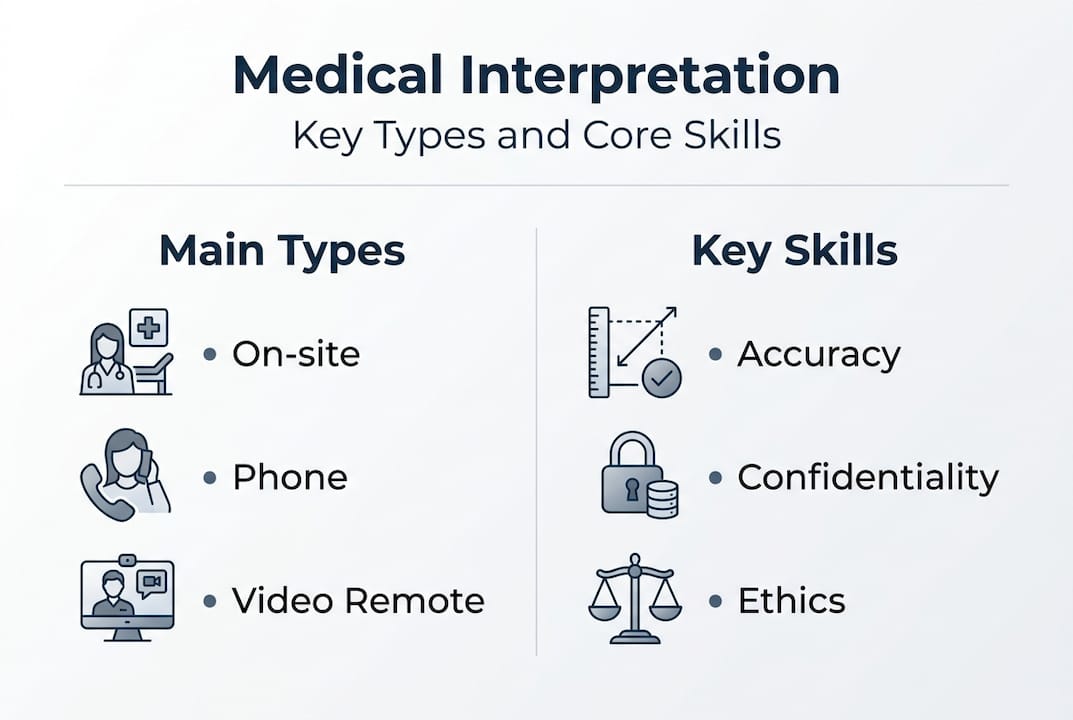
Interpretation modality matters operationally: on-site or in-person, over-the-phone (OPI), and video remote interpreting (VRI) are distinct service delivery modes. Each has operational strengths, and each suits specific clinical contexts.

| Modality | Key features | Advantages | Limitations | Best use cases |
|---|---|---|---|---|
| On-site / in-person | Interpreter physically present | Full visual and non-verbal cues | Higher cost, scheduling lead time | Complex consultations, surgery consents, mental health |
| Over-the-phone (OPI) | Audio connection only | Rapid availability, low cost | No visual cues, less nuanced | Emergency triage, short appointments, rare languages |
| Video remote (VRI) | Audio and video via screen | Visual cues, fast access | Technology dependency, privacy considerations | Outpatient clinics, virtual urgent care platforms, paediatrics |
When selecting a modality, consider the following scenarios:
- Choose on-site interpretation for psychiatric assessments, end-of-life care discussions, surgical consent, and any encounter involving trauma disclosure
- Choose OPI when a rare language is required urgently and no on-site interpreter is available within a safe timeframe
- Choose VRI for outpatient follow-ups, telehealth appointments, or any setting where technology infrastructure is reliable and privacy can be maintained
For a fuller overview of available service types, the range of interpretation service types across European and international healthcare settings is worth reviewing. If your team is assessing specific options, both over-the-phone interpreting and video remote interpreting offer accessible entry points for most clinical environments. The broader voice interpretation benefits for healthcare organisations are also worth considering when building a language access policy.
Pro Tip: Matching modality to patient needs means thinking beyond convenience. A patient with hearing impairment, limited mobility, or severe anxiety may experience significantly different outcomes depending on whether the interpreter is present in the room or on a screen. Patient preference, when safely accommodated, improves engagement and recall.
Certification, ethics, and quality assurance in medical interpretation
Appropriate modality is important, but ensuring interpreters meet recognised standards is equally critical.
Professional certification establishes standards of safe and ethical practice in the healthcare interpreting field. In the United States, the National Board of Certification for Medical Interpreters (NBCMI) issues the Certified Medical Interpreter (CMI) credential, which sets a recognised benchmark. Equivalent frameworks exist across Europe and internationally.
| Standard | Governing body | Key requirement | Renewal cycle |
|---|---|---|---|
| Certified Medical Interpreter (CMI) | NBCMI (USA) | Written and oral exam, clinical vocabulary | Every five years |
| Healthcare Interpreting Certificate | Various EU bodies | Language competency, ethics training | Varies by country |
| Community Interpreting Qualification | Regional authorities | Cultural competency, role boundaries | Ongoing CPD |
Ethical guidelines form the backbone of professional practice. Medical interpreters are bound by:
- Accuracy — interpreting the complete message without addition, omission, or substitution
- Impartiality — maintaining a neutral, non-judgemental stance throughout the encounter
- Confidentiality — treating all clinical information with the same discretion expected of clinical staff
- Role boundaries — avoiding advocacy or personal advice outside the interpreting function
To verify interpreter credentials effectively, healthcare administrators should follow these steps:
- Request written evidence of current certification or registration with a recognised body
- Confirm the interpreter has completed clinical interpreting training, not just general language qualifications
- Ask for evidence of continuing professional development over the past 12 months
- Check that the interpreter is familiar with your specific clinical setting or specialty
- Ensure your language services provider operates a quality assurance process with documented standards
For EU-based settings, guidance on certified interpreter standards provides a useful compliance reference. Those working across legal and clinical boundaries will also find the legal interpreting guide relevant. The expert interpreter impact on complex communication environments reinforces why credentials must be verified, not assumed. For further reading on communication quality in medical settings, research into effective medical communication offers useful clinical framing.
Why systematising interpretation workflows is the next patient safety frontier
Most healthcare organisations focus their interpretation efforts on sourcing qualified interpreters. That is necessary. But it is not sufficient. The evidence points clearly to a different conclusion: most clinical communication errors occur not because interpreters lack skill, but because the workflows surrounding interpretation are poorly designed.
Safer encounters require structured mechanics, including interpreter–clinician workflow practices such as pre-encounter huddles and, critically, not relying on family members to fill language gaps. This is where organisational responsibility becomes decisive.
Pre-consultation huddles are still rare in most healthcare systems. Yet they take less than five minutes and have an outsized effect on encounter quality. When a clinician and interpreter align on vocabulary, cultural sensitivities, and appointment objectives before the patient enters the room, the likelihood of misunderstanding or omission drops significantly.
Relying on family members as interpreters introduces risks that many institutions underestimate. Beyond the obvious clinical risks — filtered information, mistranslation, emotional burden — there is a legal dimension. Consent obtained through an untrained family interpreter may not withstand scrutiny in a complaint or litigation scenario. The duty of care extends to communication.
Systematising interpretation also means integrating language access into clinical governance structures, not treating it as a logistical afterthought. That means tracking interpretation use by department, reviewing adverse events for language-related factors, and training clinical staff on how to work effectively with interpreters. The frameworks for interpretation service structures provide a starting point for administrators ready to build a more robust language access policy.
The frontier here is not technological. It is organisational. The institutions that reduce language-related clinical errors in the next five years will be those that treat interpretation as an integrated clinical function, not a support service.
Streamline your healthcare communication with expert interpreters
Now that you recognise the value and nuances of medical interpretation, the practical next step is ensuring your organisation has reliable access to qualified professionals. Glocco® works with healthcare providers across Europe, the Middle East, and North America to deliver tailored interpretation solutions that meet both clinical and compliance standards.
Whether you need on-site, telephone, or video remote interpreting, our team matches the right interpreter to your specific clinical context. Explore the full range of healthcare interpretation options or review our approach to finding certified interpreters who meet recognised professional standards. Speak to our team today to build a language access strategy that genuinely supports your patients and your staff.
Frequently asked questions
How is medical interpretation different from medical translation?
Medical interpretation deals with real-time spoken or signed communication during clinical encounters, while medical translation applies to written documents such as consent forms, discharge summaries, and prescription instructions.
Can family members or bilingual staff interpret for patients?
It is not recommended, as safer encounters require avoiding reliance on family members or untrained staff, who risk omissions, mistranslations, and ethical boundary violations that carry clinical and legal consequences.
What are the main types of medical interpretation modalities?
The three primary distinct service delivery modes are on-site or in-person interpreting, over-the-phone interpreting, and video remote interpreting, each suited to different clinical settings and levels of urgency.
How can healthcare providers verify interpreter qualifications?
Request current certification from a recognised body such as the NBCMI’s CMI credential, and confirm the interpreter has completed clinical training, documented continuing professional development, and familiarity with your specific specialty.


