


TL;DR:
- Accurate legal translation requires understanding jurisdictional differences and systemic disparities.
- Using EU resources like IATE and EuroVoc ensures terminology consistency across jurisdictions.
- Human expertise remains essential for legal accuracy, with AI serving as a supportive productivity tool.
A single mis-translated clause in a cross-border contract can trigger months of costly litigation. For legal professionals and compliance officers operating across European jurisdictions, the stakes of legal terminology translation have never been higher. Translation errors can create costly legal disputes and significant delays in European legal matters. This guide walks you through a proven, structured workflow to deliver accurate, efficient, and fully compliant multilingual documentation, from initial preparation through to final delivery and verification.
Key Takeaways
| Point | Details |
|---|---|
| Centralise terminology resources | Using IATE and EuroVoc reduces inconsistencies and boosts legal compliance. |
| Balance AI with expert review | Leverage AI for efficiency, but ensure all output is checked by qualified translators. |
| Follow a defined workflow | Systematic preparation, translation and verification steps minimise errors and disputes. |
| Verify for legal compliance | Check every translation for jurisdiction, legality and certification before delivery. |
Understanding the challenges of legal terminology translation
With awareness of the risks, it is vital to examine the real-world obstacles legal translators face across Europe. Legal systems are not uniform. The divide between common law jurisdictions such as the UK and civil law systems such as France or Germany creates inherent translation difficulties that go far beyond vocabulary.
Systemic disparities between common law and civil law mean that many legal concepts simply have no direct equivalent in the target language. A term like “estoppel” or “consideration” carries specific legal weight in English common law that cannot be mapped neatly onto French or German civil codes. Understanding the difference between translation vs interpretation is itself a foundational step for any legal professional managing multilingual documentation.
The practical challenges compound quickly:
- Jurisdictional complexity: Each EU member state applies its own procedural rules, and terminology must reflect the correct legal system.
- Evolving legislation: Regulatory frameworks change frequently, meaning glossaries and reference materials must be kept current.
- Tight deadlines: Court filings, regulatory submissions, and contract negotiations rarely allow for extended review periods.
- Cultural and linguistic nuance: Legal language carries cultural assumptions that literal translation will miss entirely.
- Certification requirements: Many documents require sworn or certified translation, adding procedural layers to the workflow.
The consequences of getting this wrong extend well beyond embarrassment. Compliance failures, financial penalties, and reputational damage are all realistic outcomes when terminology is handled carelessly. The role of human translators in law is therefore not merely linguistic but interpretive and strategic.
“The quality of legal translation is not measured by fluency alone, but by its defensibility in the jurisdiction where it will be applied.”
Using EU terminology resources from the outset helps establish a reliable reference baseline, but it is only one part of a well-designed workflow.

Preparing your translation workflow: tools and prerequisites
To address such complexities, you must prepare the right tools and protocols before any document crosses your desk. Preparation is where most workflow failures begin, and where the most time can be saved.
Essential tools and resources
EU institutions use IATE and EuroVoc for centralised terminology management, multilingual vocabularies, and style guides that guarantee consistency across languages and jurisdictions. IATE (Interactive Terminology for Europe) is the official EU inter-institutional terminology database, while EuroVoc provides a multilingual thesaurus covering EU policy areas. Both are freely accessible and should be your first reference points.
| Tool | Purpose | Best used for |
|---|---|---|
| IATE | Terminology management | Cross-institutional EU documents |
| EuroVoc | Multilingual thesaurus | Policy and regulatory texts |
| Official style guides | Consistency and formatting | All formal legal documents |
| CAT tools | Translation memory | Repetitive clause structures |
| AI-assisted translation | Speed and first-draft support | High-volume, lower-risk content |
On the question of AI, the picture is nuanced. Swiss SwiLTra-Bench benchmark data demonstrates that advanced AI tools can meaningfully accelerate workflows, but human intervention remains essential for accuracy and legal defensibility. AI is a productivity tool, not a replacement for professional judgement.
Before beginning any project, establish the following prerequisites:
- Confirm target languages and relevant jurisdictions
- Identify whether certified or sworn translation is required
- Set realistic deadlines that allow for expert review
- Agree on formatting and document standards with the receiving party
- Build or access a project-specific glossary aligned with IATE and EuroVoc
Pro Tip: For accurate legal document translation, create a project brief at the outset that captures jurisdiction, certification requirements, and terminology preferences. This single document saves significant time during review and approval stages.
Exploring AI tools for translation is worthwhile, provided you build human verification into every stage of the process.
Step-by-step legal terminology translation workflow
Now that you are equipped, here are the detailed steps for a robust, compliant workflow.
-
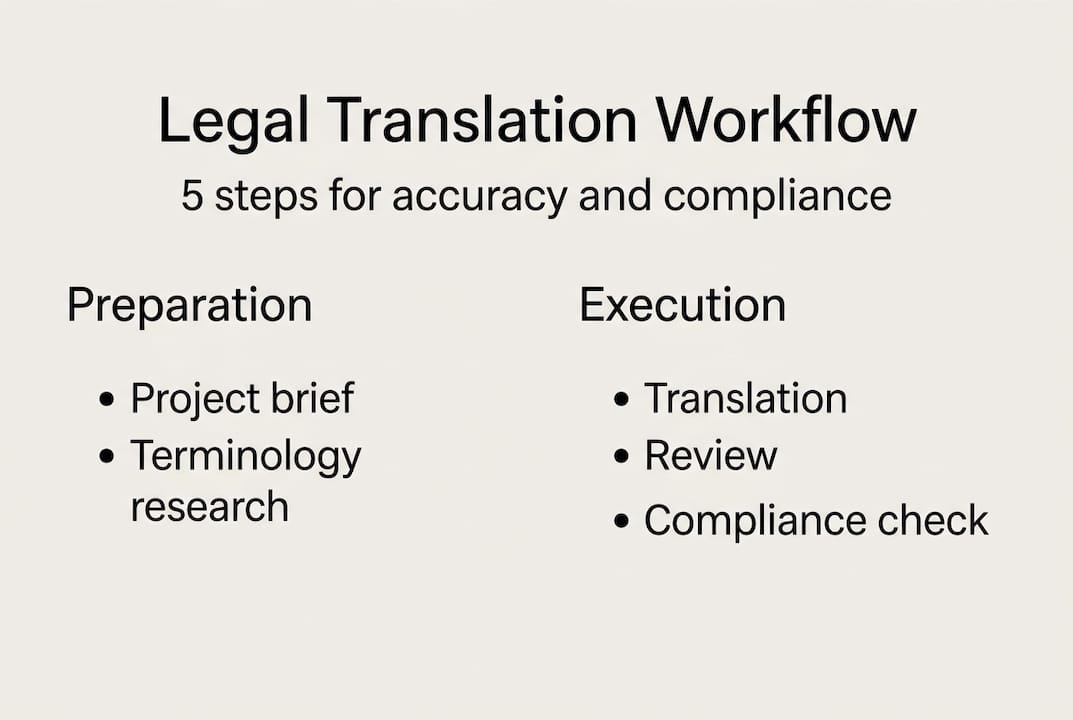
Gather and assess source materials. Collect all documents, reference texts, and jurisdictional notes. Clarify format requirements, target audiences, and any specific legal standards that apply. Identify terms likely to present translation difficulties before you begin.
-
Build your terminology reference. Use IATE and EuroVoc to research key terms. Where applicable, apply the LexALP methodology: LexALP harmonises terminology across Alpine jurisdictions by building shared term banks and corpora, offering a replicable model for any multilingual legal project.
-
Draft the translation with contextual annotations. Translate the document while maintaining the source text’s legal register and style. Where concepts are untranslatable, annotate them clearly rather than forcing an inaccurate equivalent. Context must always govern word choice.
-
Expert review and peer check. Submit the draft to a subject-matter expert or a second qualified translator. This step is non-negotiable for legal translation quality. A fresh pair of expert eyes catches errors that the original translator may overlook.
-
Compliance and quality assurance checks. Verify that the translation meets GDPR requirements, court standards, and any jurisdiction-specific documentation rules. If the output requires legalisation, engage a sworn translation professional at this stage.
-
Finalise and deliver with full documentation. Deliver the completed translation alongside all metadata, certification records, and a terminology log. This supports future projects and provides an audit trail.
| Stage | Key action | Output |
|---|---|---|
| Assessment | Gather materials, clarify scope | Project brief |
| Terminology | IATE, EuroVoc, LexALP research | Glossary |
| Drafting | Translate with annotations | Draft document |
| Review | Expert and peer check | Revised draft |
| Compliance | QA and certification | Compliant document |
| Delivery | Full documentation package | Final deliverable |
Pro Tip: Working with experienced language service providers at the review and compliance stages significantly reduces error rates and speeds up final approval.
Verification and troubleshooting: ensuring accuracy and compliance
No workflow is complete without rigorous verification. Here is how to get it right.
Verification is not a single action but a structured process. Use the following checklist to confirm your translation is accurate, consistent, and jurisdictionally sound:
- ✓ All key terms align with IATE and EuroVoc definitions
- ✓ Untranslatable concepts are annotated with explanatory notes
- ✓ The legal register matches the source document throughout
- ✓ GDPR and data handling references are correctly rendered
- ✓ Court-specific terminology meets the requirements of the target jurisdiction
- ✓ Certification or sworn translation has been obtained where required
- ✓ A second expert has reviewed the final draft
- ✓ All metadata and records are preserved for audit purposes
On AI-assisted verification, the evidence is clear. Frontier LLMs such as Claude-3.5-Sonnet surpass specialised NMT in law and headnote translation, but still require human validation before any document can be considered legally defensible. AI accelerates the process; it does not conclude it.
Common workflow pitfalls to address proactively include:
- Ambiguous source terms: Always seek clarification from the instructing party before translating.
- Misleading literal translations: A word-for-word approach often produces legally incorrect results in cross-system translation.
- Unsupported AI-generated terminology: Never accept AI output for specialist legal terms without cross-referencing against authoritative databases.
- Outdated glossaries: Legal language evolves with legislation. Review your reference materials regularly.
The evidence is unambiguous: translation errors are a primary source of disputes and delays in European legal matters. Investing in human review in legal translations is not a luxury but a professional obligation. Equally, ensuring certified accuracy compliance at the point of delivery protects your organisation from downstream risk.
Our perspective: why the human factor still defines legal translation quality
Stepping back, here is how we see the future of legal translation workflows at Glocco.
There is a temptation in the industry to treat AI benchmarks as proof that human translators are becoming optional. We disagree, and the evidence supports our position. Empirical studies show frontier LLMs are efficient but cannot wholly replace human translators for legal defensibility. Efficiency and defensibility are not the same thing.
Legal translation is not primarily a linguistic exercise. It is an act of legal interpretation. When a translator chooses between two plausible renderings of a term, they are making a judgement about legal meaning, jurisdictional context, and the likely reading of a court or regulator. That judgement requires professional training, contextual experience, and accountability. No model provides all three.
The teams that achieve the best outcomes blend technology with human expertise in law. AI handles volume and speed. Human experts handle meaning, nuance, and defensibility. That balance is not a compromise; it is the optimal model for high-stakes multilingual compliance work.
Simplify your legal terminology translation workflow with Glocco
Ready to strengthen your translation workflow? Here is how Glocco helps EU legal professionals stay compliant and efficient.
At Glocco, we provide tailored workflow solutions built specifically for legal and compliance teams operating across European jurisdictions. Our certified professionals bring deep subject-matter expertise to every project, combining the speed of modern technology with the accuracy that only qualified human translators deliver. Whether you need support with legal translation services, accurate document translation solutions, or full EU compliance language services, our team is ready to support you. Contact Glocco today to discuss your requirements and discover how we can make your multilingual documentation processes more efficient and defensible.
Frequently asked questions
What is the best way to handle untranslatable legal terms?
Provide explanatory footnotes or annotations that clarify the meaning and legal context for each jurisdiction involved. Untranslatable concepts require explanation rather than forced equivalents, which risk introducing legal inaccuracies.
Which tools are essential for legal terminology translation in Europe?
IATE and EuroVoc are the official EU terminology databases and should be your primary references. EU institutions use IATE and EuroVoc for centralised terminology management, ensuring consistency and compliance across all official languages.
Does AI translation replace human legal translators?
No. AI tools improve speed and support first-draft production, but human review remains essential for legal defensibility. Benchmarks show LLMs improve efficiency but do not replace human translators for legal accuracy and contextual judgement.
How can I ensure the translation meets court and compliance requirements?
Engage certified or sworn translators and perform strict quality and jurisdictional checks on every document. Certified or sworn translations are required for courts and formal compliance submissions across the EU.
What are common causes of translation workflow failure?
Most failures stem from outdated resources, inconsistent terminology, insufficient review time, or a misunderstanding of legal context. Translation errors cause disputes and delays, making regular workflow verification an essential professional practice.


