


Global language providers are firms that deliver certified translation, localisation, and interpretation services across multiple languages and regions, and they are the single most reliable option for businesses communicating across borders. The industry term is language service provider (LSP), though “global language provider” captures the international scope these firms operate at. Providers like Glocco hold certifications such as ISO 17100 for translation processes and ISO 18587 for machine translation post-editing, which turn quality promises into verifiable evidence. If your business is asking why choose global language providers over freelancers or in-house teams, the answer comes down to three things: certified quality, cultural accuracy, and the ability to scale.
What are the key benefits of choosing global language providers?
Certified translation companies use trained linguists and structured workflows to reduce errors and maintain consistent professional brand images internationally. That consistency matters enormously when your legal contracts, product descriptions, or patient-facing documents reach audiences in Frankfurt, Dubai, and Seoul simultaneously.
Here is what the advantages of global language services look like in practice:
- Certified linguists with sector expertise. A fintech firm needs translators who understand regulatory language, not just vocabulary. Sector-specific linguists reduce the risk of costly mistranslations in compliance documents.
- Cultural localisation. Local cultural knowledge ensures content resonates authentically rather than reading like a word-for-word swap. A marketing campaign that lands in London can fall flat in Riyadh without proper cultural adaptation.
- Scalable, structured workflows. Certified providers manage complex multilingual projects with documented processes, meaning you can go from a 10-page brief to a 500-page product catalogue without losing quality control.
- Security and confidentiality. Professional LSPs operate with non-disclosure agreements, secure file transfer protocols, and data handling policies that protect sensitive business information.
- Long-term partnership value. A provider who knows your brand, terminology, and markets becomes a genuine asset over time, not just a vendor you call when something needs translating.
Pro Tip: Ask any prospective provider for their termbase and translation memory policies. A provider who maintains your glossary and memory files across projects will deliver faster turnarounds and more consistent output from day one.
How do certification and quality standards add value?

Certification is the difference between a provider saying “we deliver quality” and one that can prove it. ISO 17100 defines translation process requirements with documented workflows and competence criteria, giving buyers an objective basis for comparison. This matters particularly in regulated sectors such as legal, medical, and public procurement, where a mistranslation is not just embarrassing but potentially unlawful.
ISO 18587 takes things further by setting international standards for post-editing machine translation output, covering competence requirements, workflow control, and audit-ready evidence. It requires traceable review activities, which means every AI-assisted translation has a documented human review trail. That traceability is exactly what a procurement officer or compliance team needs to sign off on a multilingual contract.
Here is a quick comparison of the two key standards:
| Standard | Focus | Key Requirement | Who Benefits Most |
|---|---|---|---|
| ISO 17100 | Human translation process | Documented workflows and linguist competence | Legal, public sector, regulated industries |
| ISO 18587 | Machine translation post-editing | Traceable human review and audit evidence | Tech, e-commerce, high-volume content |
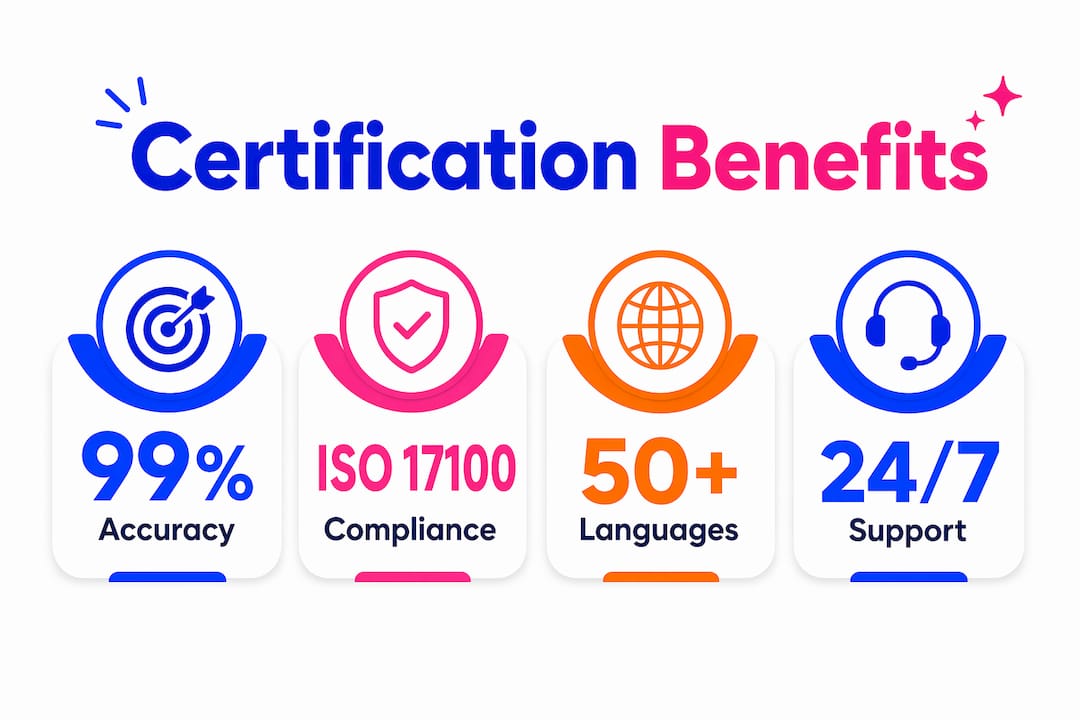
Certification turns a provider’s internal discipline into external evidence, which is often critical for securing regulated or large-scale contracts. Without it, you are relying on a provider’s word alone.
Pro Tip: When issuing an RFP for language services, specify ISO 17100 or ISO 18587 compliance as a minimum requirement. It immediately filters out providers who cannot meet professional standards.
What role does technology play in global language services?
Technology has changed the speed at which language services operate, but it has not replaced the need for human expertise. Here is how the two work together in a professional LSP workflow:
- Machine translation (MT) generates a first draft. Tools like DeepL or Google Translate produce rapid output across large volumes of content.
- Human post-editors review and correct the draft. Under ISO 18587, this step is structured, documented, and traceable, not an informal glance before sending.
- Translation management systems (TMS) control the workflow. Platforms like memoQ or Phrase manage terminology, translation memories, and project routing across teams and time zones.
- Glossaries and termbases enforce consistency. Every time a product name or technical term appears, the TMS pulls the approved translation automatically.
AI-powered tools and MT significantly speed up translation workflows, but they require careful human post-editing to meet quality standards. That combination is where the real value lies. You get speed without sacrificing accuracy.
The limitations of AI in language services are equally worth knowing:
- MT struggles with idiomatic expressions, cultural references, and highly technical or legal language.
- Without human review, AI output can introduce subtle errors that damage brand credibility.
- AI tools trained on general data perform poorly in specialist domains like medical or crypto content.
Glocco integrates AI tools for translators within a human-led quality framework, which means clients get the efficiency of technology with the reliability of professional oversight. That is not a compromise. It is the standard.
How do you select the right global language provider?
Choosing language service providers is a procurement decision, and it deserves the same rigour you would apply to any critical supplier. Here is a practical framework:
- Check language coverage and native-speaker expertise. Businesses should select providers who employ native speakers with qualifications and relevant sector experience. A provider claiming 100 languages but using non-native translators for half of them is not a safe bet.
- Verify certifications. ISO 17100 and ISO 18587 are the benchmarks. Ask for certificates, not just claims.
- Assess technology and integration capabilities. Can the provider connect with your CMS, e-commerce platform, or content management workflow? A provider who works in isolation adds friction, not value.
- Evaluate security procedures. GDPR compliance, secure file handling, and signed NDAs are non-negotiable for any business handling client or patient data.
- Test the working relationship. Run a pilot project before committing to a long-term contract. A provider’s responsiveness, communication style, and willingness to adapt tells you more than any sales pitch.
The language services checklist Glocco publishes covers these criteria in detail and is worth working through before you shortlist providers. Getting this decision right the first time saves significant cost and rework down the line.
Pro Tip: Request a sample translation in your most technically demanding subject area. Compare it against your internal terminology. That single test reveals more about a provider’s real capability than any credentials document.
Glocco’s take: what a decade of language services has taught us
Here is something most articles on this topic will not tell you: the biggest risk in multilingual communication is not bad translation. It is the illusion of good translation. A document can read fluently and still be culturally wrong, legally ambiguous, or terminologically inconsistent with your brand. We have seen it happen across e-commerce, fintech, and legal sectors alike.
The businesses that get the most from their language partnerships are the ones who treat their LSP as a strategic collaborator, not a commodity supplier. They share brand guidelines, glossaries, and market context upfront. They ask questions about post-editing workflows and certification. They do not just send files and wait.
There is also a persistent misconception that AI will eventually make professional language services redundant. It will not. What AI does is change the shape of the work. Post-editing under ISO 18587 is a skilled profession in its own right. The demand for language services in global business is growing, not shrinking, precisely because more businesses are entering more markets simultaneously.
The providers worth partnering with are the ones who are transparent about their processes, honest about the limits of technology, and genuinely invested in your market success. That is the standard Glocco has held since 2014.
— glocco®
Work with Glocco on your global communication
Glocco has been delivering certified translation, localisation, and interpretation services since 2014, working with clients across e-commerce, fintech, legal, medical, and manufacturing sectors in Europe, the Middle East, North America, and Asia. Every project follows ISO-aligned quality workflows, with human expertise at the centre of every AI-assisted process. Whether you need multilingual document translation for EU markets or specialist interpretation for regulated industries, Glocco has the coverage and the credentials to deliver. Start with the EU document translation guide to understand exactly what professional language services look like in practice, then get in touch to discuss your specific requirements.
FAQ
What is a global language provider?
A global language provider, formally known as a language service provider (LSP), is a firm that delivers certified translation, localisation, and interpretation services across multiple languages and regions. They operate with documented quality workflows and sector-specialist linguists.
Why use language translation services instead of in-house staff?
Professional LSPs offer certified quality standards, scalable capacity, and native-speaker expertise across dozens of languages that no in-house team can realistically replicate. They also carry the liability and quality controls that protect your business in regulated markets.
What does ISO 17100 certification mean for buyers?
ISO 17100 defines translation process requirements with documented workflows and competence criteria, giving buyers objective proof of quality management beyond self-declared statements. It is the benchmark standard for professional translation services.
How does AI fit into professional language services?
AI and machine translation speed up workflows considerably, but standards-based post-editing under ISO 18587 ensures every AI-generated draft undergoes structured human review with traceable evidence. The result is faster delivery without compromising accuracy.
How do i compare language service providers effectively?
Check for ISO 17100 and ISO 18587 certification, request a sector-specific sample translation, and verify that the provider employs native speakers with qualifications relevant to your industry. A pilot project before full commitment is always the smartest first step.


