


Managing localisation teams means coordinating strategy, operations, and people to deliver consistent multilingual content at scale. Done well, it produces measurable results: 2.3x faster time-to-market and 40% lower costs per language compared to ad hoc approaches. That is not a marginal gain. It is the difference between a localisation function that drives revenue and one that creates bottlenecks. Whether you lead an in-house team, manage external vendors, or run a hybrid model, knowing how to manage localization teams with clarity and structure is the single biggest lever you have.
What are the essential roles and structures in successful localisation teams?
The foundation of any well-run localisation programme is role clarity. Without it, tasks fall between the cracks, reviewers duplicate work, and project managers spend their days firefighting rather than planning.
The core roles in a high-performing team are:
| Role | Primary responsibility |
|---|---|
| Localisation manager | Strategy, vendor oversight, quality standards |
| Project manager | Scheduling, resource allocation, delivery tracking |
| Language lead | In-language quality ownership per market |
| Localisation engineer | TMS configuration, file handling, automation |
| Reviewer / LQA specialist | Linguistic and functional quality assurance |

Most scaling companies benefit from a hybrid team model, where internal staff own strategy and vendor relationships while external partners handle execution. This gives you flexibility without sacrificing control. A fintech company expanding into five new markets, for example, can ramp up external translators for a product launch without permanently inflating headcount.
Team structure also depends on your localisation maturity. Early-stage teams often centralise everything under one manager. More mature programmes tend to embed localisation staff across engineering, product, marketing, and support. That cross-functional presence reduces handoff delays and catches content issues before they reach the translation stage.
Pro Tip: Define who owns each deliverable before a project starts. Ambiguous ownership is the leading cause of rework and missed deadlines in localisation teams.
How to establish efficient workflows and tooling for localisation teams
Workflow design is where good intentions either hold up or fall apart. Continuous localisation pipelines that automate string extraction, AI-assisted translation, QA checks, and deployment are now the standard for teams working at pace. Connecting your Translation Management System (TMS) to your CMS and project tracking tools removes manual handoffs and the errors that come with them.
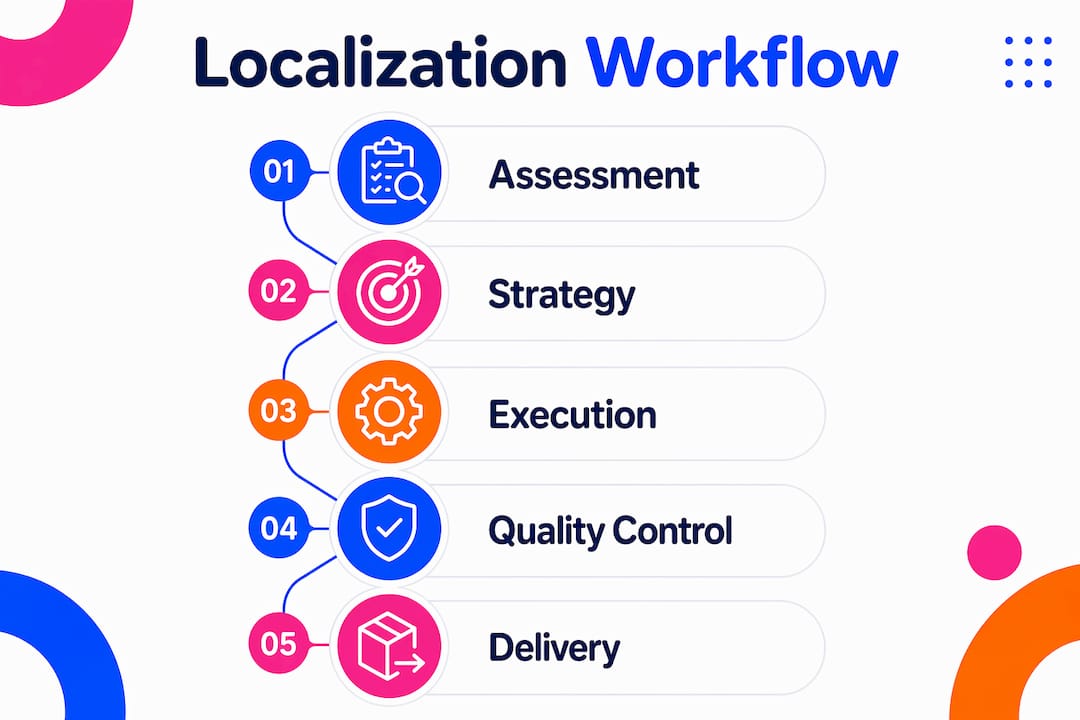
Here is a practical setup sequence for teams building or upgrading their workflow:
- Audit your content sources. Identify where translatable strings originate: product UI, marketing CMS, support documentation, legal content.
- Select and configure a TMS. Tools like Phrase, Lokalise, or XTM connect directly to development pipelines and content repositories.
- Integrate automation. Set up automated string extraction, translation memory ™ leverage, and AI pre-translation to reduce repetitive manual work.
- Build QA checkpoints. Automated QA catches formatting errors, missing variables, and length violations before human review.
- Connect project tracking. Link your TMS to tools like Jira or Asana so project managers see task status without chasing updates.
Automation tools integrated with TMS and CMS reduce manual handling errors and accelerate delivery significantly. The practical upside is that your team spends less time on file management and more time on decisions that actually require human judgement.
Pro Tip: Use a shared dashboard showing live task status, deadlines, and blockers. Dashboard transparency cuts communication overhead and stops the same question being asked five times a day.
What leadership skills do localisation team leads need in 2026?
The role of the localisation project manager has shifted. Localisation PMs now act as strategic advisors using real-time data to spot risks and influence resource planning, not just coordinators moving files between linguists and clients. That shift demands a different skill set.
The most effective localisation managers combine technical fluency with advanced soft skills. Emotional intelligence matters here. Teams working across time zones, cultures, and languages operate in genuinely complex environments, and a manager who creates psychological safety gets better output from every contributor.
Practically, this means:
- Using data to lead. KPI tracking on revenue, quality, and turnaround times gives you the evidence to influence budget decisions and prioritise markets.
- Building cross-functional relationships. Localisation managers who work closely with engineering, marketing, and customer support catch problems upstream, before they become expensive.
- Balancing support with challenge. High-performing teams need managers who set clear expectations and hold people to them, while remaining genuinely supportive when things go wrong.
- Communicating upward. Translating localisation metrics into business outcomes is a skill in itself. If leadership does not understand the ROI, budgets get cut.
The Architect and Builder model is worth adopting here. One person or function designs the system and sets standards. Another executes daily. Separating those responsibilities prevents the common failure mode where your most strategic thinker is buried in file delivery. You can read more about the skills behind this shift if you want a deeper breakdown.
How to handle common challenges in managing localisation teams
Every localisation team hits the same walls eventually: inconsistent quality, communication gaps, and the question of how to scale without losing control. The good news is that these problems are predictable, which means they are solvable.
Clear SLAs and reviewer agreements prevent the most common source of delay: nobody knowing who is responsible for what, by when. Define responsibility, timelines, escalation paths, and approval criteria in writing before a project starts, not during it.
Here is where most teams lose ground and how to recover it:
| Challenge | Root cause | Fix |
|---|---|---|
| Inconsistent quality across markets | No language lead ownership | Assign a named language lead per locale |
| Slow turnaround | Manual handoffs between tools | Automate string extraction and file delivery |
| Vendor communication gaps | No shared visibility | Shared dashboard with live status |
| Scaling bottlenecks | Over-reliance on one team | Hybrid staffing with vetted vendor partners |
| Poor ROI visibility | No KPI framework | Track quality, speed, and cost per language |
Proactive maintenance during quieter periods, such as TM clean-up and glossary validation, keeps your linguistic assets sharp and reduces rework costs on the next project. Teams that treat downtime as maintenance time consistently outperform those that only react to active projects.
For teams managing multilingual content across EU markets, the language localisation workflow guide from glocco® covers error reduction strategies in detail.
What glocco® has learned from managing localisation teams
Here is the honest version: the biggest mistake we see is teams trying to hire their way out of a systems problem. You bring in a brilliant localisation manager, give them no clear processes, no defined roles, and no tooling, and then wonder why delivery is still chaotic. The person is not the problem. The absence of a system is.
The teams that consistently perform well are not the ones with the most talented individuals. They are the ones where everyone knows their role, assets are maintained proactively, and the manager spends time on strategy rather than chasing status updates. Hybrid models work best when the internal team owns the standards and the external partners are genuinely briefed, not just handed files.
We have also noticed that transparency is underrated. When linguists, project managers, and clients can all see the same task board, the volume of clarification emails drops sharply. That is not a technology win. It is a culture win enabled by technology.
The localisation checklist we put together covers the collaboration side of this in practical terms. Worth a look if you are building or restructuring a team.
— glocco®
How glocco® supports localisation team management
glocco® has been working with localisation teams across e-commerce, fintech, gaming, legal, and medical sectors since 2014. If you are putting the strategies in this article into practice, the document translation guide for EU businesses is a strong starting point for understanding how multilingual content management works at the operational level. glocco® also offers guidance on AI translation tools that integrate with TMS platforms to accelerate delivery without compromising quality. Whether you are scaling a team or restructuring an existing one, glocco® brings the expertise to make it work.
FAQ
What does managing a localisation team actually involve?
Managing a localisation team means coordinating roles, workflows, tools, and vendor relationships to deliver accurate multilingual content on time and within budget. It covers everything from TMS configuration and SLA definition to cross-functional collaboration and quality assurance.
What is the best team structure for localisation?
Hybrid teams combining internal strategy owners with external execution partners offer the best balance of flexibility and quality control for most scaling companies. The right structure depends on your localisation maturity and the volume of content you produce.
How do you measure localisation team performance?
Track KPIs across three dimensions: quality (LQA scores, error rates), speed (turnaround time per language), and cost (cost per word, cost per language). Data-driven dashboards make these metrics visible to both the team and senior stakeholders.
How do you scale a localisation team without losing quality?
Use a hybrid staffing model with vetted vendor partners, define clear SLAs before scaling, and maintain your translation memory and glossaries proactively. Clear role ownership is the single most effective way to prevent quality from slipping as volume increases.
What tools do localisation teams use?
Most professional localisation teams use a TMS such as Phrase, Lokalise, or XTM, integrated with a CMS and project tracking tools like Jira or Asana. Automation handles string extraction, AI pre-translation, and QA checks, freeing the team to focus on review and strategy.


