


Machine-aided legal translation pairs machine-generated output with specialist human review to produce translations that are legally reliable, not just linguistically plausible. It sits between raw machine translation (MT), which has no human check, and fully human translation, which involves no automated assistance. For legal professionals and translators in the UK, the distinction matters enormously.
The short verdict: machine-aided legal translation is appropriate for low-to-medium-risk legal texts where speed and cost matter. It is not appropriate as a standalone solution for court filings, certified translations, or any document whose unedited machine output could affect legal rights.
Use it for:
- Internal contract drafts and first-pass reviews
- eDiscovery document triage and prior-art patent searches
- Due diligence checklists and regulatory draft filings
- Mass boilerplate review where terminology is standardised
Avoid unedited machine output for:
- Court submissions and sworn statements
- Certified translations required by HMRC, the Home Office, or UK courts
- Any document on which a party will rely to assert or defend legal rights
What machine-aided legal translation actually is and how it works
The term covers a collaborative process, not a single tool. Several components typically work together.
The core components:
- Machine translation (MT): software that automatically converts text from one language to another, using statistical or neural methods.
- Neural machine translation (NMT): the current dominant architecture, which uses deep learning to model entire sentences rather than word-by-word substitutions. NMT handles complex syntax better than its predecessors.
- Large language models (LLMs): models such as GPT-4 or specialised legal LLMs that generate fluent translations and can follow domain-specific instructions, though they still require human review for accuracy-sensitive documents.
- Computer-assisted translation (CAT) tools: software environments (SDL Trados, memoQ, Phrase) in which a human translator works alongside MT output, translation memories (TMs), and glossaries.
- Translation memory ™: a database of previously approved source-target segment pairs. When a new segment matches a stored one, the TM proposes the approved translation automatically, reducing both effort and inconsistency.
- Glossaries and termbases: controlled lists of approved legal terms and their target-language equivalents, locked so the MT engine cannot deviate from them.
How the workflow flows:
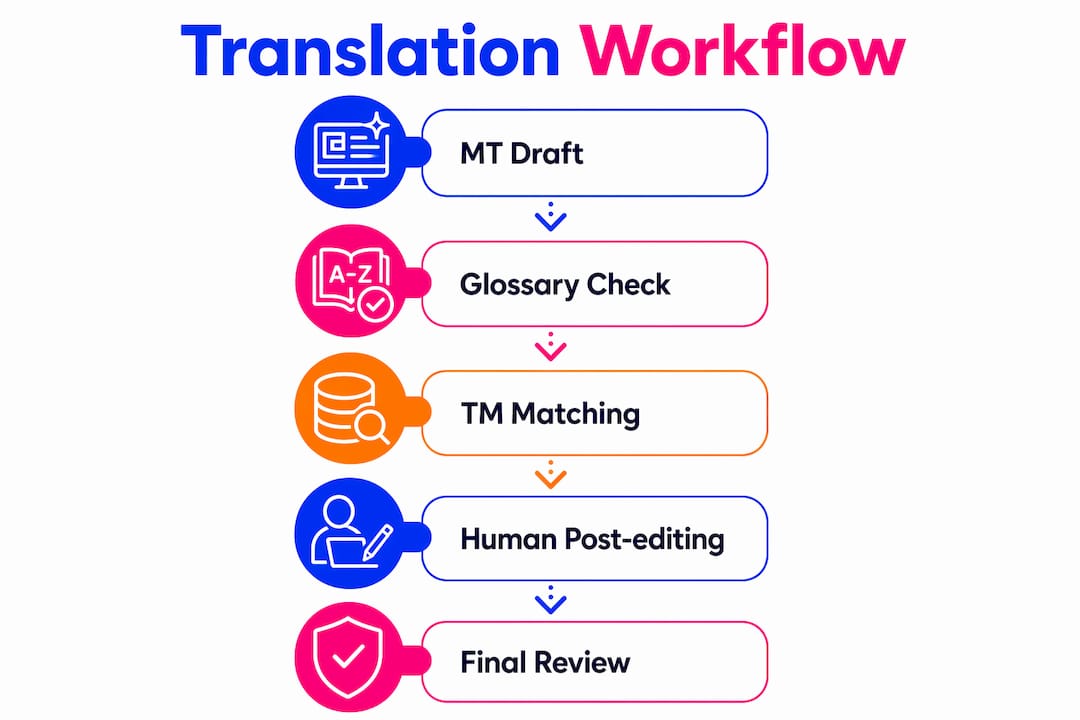
Raw MT or LLM draft → terminology and glossary alignment → TM reuse for matching segments → human post-editing (light or full) → legal-qualified reviewer sign-off.
The difference from plain MT is the human check. The difference from fully human translation is that the translator starts from a machine draft rather than a blank page, which reduces completion time while maintaining comparable quality under controlled conditions.

On customisation: custom MT engines trained on proprietary legal corpora and limited-access data produce better terminology fidelity than public consumer services. Private-cloud or on-premise deployment also addresses confidentiality concerns that public endpoints cannot.

Which legal tasks benefit most from machine-aided translation?
Not every legal document is equally suited to machine assistance. The key variable is how standardised and repetitive the language is.
- eDiscovery and document review (low risk, light post-editing): large volumes of documents need rapid triage to identify relevance. MT provides a fast first-pass read; a reviewer confirms relevance, not legal effect.
- Mass contract review (low-to-medium risk, light-to-full post-editing): boilerplate clauses in NDAs, supply agreements, and standard terms are where MT adds the most value. Repetitive, standardised language is exactly what MT handles well.
- Patent prior-art searches (low risk, light post-editing): understanding the gist of foreign-language patents for search purposes, not for filing.
- First drafts of commercial contracts (medium risk, full post-editing): MT produces a working draft; a legally qualified translator then edits for legal effect, not just fluency.
- Regulatory filings that are internal drafts (medium risk, full post-editing): drafts circulated internally before a qualified professional prepares the final submission.
- Due diligence checklists (low risk, light post-editing): summarising foreign-language corporate documents for internal review.
- Language access communications for litigants (medium risk, full post-editing): letters and procedural notices where comprehension matters but legal effect is limited.
Pro Tip: Lock your glossary before the MT engine runs. For repetitive boilerplate, a well-maintained termbase can cut post-editing time significantly and prevents the engine from introducing variant translations of the same defined term across a long document.
What machine-aided translation delivers for legal teams
The advantages are real, but they are concentrated in specific scenarios.
- Speed and throughput: MT produces a draft in seconds. For high-volume, standardised text, that acceleration is the primary gain.
- Terminology consistency: glossaries and TMs enforce approved term choices across every segment, which matters when a single defined term appears hundreds of times in a contract.
- Cost predictability for draft-level work: machine-assisted drafts cost less than fully human translation for the same volume, making large-scale projects more viable.
- Searchable bilingual corpora: approved TM pairs accumulate over time, creating a reusable asset that speeds future projects and supports multilingual teams working across jurisdictions.
- Faster turnaround for discovery and multilingual teams: legal teams under time pressure can review a machine-assisted draft far sooner than a fully human translation would arrive.
Legal language’s structural regularity, its preference for fixed formulae and decontextualised written form, makes it more amenable to MT than conversational or literary text. That amenability is the foundation of the efficiency gains above.
Where machine-aided translation falls short in legal work
The risks are specific and serious. Knowing them is what separates professional use from careless use.
- Accuracy limits on nuance and modality: legal language relies on precise modal verbs (“shall”, “may”, “must”) that carry different legal obligations. MT tools frequently mistranslate these, producing output that is grammatically correct but legally wrong.
- Jurisdictional risk: a term that is linguistically accurate in one legal system may carry a different legal consequence in another. MT tools lack an inherent understanding of legal systems, so a correct-sounding phrase can still be legally dangerous if it misaligns with the target jurisdiction’s meaning.
- Fixed legal formulae: corpus-based research shows MT tools frequently mistranslate established legal formulae and fail to comply with legal writing conventions, producing output that a native legal professional would find awkward and non-compliant.
- Confidentiality and GDPR risk: submitting privileged material to a public MT endpoint is a data-protection risk. Consumer-grade services process data on shared infrastructure with no guarantee of confidentiality.
- Serious social and legal consequences: scholarly reviews highlight that MT errors in sensitive domains can have serious social and legal consequences, and that the societal impacts of MT in law require careful study.
The hard rule: raw machine output is rarely sufficient for legal filings. Any output that affects rights or obligations requires a legally qualified reviewer. No glossary or fine-tuned engine changes that.
Never use unedited MT for:
- Court filings and sworn declarations
- Certified translations for official use
- Evidence relied on by a court or tribunal
- Documents asserting or waiving legal rights
How to build a post-editing workflow that keeps translations defensible
A structured machine translation post-editing (MTPE) workflow is what separates professional deployment from ad hoc use. Here is a practical sequence.
MTPE workflow steps:
- Pre-processing and classification: identify the document type, risk level, and certification requirement before anything else.
- Glossary and TM lock: load the approved termbase and translation memory. Lock glossary terms so the engine cannot deviate.
- Machine draft: run the MT or LLM engine on the pre-processed source.
- Post-editing level decision: choose light post-editing (gist-level accuracy, internal use only) or full post-editing (legal-quality output, suitable for external or medium-risk use).
- Legal-qualified reviewer sign-off: for any medium-to-high-risk output, a legally qualified reviewer checks legal effect, not just fluency.
- Version control and archiving: store the source, MT draft, post-edited version, and reviewer sign-off in a version-controlled system with an audit trail.
Post-editing levels explained:
- Light post-editing: corrects errors that impede understanding; does not aim for legal-quality output. Appropriate for internal drafts and gist-level review only.
- Full post-editing: brings the translation to the standard a qualified human translator would produce. Required for any document with external or legal effect.
QA checklist for in-house teams:
- Terminology pass: verify all defined terms match the approved glossary
- Legal effect check: confirm modal verbs and obligation language are correctly rendered
- Citation and reference verification: check statute names, case references, and clause cross-references
- Cross-jurisdictional clause review: flag any term whose meaning differs between the source and target legal system
- Reviewer sign-off: obtain written confirmation from a legally qualified reviewer for medium-to-high-risk items
Pro Tip: Track post-editing time and error classes by document type. After a few projects, patterns emerge: the same glossary gaps or engine weaknesses recur. Fixing them at the source reduces post-editing effort on every subsequent project.
Controlled studies confirm that MTPE reduces translation time compared with human translation while achieving similar overall quality. The efficiency gain is real. The condition is that the post-editing is genuine, not a rubber stamp.
UK-specific considerations you cannot afford to ignore
UK legal practice adds several layers that generic MT guidance does not address.
- Court submissions and tribunal filings: national guidance recommends that courts avoid relying on MT for courtroom interactions. MT may be used for drafts and non-substantive resources only when reviewed by a professional. For UK courts and tribunals, unedited MT is not acceptable.
- Certified translations: certified translations for official use in the UK (Home Office, HMRC, UK Visas and Immigration, courts) require human-qualified sign-off. Machine output alone does not meet the standard. A legally qualified reviewer must attest to accuracy.
- GDPR and data security: submitting privileged or personal data to a public MT endpoint raises clear GDPR compliance concerns. Professional workflows use private-cloud or on-premise engines and require a data-processing agreement with the provider.
- Professional responsibilities: solicitors and legal professionals in England and Wales have a duty of competence. Relying on unreviewed MT output without understanding its limitations could constitute a breach of that duty. Audit trails and reviewer sign-offs are not optional extras; they are professional protection.
- UK-specific terminology and statutes: MT engines trained on general legal corpora may not reflect UK-specific statutory language, case law terminology, or jurisdiction-specific drafting conventions. Glossaries must be maintained and updated as UK legislation evolves.
UK practice point: the translation compliance and legal risk question is not just about linguistic accuracy. A translation that is linguistically correct but jurisdictionally misaligned can create liability. Always confirm that the reviewer understands both the source and target legal systems, not just the languages.
Should you use machine-aided translation for this task? A decision checklist
Run through these questions before committing to a workflow.
Triage questions:
- Is the document privileged or confidential? If yes, use a private-cloud or on-premise engine only.
- Does the task require a certified translation? If yes, human sign-off is mandatory; MT can assist but cannot replace it.
- What is the legal risk if the translation contains an error? Low (internal use), medium (commercial contract), or high (court filing, statutory declaration)?
- Is there a volume or time pressure that makes fully human translation impractical?
- Has the client or instructing party consented to machine-assisted workflows?
Risk categories and recommended workflows:
| Risk category | Example documents | Recommended workflow | Post-editing level | Controls |
|---|---|---|---|---|
| Low | Internal drafts, eDiscovery triage, patent searches | MT + light post-editing | Light | Glossary lock, internal review |
| Medium | Commercial contracts, NDAs, regulatory drafts | MT + full post-editing | Full | Glossary lock, TM, legal reviewer sign-off |
| High | Court filings, certified translations, sworn declarations | Human translation (MT as draft aid only) | Full + legal sign-off | Audit trail, certified reviewer attestation |
How glocco® applies machine-aided legal translation in practice
glocco® has been providing language services since 2014, including legal translation workflows for clients across the legal, fintech, and regulatory sectors. The workflow below reflects how a specialist provider structures machine-aided legal translation to keep output defensible.
glocco® workflow steps:
- Intake and classification: the document is assessed for type, risk level, certification requirement, and data-sensitivity before any engine is selected.
- Engine selection and customisation: a domain-specific or private-cloud engine is chosen based on the language pair and subject matter. Public consumer endpoints are not used for privileged material.
- Glossary and TM lock: client-specific termbases and approved TM pairs are loaded and locked before the MT draft runs.
- MT draft generation: the engine produces a first draft, which is stored alongside the source for version control.
- MTPE (light or full): a specialist translator post-edits to the agreed level. Light for internal drafts; full for anything with external or legal effect.
- Legal sign-off: a legally qualified reviewer confirms legal effect, not just fluency, for medium-to-high-risk documents.
- Delivery and archiving: the final translation, MT draft, post-edited version, and reviewer attestation are archived with a full audit trail.
What this looks like in practice (anonymised example):
A UK-based legal team needed to review several hundred foreign-language commercial contracts during a due diligence exercise under a tight deadline.
- Problem: volume and timeline made fully human translation impractical.
- Workflow chosen: MT with full post-editing for flagged clauses; light post-editing for standard boilerplate.
- Quality controls: client-specific glossary locked before processing; legally qualified reviewer checked all non-standard clauses.
- Outcome: the team completed the review within the deadline. Flagged clauses were escalated for full human review before any reliance was placed on them.
- Lesson learned: pre-classifying clauses by risk level before MT runs saves post-editing time and focuses human effort where it matters most.
glocco®’s approach reflects the growing consensus that the profession is moving towards collaborative human-in-the-loop models, where translators validate, quality-check, and bring legal-system awareness that no engine currently provides.
glocco®’s honest take on machine-aided translation in law
Here is the thing: machine-aided legal translation is genuinely useful, and we are not going to pretend otherwise. The efficiency gains for high-volume, standardised text are real. The cost savings for draft-level work are real. And for legal teams under time pressure, a well-managed MTPE workflow can be the difference between meeting a deadline and missing it.
But the word “aided” is doing a lot of work in that phrase. The machine produces a draft. A qualified human makes it legal. Skipping that second step is where things go wrong, and in legal practice, wrong can mean liability, a failed filing, or a client who relied on a translation that said something subtly different from what they thought.
glocco®’s recommendation is simple: pilot MTPE on a low-risk project first. Measure the post-editing time. Track the error classes. See where your glossary gaps are. Then scale up with confidence, knowing exactly where the human review needs to be most thorough. If you want to talk through what that pilot might look like for your team, we are genuinely happy to have that conversation.
glocco® legal translation services: what we can do for you
If you are a legal team or translation specialist looking to deploy machine-aided workflows without the compliance headaches, glocco® offers the full stack.
What glocco® provides for legal translation:
- Secure, private-cloud MT deployment for privileged and confidential material
- MTPE services at both light and full post-editing levels
- Glossary and translation memory creation, maintenance, and updates for UK legal terminology
- Certified human sign-off for official and court-required translations
- GDPR-compliant data-processing agreements as standard
The document translation service covers legal, regulatory, and commercial documents across 76 languages, with workflows adapted to your risk level and deadline. For teams exploring AI-assisted options, the AI tools for translators resource is a practical starting point. Get in touch to discuss a pilot project or request a quote for your next legal translation brief.
This article provides general information about machine-aided legal translation. It is not legal advice. Confirm current requirements with the relevant authority or a qualified legal professional for your specific situation.
Useful sources and further reading
| Source | What it covers | Why it is useful |
|---|---|---|
| Legal machine translation explained (Academia.edu) | Scholarly analysis of MT in legal contexts, jurisdictional risks, and terminology mismatches | Foundational reading on why linguistic accuracy does not guarantee legal accuracy |
| Introduction to translation technology (Digital.gov) | Overview of translation technology types and the case for human review | Useful primer on CAT tools, MT, and when automated translation is insufficient |
| Machine translation: considerations and cautions for courts (NCSC) | National guidance on MT use in court settings, custom engines, and professional review | The most directly applicable authority for UK court and tribunal contexts |
| Machine translation for language access in government settings (John Benjamins) | Controlled study on MTPE time reductions, quality parity, and human-in-the-loop models | Empirical evidence for MTPE efficiency and the future of collaborative translation |
| Pros and cons of MT and AI in legal translation (McGill) | Industry commentary on boilerplate handling and AI advantages in legal translation | Practical framing of where MT adds value and where it does not |
| MT integration in legal interpretation (SciencePG) | Review of MT’s suitability for legal language and the continued need for human proofreading | Supports the case for MT on standardised legal text with human oversight |
| Legal translation industry trends 2026 (glocco®) | glocco® analysis of current trends, human translator roles, and technology adoption | Practical context for UK legal teams planning translation workflows in 2026 |
| Legal translation quality explained (glocco®) | QA frameworks, audit trails, and compliance controls for legal translation | Operational detail for teams building or reviewing their QA processes |
| Top ways to ensure legal translation quality in the EU (glocco®) | Practical quality controls and human-in-the-loop workflows | Checklist-style guidance for in-house legal teams and procurement |


