


Subtitles for compliance training do one job: make sure every employee understands the rule, in their own language, the first time. Get the wording wrong and the training is a box ticked on paper, not a risk reduced. The short version? Use human-edited text, keep it readable at normal speed, store it as a separate file, and have someone who knows your terminology check it before the video goes live.
Sounds simple. It rarely is! Let’s walk through it.
Captions or subtitles: which one do you need?
People use the words as if they were the same thing. They are not, and the difference matters for your training plan.
According to W3C’s Web Accessibility Initiative, captions are synchronised text that carries the speech plus the non-speech audio information a viewer needs, generally in the same spoken language. Subtitles usually present the dialogue translated into another language. The same page adds that captions are an accessibility accommodation for people who are Deaf or hard of hearing, while subtitles in other languages are not directly one.
In practice, a Slovak compliance course often needs both:
- Slovak captions for colleagues who are Deaf or hard of hearing, or who watch with the sound off in an open office.
- Translated subtitles (English, Hungarian, Ukrainian, German, whatever your workforce speaks) so a rule is understood in the language people think in.
Non-speech information is the part people forget. An alarm sounding in a safety scenario, a phone ringing in a bribery role-play: if it matters for the lesson, it needs to be in the text.
What Slovak and EU rules say about video accessibility
We are a language provider, not your lawyer, so treat this as a map of where to look. Your legal or accessibility officer decides what applies to you.
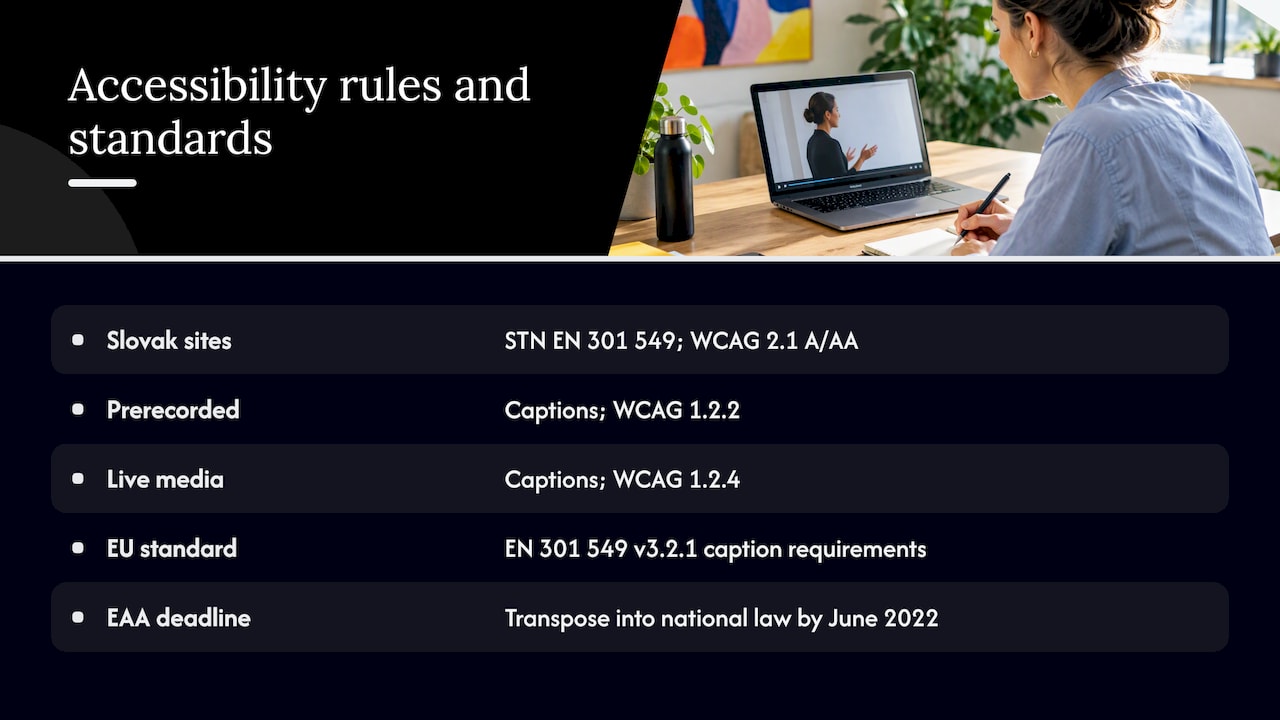
For Slovak public-sector websites, government guidance points to STN EN 301 549 and WCAG 2.1, especially levels A and AA. It says prerecorded and live synchronised media must come with captions, and names WCAG success criterion 1.2.2 for prerecorded captions and 1.2.4 for live captions.
At EU level, the European Commission’s summary of the accessibility standard lists the EN 301 549 v3.2.1 requirements that touch captions: playback, synchronisation, preservation, caption characteristics, spoken subtitles and user controls. Each comes with its own conditions, so read the detail before you promise anything to an auditor.
The European Accessibility Act is a directive meant to improve the internal market for accessible products and services. Member States had to transpose it into national law by June 2022. Whether it reaches your particular training platform depends on what you offer and to whom, so ask your legal team.
Even when no law forces you to caption internal training, an audit trail that shows people could actually follow the content is a strong argument in its own right. If you want to see how this plays out for audits, our piece on audit-ready compliance video captions in Slovakia goes deeper.
Translating for the screen, not for the page
A literal translation of a script is rarely a good subtitle. Screen space is small and reading time is short, so text has to be condensed.
SUBTLE’s quality criteria put it well: convey the source message closely, keep the register equivalent, compress where needed, and stay coherent and consistent. They also say to avoid translation, style and grammatical errors and convoluted sentences.
For compliance content that means three habits:
- Lock the terminology first. Decide how “whistleblower”, “conflict of interest” or “data controller” appear in each language, once, and reuse it everywhere. Microsoft Learn recommends a dedicated style guide for shortening, punctuation and terminology, which is a good idea for any team.
- Shorten the words, not the obligation. “You must report within 24 hours” can lose a lead-in. It cannot lose “must” or “24 hours”.
- Keep sentences whole where you can. Break lines at natural phrase boundaries so the eye does not have to rebuild the grammar.
Want a feel for regulated vocabulary? Our regulatory terminology examples show how one term can shift between jurisdictions.
Timing, line length and file format
This is where good subtitles are separated from readable-ish ones. Remember: these are guidance values from standards bodies, not Slovak statutory limits.
| Parameter | Guidance | Source |
|---|---|---|
| Lines on screen | Maximum two | Council of Europe |
| Line length | Roughly 35 to 40 characters | Council of Europe |
| Time on screen | At least 1 second, no more than 10 seconds | Council of Europe |
| Start time | 50 to 200 ms before speech | Council of Europe |
| Reading speed | Average 12 to 15 characters per second, peaks around 16 to 17 | SUBTLE |
| Maximum duration | Six seconds where possible | SUBTLE |
The EU Publications Office is stricter on speed: its transcript guidance advises avoiding more than 15 characters per second and never going above 20. SUBTLE also recommends a consistent gap between consecutive subtitles, typically two to six frames and preferably three or four.
For appearance, the Publications Office caption requirements suggest letting users customise typeface, size and colour. Its stated defaults are sans-serif, non-bold text at 22 points, white on black, with at least 3:1 contrast.
Separate file or burnt-in text?
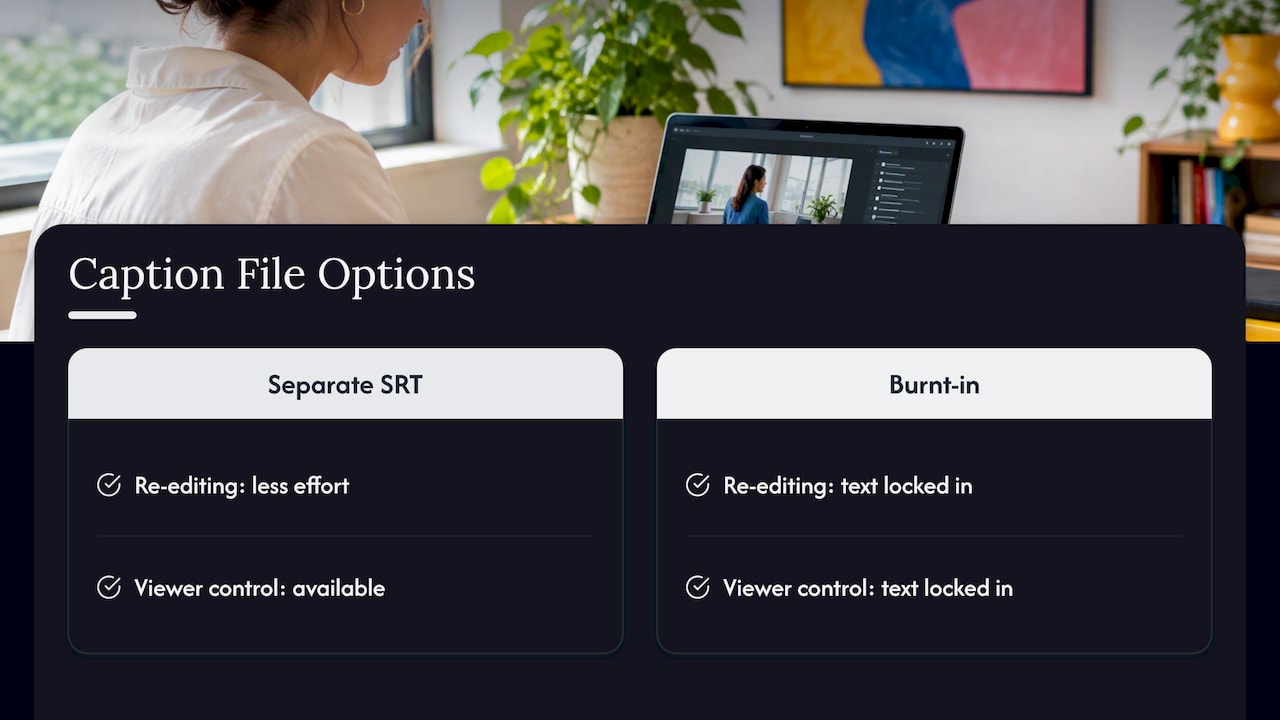
Use a separate caption file in a format your player supports. The Council of Europe notes that separate files (SRT, for example) cut re-editing effort and give viewers control, whereas embedded text is locked in. If you publish in the Slovak public-sector information environment, Decree No. 78/2020 Coll. lists standard container and compression formats, including MP4/MPEG, H.264 and Ogg Theora, so check your export settings against it.
Why auto-captions are only a first draft
Automatic captions are tempting. They are fast and cheap. But W3C WAI warns that they usually need significant editing because they may be wrong and can change the meaning. The Council of Europe goes further and describes automatic subtitles as unreliable and platform-dependent. An academic view from the University of Illinois says human review is essential, since automatic captions miss both accuracy and meaningful non-speech content.
Now picture that in a data-protection module. “Shall” becomes “should”, “not” disappears. Suddenly your training teaches the opposite of the policy. Not funny!
A quality check that holds up
Here is a simple review flow you can adopt, whoever does the work:
- Linguistic check: accuracy, coherence, consistency, register, and sensible segmentation, as the SUBTLE criteria list them.
- Subject check: a compliance or legal colleague confirms the terms and obligations are right.
- Technical check: timing, line limits, file format, and playback in the actual learning platform.
- Text conventions: the Publications Office asks for conventional spelling, no phonetic writing unless essential, inaudible speech flagged, and sounds described separately from the actions that cause them.
We go through a two-step human review in our guides on legal video captions and on compliance videos above, which is a handy template if you build your own process.
Our perspective
We have spent years working with regulated sectors, from legal and fintech to medical and defence, and one thing keeps coming up: compliance training fails quietly. Nobody complains when a subtitle is slightly off. They just learn the wrong thing.
That is why we pair modern tools with people who know the subject. Technology gives speed and consistency. Specialist linguists give judgement, so “must” stays “must” in every one of the 76 languages we work in. We think that mix is the sensible way to treat training that auditors may one day ask about.
Our advice? Agree terminology before the first line is translated, and never publish a machine draft unreviewed.
glocco®
Where glocco® comes in
If you have a library of training videos and a multilingual workforce, our video subtitling services cover subtitles and captions in many languages, with specialist teams for sector-specific content. Planning the budget? Our Slovak subtitling cost guide includes a quote checklist, so you can compare offers like for like.
FAQ
Do compliance training videos need captions by law in Slovakia?
It depends on who you are and where the video is published. Slovak government guidance requires captions for prerecorded and live media on public-sector websites under WCAG 2.1 levels A and AA. For a private company’s internal training, ask your legal team which rules apply, and consider captions good practice regardless.
Can we just use automatic subtitles?
Only as a starting point. W3C WAI says automatic captions often need significant editing because errors can change the meaning. For compliance content, have a human reviewer correct and approve every line.
How many characters per line should subtitles have?
The Council of Europe suggests no more than two lines of roughly 35 to 40 characters each. Reading speed should stay around 12 to 15 characters per second on average, according to SUBTLE. These are guidance values rather than Slovak law.
Should we use a separate subtitle file or burn the text into the video?
A separate file is usually the better choice. It is easier to edit when a policy changes and lets viewers adjust the display. Check that your player supports the format you choose.
Sources
- Captions/Subtitles, W3C Web Accessibility Initiative
- Časté otázky – (ne)diskriminácia, horizontalneprincipy.gov.sk
- Web accessibility standards: latest changes, European Commission
- European Accessibility Act, European Commission
- Recommended Quality Criteria for Subtitling, SUBTLE
- Captioning and subtitling, Microsoft Learn
- Guidelines for videos on social media and web, Council of Europe
- Transcript, audiovisual elements, EU Publications Office
- Caption requirements, EU Publications Office
- Decree No. 78/2020 Coll., Zbierka zákonov SR
- Audio and Video, University of Illinois Digital Accessibility


