


A good email campaign translation isn’t the one where every sentence is correct. It’s the one where a Slovak reader opens it, understands the offer and clicks. To get there, lock your master email first, adapt tone and variables (not just words), test everything with real data, and check the consent rules before sending. Here’s how we’d do it, step by step.
Why word-for-word translation fails in email
Email is small, fast and unforgiving. A subject line has a few words to earn the open. A button has one job. If a name appears in the wrong grammatical form, or a raw {{first_name}} shows up in the greeting, the reader notices in a second.
So think of the job as localisation, not conversion of text from one language to another. One source on cold email puts it as four layers: the language itself, the grammatical inflection of variables, tone and formality, and local business context. We like that frame, because it covers what actually goes wrong in practice.
Want the bigger picture first? Our guide to content localisation explains how translation fits into the whole process.
Step 1: Finish the master email before you add languages
Translating a moving target is expensive. Every design tweak after translation means touching every language version again. The documentation of one email platform recommends finalising the master campaign structure and content before adding languages, so you keep a single source of truth for updates.
Before handing anything over, prepare:
- the final master template, with copy approved
- a list of every recipient-visible field: subject line, preheader, body, buttons, alt text, footer
- a list of variables and what they hold (name, city, company, product)
- a short brief: audience, goal, brand voice, formal or informal address
- a glossary of product names and terms that stay in English
Our language localisation checklist goes deeper on this kind of prep.
Step 2: Decide on tone, formality and transcreation
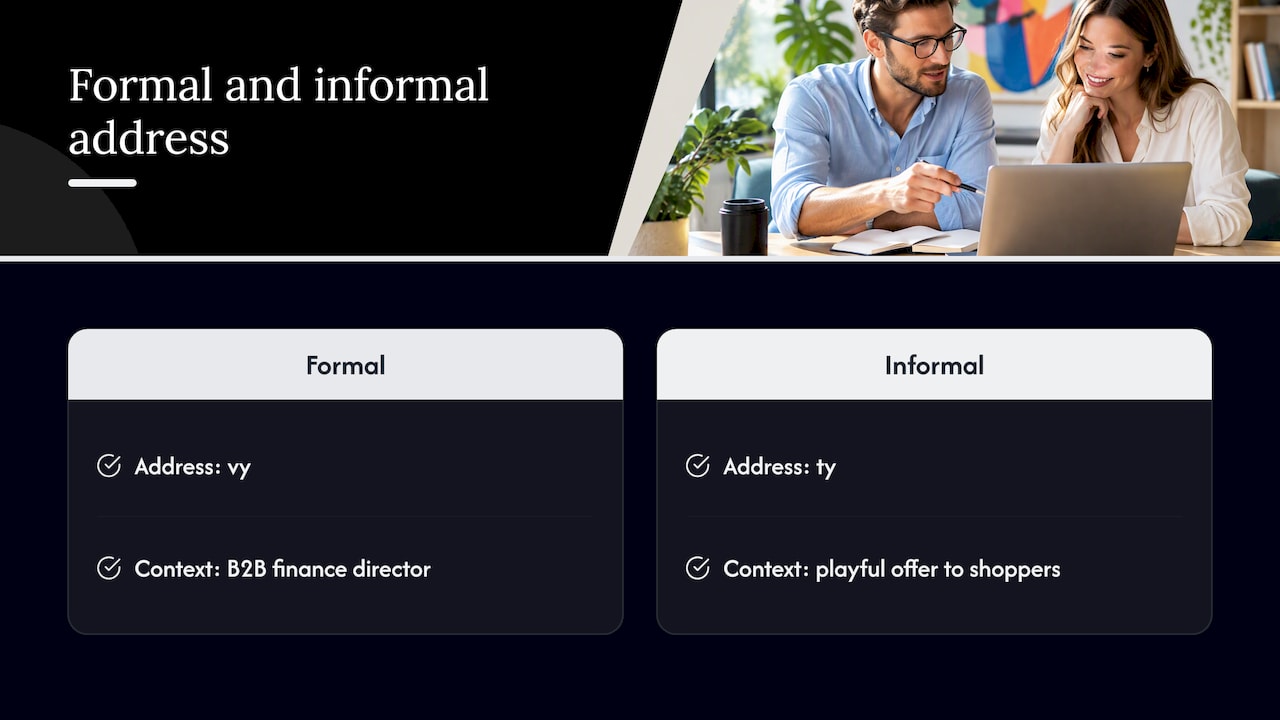
Slovak has a formal “vy” and an informal “ty”. Choose before translation starts, not during review. B2B to a finance director and a playful offer to online shoppers need different answers. An academic paper on transcreating slogans in Slovak says the client should specify whether the text is formal or informal, and notes that rhythm and rhyme can make Slovak slogans more memorable.
That’s where transcreation comes in. For headlines, subject lines and campaign hooks, a literal translation often reads flat. Transcreation rebuilds the message so it has the same emotional effect in Slovak. If your campaign leans on puns, idioms or humour, this is the route. Our piece on transcreation for marketing, briefing and A/B tests shows how a good brief saves rounds of rewriting.
Heads up: what’s funny in English can be baffling in Slovak. (We’ve seen it. Nobody laughed.)
Step 3: Handle each email element on its own terms
| Element | What to do |
|---|---|
| Subject line | Translate it and write it fresh in Slovak. Don’t just match the length of the English one. |
| Preheader | Treat it as a second subject line. It should add information, not repeat the first. |
| Body copy | Allow for text expansion. Slovak sentences often come out longer or shorter than English, so use flexible text areas. |
| Buttons (CTAs) | Use real text buttons, not images. Bulletproof buttons stay visible when images are blocked. |
| Images | Don’t bake essential text into them. Translate alt text and replace text-bearing visuals. |
| Fonts | Pick fonts that support Slovak characters such as č, š, ž, ď, ľ and ô. |
| Dates, numbers, currency | Use Slovak conventions: 30. 10. 2026, 1 200,50 €. |
One more design tip: international templates work best with simple layouts and text-based content wherever possible. Simple templates are easier to translate, easier to test and easier to keep in sync.
If you’re building templates for several languages from scratch, email templates for digital products is one angle on setting up follow-ups that you can adapt per market.
Step 4: Treat personalisation as a translation problem
This is the one that catches people out. Slovak inflects nouns and names. “Hello, Peter” becomes “Ahoj, Peter”, but address him in the vocative where it fits, or rework the sentence, and you avoid awkwardness. Insert a city or industry into a sentence and the case ending changes: “v Bratislave”, “do Košíc”, “v oblasti fintechu”.
A single variable can’t do that. Guidance on cold email localisation lists inserting city or industry variables in the wrong grammatical form as a common mistake, and the fix is to test the email and check the inflected variables. In practice that means:
- Rewrite the sentence so the variable sits in a neutral position (“Pozdravujeme vás z Bratislavy” can become “Naši klienti z mesta: Bratislava”).
- Or store the inflected forms as separate fields.
- Keep tags, URLs and template syntax untouched. Only the visible text and fallback wording get localised, as template documentation describes.
Always write a fallback for empty fields. “Dobrý deň,” beats “Dobrý deň, !” every time.
Step 5: Review and test before sending
Grammar-perfect isn’t the finish line. One review guide argues the decisive test is whether the customer can make the intended decision: what they receive, who qualifies, what it costs and what to do next. We agree. Ask a Slovak-speaking reviewer to read the email cold and tell you what they’d do.
Then run a technical check. The same template guidance suggests testing:
- long names and missing variables
- that no raw tokens appear
- dates, numbers, currencies and plural forms
- mobile and desktop wrapping
- images blocked, with alt text visible
- every CTA and footer link
- seed sends to the mailbox and client combinations your audience uses
Tick them all, and only then schedule.
Step 6: Check the rules for sending to Slovak recipients
Translation doesn’t change the legal side, but it does mean the footer, consent wording and unsubscribe text must be in Slovak too. This isn’t legal advice, so ask your data protection officer or lawyer about your case. The basics:
- Under the EU ePrivacy Directive, direct-marketing email generally needs prior consent. The exception covers similar products or services to existing customers, and they must be able to object easily at collection and in every message.
- Under Slovakia’s Act No. 18/2018, if you rely on consent, you must be able to show it was freely given, specific, informed and unambiguous. It can be withdrawn at any time, and people can object to direct marketing at any time.
- Slovak consumer guidance points to Act No. 351/2011 on electronic communications for the consent rule and its exception for a seller’s own similar products.
Practical result: the unsubscribe link, your company details and the privacy policy link all need proper Slovak text, and the consent checkbox wording needs the same care as the subject line.
Our perspective
We see the same pattern again and again: teams translate the copy and forget the campaign. The subject line is translated, but the button breaks, the variable is in the wrong case and nobody on the Slovak side saw the final render.
That’s why we pair human linguists with AI-supported workflows, and why we ask for the brief, the glossary and the template up front. For creative hooks we’d reach for transcreation. For high-volume sequences, a tight process with in-context review. Our teams work across industries from e-commerce to fintech and legal, so tone and terminology get matched to your sector.
Email is small, but it’s where trust is won or lost in a few seconds. We’d rather you sound like a local than like a translation.
glocco®
Common mistakes to avoid
- Translating before the master is final. Every late change multiplies across languages.
- Mixing “vy” and “ty”. Pick one and put it in the style guide.
- Text inside images. It can’t be reliably translated and hurts accessibility.
- Untested variables. Test with long names, empty fields and inflected city names.
- English footers. Unsubscribe and privacy text should read naturally in Slovak.
- Skipping the decision test. Ask: can the reader act on this?
Where glocco® fits in
Got a campaign heading to Slovak inboxes? Our HumanCreative service is built for marketing copy that needs to sound native, while HumanPro suits more routine, high-volume content. Not sure which fits? Tell us about your sequence and we’ll point you to the right workflow via glocco.com. For the wider strategy, see our localisation strategies for EU business.
FAQ
Should I translate the subject line separately?
Yes. Treat it as its own piece of copy, not a by-product of the body. Length, tone and hook all change in Slovak, so write it fresh, then test a couple of variants if your list is big enough.
Is machine translation good enough for email campaigns?
It can help with speed on simple, low-risk content. For subject lines, offers and brand-voice copy, a human linguist should review or rewrite, because the message has to land and the variables have to read correctly. Our piece on AI in localisation covers how we combine both.
Do I need consent to email Slovak businesses and customers?
In general, EU rules require prior consent for direct-marketing email, with a limited exception for similar products or services sold to existing customers. Recipients must be able to opt out easily in every message. Check your exact situation with a lawyer.
Formal or informal address in Slovak emails?
It depends on your audience and brand. B2B and regulated sectors usually lean formal (“vy”), while lifestyle and e-commerce brands often go informal. Decide once, write it in the brief, and keep it consistent across the whole sequence.
Sources
- Translation | Better Email Documentation
- Ako lokalizovať cold email pre viacero krajín | DataSend.ai
- Ácsová, Transkreácia reklamných sloganov (2022)
- Email Marketing Translation: Guide to Multilingual Emails
- Template Translations for Transactional Email Teams
- Kontrola překladu e-mailu: ověřte rozhodnutí
- EUR-Lex: Directive 2002/58, Article 13
- Act No. 18/2018 on personal data protection
- Nevyžiadaná pošta, Spoločnosť ochrany spotrebiteľov
- Email Marketing for Digital Products


