


Here’s a bold one: your fintech model is only as clever as the labels it learned from. Data annotation for fintech means humans (backed by good tooling) tagging and labelling financial text, documents, transactions and speech so a model can learn from them. Do it well and fraud flags, KYC checks and chatbots behave. Do it badly and you pay for it twice, once in the model and once in the audit.
Let’s walk through how to set it up, step by step. We’ll keep it friendly. We promise.
Where fintech actually uses annotation
Annotation shows up wherever a model has to read something messy and decide what it means. Typical fintech jobs:
- Document extraction. Marking names, IBANs, amounts and dates on invoices, statements and ID documents.
- Text classification. Sorting customer messages into complaint, fraud report, card issue or general question.
- Entity recognition. Finding companies, products, currencies and people in news, filings and contracts.
- Sentiment and intent. Labelling how clients feel and what they want in chats and call transcripts.
- Transaction labelling. Tagging transactions as normal, suspicious or needing review.
- Speech data. Transcribing and labelling calls for compliance monitoring.
Not all of this is plain text. If your product speaks several languages, the labelling team has to as well. That’s where a language specialist earns its keep.
Define labels before anyone labels anything
Most annotation problems are really instruction problems. Two people read “suspicious” differently and your dataset quietly contradicts itself.
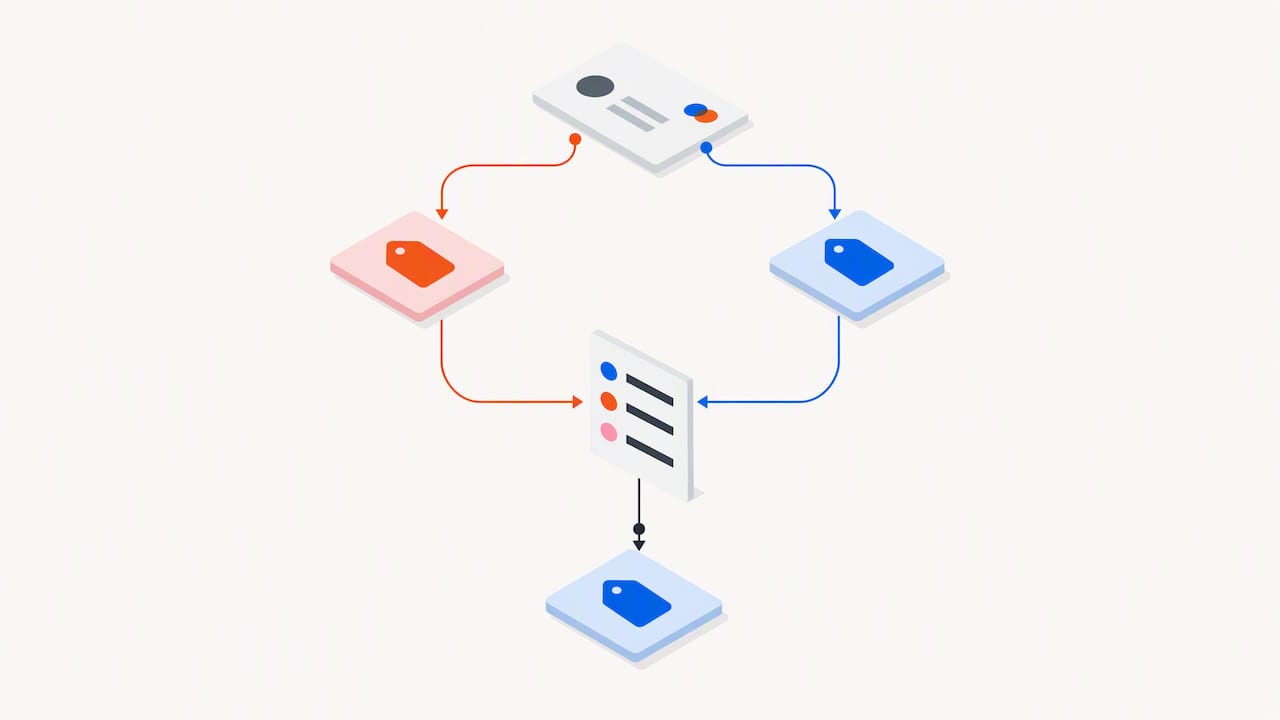
Good annotation guidelines define the elements and labels, specify the unit to be tagged (a word, a phrase, a block of text), include examples and cover edge cases. Write all four down before the first batch.
A few habits that help in finance:
- Keep a short label list. Twelve clear labels beat forty fuzzy ones.
- Define the unit. Is “€1 200,50” one amount token or three? Decide once.
- Show edge cases. A refund that looks like a payment. A joint account. A company name that is also a surname.
- Put the guidelines inside the tool. Research on managing annotation projects says guidelines should be accessible in the annotation tool and fitted to the project’s complexity and the type of workforce.
Need a pilot? Label 100 items, argue about the odd ones, then update the guide. It’s boring. It saves weeks.
Slovak-language data needs its own plan
Slovak is a morphologically rich language. One word shows up in many forms (“účet”, “účtu”, “účtom”), and financial slang, abbreviations and mixed Slovak-English phrases are everywhere in real client messages. So:
- Decide whether labels apply to the surface form or the base form.
- Give annotators examples of Slovak, Czech and English code-switching, because clients mix them.
- Use native Slovak speakers who also understand financial terms. A generalist will mislabel “poistné plnenie” or “ručenie” with confidence.
- Keep a glossary and update it when products change.
The same goes for any other EU language you add. If you also localise your app or documentation, the glossary can be shared between both jobs. Our guide on EU fintech localisation focused on compliance shows how.
Protect personal data before it reaches annotators
Financial data is personal data, so GDPR applies from the first export. The principle to remember is data minimisation: personal data must be adequate, relevant and limited to what is necessary for the purpose. The EDPB also recommends technical tools so providers see only the specific fields they need.
In practice:
- Strip what the task doesn’t need. Labelling sentiment? The IBAN stays out.
- Anonymise or pseudonymise first. The EDPB treats anonymisation as an alternative to deletion, as long as context is considered and re-identification risk is assessed regularly. Do not tick it once and forget it.
- Limit access. Role-based access, encrypted transfer, no files on personal laptops.
- Log who saw what. You’ll want that trail later.
The EU AI Act points the same way for high-risk systems: technical measures such as encryption and pseudonymisation, plus human oversight. If you need a step-by-step method, our GDPR anonymisation playbook covers it.
Review, disagreement and quality assurance
One annotator labelling alone gives you speed and no safety net. A better flow follows the reading, annotation and review passes described in annotation best practice. For double annotation, two people label independently, then an adjudicator reconciles the differences.
Disagreements are useful, not annoying. If two good annotators split on a label, either the guideline is vague or the data is genuinely ambiguous. Fix the guideline, add the case to the examples, move on.
A simple cycle:
- Pilot batch, full double annotation.
- Adjudication and guideline update.
- Production batches, double annotation on a sample.
- Regular spot checks by a senior reviewer.
Want a formal check? Here is what an annotation quality audit is and how to run one.
Metrics that show your dataset is good
The BIS names accuracy, completeness and representativeness as data-quality dimensions that affect AI performance, reliability and fairness. Slovakia’s central bank (NBS) lists accuracy, completeness, timeliness, consistency and interpretability as essential, and describes data cleaning as applying standardised rules to problem elements.
Turn those into checks you can run:
| Dimension | What to check | Example check |
|---|---|---|
| Accuracy | Do labels match the guideline? | Senior reviewer re-labels a random sample and compares |
| Completeness | Is anything missing? | Share of records with every required field labelled |
| Consistency | Do annotators agree? | Agreement rate between double-annotated items |
| Representativeness | Does it cover real cases? | Mix of products, languages, channels and rare events |
| Timeliness | Is it current? | Age of the newest data versus product changes |
There is a regulatory reason to care too. For high-risk AI in finance, such as creditworthiness assessment, the AI Act requires datasets that are relevant, representative and, as far as possible, free of errors and complete.
If you want to dig into the wider topic of dataset quality and governance across the AI lifecycle, that’s a good next read.
Documentation you should keep
The NBS notes that the EU AI Act brings transparency, risk-management and ethical requirements and applies to financial institutions in Slovakia that use AI tools. The Act also requires providers of high-risk systems to run data governance and management practices across the lifecycle. So keep a paper trail:
- Current and past versions of the guidelines and label list.
- Where the data came from and what was removed or anonymised.
- Who annotated, who reviewed, and when.
- Agreement scores and audit results per batch.
- Decisions on edge cases, with the reason.
If a supervisor or your own risk team asks “why does the model think this?”, this folder is your answer.
Our view: treat labels as a product
Here’s where we stand at glocco®: an annotated dataset is not a one-off purchase. It’s a product with an owner, a changelog and a quality bar. Products change, regulations change, Slovak customers invent new slang overnight. So the guidelines, glossary and sample checks should live as long as the model does.
We also believe the right people matter more than the fanciest tool. Language specialists who know the sector spot the weird cases early. Technology then handles the repeatable bits, and humans handle judgement. That mix of modern tooling and proven localisation practice is how we’ve worked since 2014.
— glocco®
Want help with your fintech data?
glocco® supports teams with data annotation, plus data collection and validation, across 76 languages and with specialist teams for fintech and other regulated sectors. Not sure what a project would cost to buy? Read our pricing models and GDPR-ready cost template first, then tell us about your dataset.
FAQ
What is data annotation in fintech?
It is the process of tagging and labelling financial data, such as documents, messages, transactions and call recordings, so machine learning models can learn from it. Typical uses are document extraction, fraud and risk flags, intent detection and compliance monitoring.
Can we send real customer data to an annotation provider?
Only if the data is limited to what the task needs and protected properly. Remove or pseudonymise identifiers first, restrict access, and document the process. Your data protection officer should sign off the setup before the first batch goes out.
How many annotators should review each item?
It depends on risk. For high-stakes labels, double annotation with adjudication is the safer route. For lower-risk labels, a single pass with sample checks by a senior reviewer may be enough.
Does Slovak need special handling?
Yes. Rich word forms, financial jargon and mixed Slovak-English phrases call for native annotators who know finance, a shared glossary and examples of those mixed cases in the guidelines.
Sources
- Data Annotation Best Practices Guide
- Best Practices for Managing Data Annotation Projects
- EDPB Guidelines 06/2020 on PSD2 and the GDPR
- EDPB guidelines on data protection by design and by default
- Regulation (EU) 2024/1689, EUR-Lex
- BIS: In data we trust?
- NBS: BACH Database and its Possible Use
- NBS: Report on the Innovation Hub and Regulatory Sandbox


