An audit kvality anotácie, or annotation quality audit, is the systematic review, validation and measurement of labels in your training data to check they’re accurate, consistent and fit for purpose. That’s it. No mystery here.
Before you dive into a full audit, run this quick checklist:
- Sample-based error-rate check: pull a statistically valid sample and score it against your guidelines.
- Inter-annotator agreement spot-check: get two or more annotators to label the same slice and compare.
- Provenance and metadata check: confirm every label has a traceable source, timestamp and annotator ID.
For procurement teams, don’t accept a vendor’s word for it. Ask for auditable records, the sampling method used, and a confidence interval on the reported error rate. If they can’t produce those three things, you’re buying a black box.
The core annotation quality dimensions auditors must evaluate
Not all quality problems are equal, and treating them that way wastes your audit budget. Five dimensions matter most, and each one maps to a different flavour of downstream model risk.
- Accuracy — do the labels match ground truth? Get this wrong and your model learns the wrong lesson from day one.
- Representativeness — does the labelled sample reflect the real-world distribution your model will see in production?
- Consistency — do similar inputs get similar labels, across annotators and over time?
- Completeness — are all required fields, edge cases and rare classes actually covered?
- Timeliness — is the labelling schedule keeping pace with your model’s release cycle, or is drift creeping in while you wait?
Add a sixth for regulated sectors: privacy and compliance, meaning labels don’t leak sensitive attributes and handling matches your legal obligations.
Statistic callout: the METRIC-framework, built for medical ML datasets, identifies 15 distinct data-quality awareness dimensions. It flags representativeness, feature importance, distribution consistency and human-induced error as the ones that most strongly shape downstream model behaviour when time or budget forces a trade-off.
If you’re buying annotation for anything touching health, finance or safety, don’t just ask “is it accurate?” Ask specifically about representativeness across subgroups and how human-induced error gets tracked. That’s where the real risk hides.
When and how to run the audit: batches, sampling and statistics
Auditing everything, every time, is a fast way to burn your budget on nothing. The smarter play is agile batches: annotate a slice, audit it, fix what’s broken, then move to the next slice with an updated guideline.
Here’s a practical cadence:
- Label a batch (say, 2,000 to 5,000 items depending on your pipeline speed).
- Pull a statistically grounded sample for review, not just “the first 50 we noticed.”
- Calculate error rate with a confidence interval, not a bare percentage.
- Feed findings back into annotator guidelines before the next batch starts.
Choosing between full inspection, confidence-interval sampling, and acceptance sampling comes down to cost versus precision. Full inspection gives you certainty but costs the most. Confidence-interval sampling gives you a defensible error-rate estimate with a known margin. Acceptance sampling goes further: it can cut required inspection sample sizes by up to roughly 50% while offering comparable statistical guarantees, making it the practical choice for repeated batch accept/reject decisions.
Pro Tip: For a 10,000 item batch where you need 95% confidence and a 5% margin of error, a simple random sample of around 370 items is a solid starting point. If you’re running dozens of batches, switch to acceptance sampling once you’ve established a baseline error rate. It saves real money without loosening your standards.
Concrete metrics and thresholds for IAA and error rates
You can’t manage what you don’t measure, and “looks fine to me” isn’t a metric. Two numbers do the heavy lifting in any annotation quality audit:
- Inter-annotator agreement (IAA): Cohen’s kappa for two annotators, Fleiss’ kappa for three or more. A kappa value above a high threshold generally indicates strong agreement; a lower value usually means guidelines are ambiguous, not that annotators are careless.
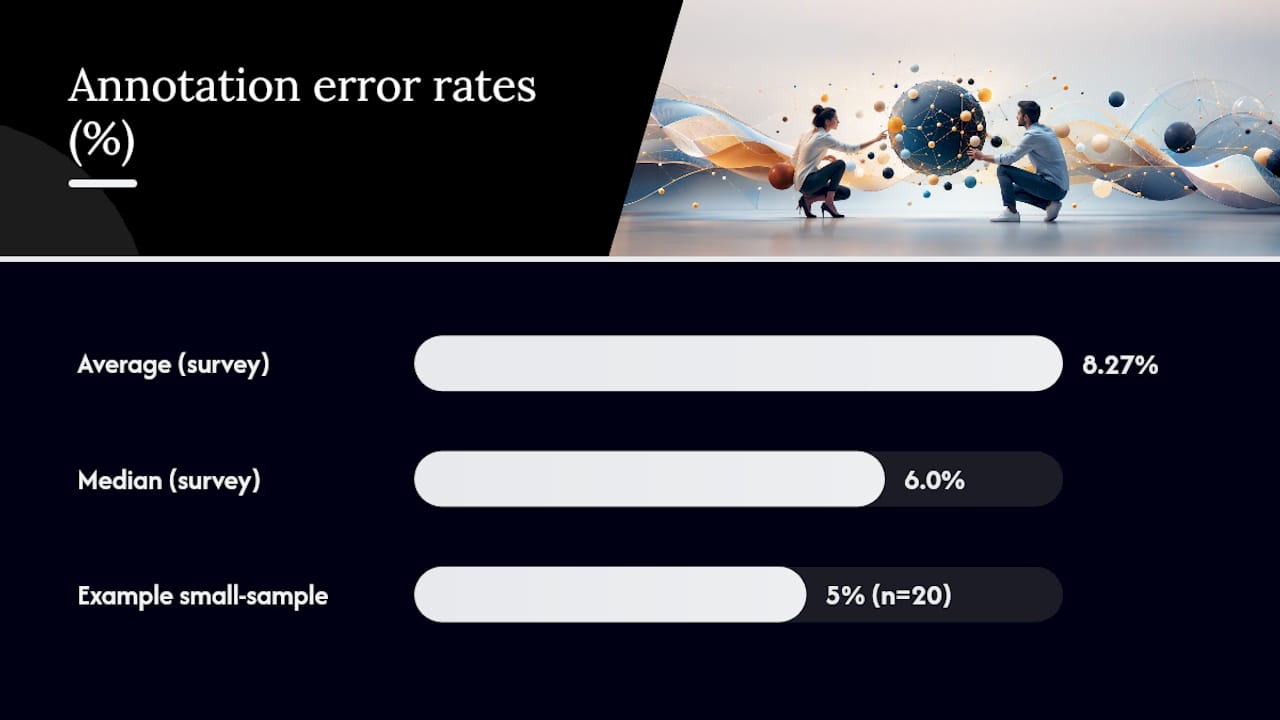
- Error rate: never report this as a bare number. Pair it with sample size and a confidence interval, because a 5% error rate from 20 items means something very different from 5% out of 2,000.
Surveys of real annotation projects found the average reported error rate sits around 8.27%, with a median closer to 6.0%, and that many projects still rely on small, ad-hoc samples rather than statistically grounded ones. That’s the bar you’re trying to beat.
When IAA is low, you need adjudication, and the method you pick has trade-offs:
| Adjudication method | Speed | Reliability | Best for |
|---|---|---|---|
| Majority vote | Fast | Moderate | High-volume, low-ambiguity tasks |
| Expert adjudication | Slow | High | Regulated or safety-critical data |
| Probabilistic aggregation | Moderate | High | Large annotator pools with known skill variance |
Present every audit result as rate, confidence interval, sample size and a remediation plan together. Anything less is a number without context.
Tools and automation that reduce cost and improve audit coverage
Manual review alone doesn’t scale, but throwing automation at the problem blindly doesn’t work either. The trick is combining the two properly.
- Data profiling and deduplication: techniques like MinHash and n-gram overlap catch near-duplicate records before they inflate your dataset with redundant signal.
- Encoding normalisation: catch silent formatting drift (different date formats, inconsistent Unicode) that quietly corrupts downstream consistency checks.
- Label-noise detection: benchmarking approaches such as AQuA show that cleaning methods perform very differently depending on data modality and noise type, so match your tooling to your actual data, not a generic default.
- Provenance and metadata capture: auditable records matter more now than ever, with EU AI Act obligations pushing high-risk systems towards documented, traceable training data.
- Expert review for ambiguous cases: automation flags candidates; humans still make the final call on genuinely unclear items.
A tool like Glocco’s AI-supported translation and localisation workflows shows how automated checks and human review work together at scale, rather than replacing one with the other.
Turn audit findings into fixes: remediation, gates and monitoring
An audit that produces a report nobody acts on is a wasted audit. Findings need to trigger specific, structured responses.
- Relabel the batch items that failed review.
- Update guidelines where ambiguity, not carelessness, caused the errors.
- Retrain annotators on the specific error patterns you found, not generic refreshers.
- Set quality gates: define accept/reject thresholds for each batch based on your sampled error rate and acceptance-sampling outcome, before the next batch starts.
Once labels ship, the job isn’t done. Set up drift monitoring to catch distribution shifts in production data, and schedule periodic re-audits rather than treating quality as a one-off tick box.
Pro Tip: Ask any annotation vendor for a machine-readable QA report, not just a summary email. Standards like LQS v3.1 propose cryptographically verifiable certificates for exactly this purpose, giving procurement teams evidence they can actually check rather than take on trust.
What glocco® sees when auditing annotation quality for clients
We’ve been in the language and data business since 2014, and the same lesson keeps repeating: quality problems are cheaper to catch early than to fix after deployment. Our translation QA workflows and certified interpreter network taught us that structured review beats gut feeling, every single time. We apply the same discipline to AI annotation work.

A typical pilot with glocco® runs a small batch through sampling, IAA checks and adjudication, then hands back a remediation plan with documented evidence, not a vague “looks good” email.
If you’re vetting vendors, ask them: what’s your sampling method, what’s your IAA threshold, and can you show me a QA report? Their answers tell you more than any sales pitch ever will.
Want a pilot audit before you commit to a full annotation contract?
Here’s the thing: most annotation vendors will tell you their quality is great. Few will hand you an auditable report proving it. That’s the gap Glocco fills.
We run a starter pilot audit: sample your existing annotations, measure IAA and error rate with proper confidence intervals, then hand you a clear remediation plan you can act on immediately. No vague reassurances, just documented evidence you can put in front of your own compliance team.
Our approach borrows from the same rigour we apply to translation quality assurance, so you get governance you can actually show an auditor, not just a nice PDF.
Curious what a pilot looks like for your data? Get in touch and explore our AI-powered translation and annotation services to see how the engagement typically unfolds, timeline and all.
Sources
- On efficient and statistical quality estimation for data annotation (arXiv 2405.11919)
- The METRIC-framework for assessing data quality for trustworthy AI in medicine (PMC)
- AQuA: Automated label quality assessment benchmark (arXiv 2306.09467v1)
- Analyzing dataset annotation quality management in the wild (arXiv 2307.08153v2)