


Localisation of financial applications means translating and adapting every user touchpoint, from onboarding screens to legal disclosures, so an app works correctly and legally in a new market. Get the words right but the date format wrong, or the tone friendly but the consent clause legally void, and the app risks failure. The single priority for any product, compliance or engineering lead running this project is accuracy: correct legal language under GDPR and PSD2/PSD3, paired with locale-correct number, date and currency formatting, every single time.
What should be on your fintech localisation checklist first?
Not every screen deserves the same attention on day one. A sensible MVP focuses on the four areas where mistakes cost the most, either in lost trust or in legal exposure.
- Transaction flows — payment confirmations, transfer summaries and balance displays get localised first because users read these obsessively and any ambiguity here erodes confidence fast.
- KYC and onboarding — identity checks and account setup involve legally binding statements, so these strings need careful, consistent phrasing across languages.
- Regulatory disclosures — fee schedules, interest terms and consent language must go through legal review before anything ships; there’s no shortcut here.
- Fraud and error messaging — a confusing error during a failed payment is exactly when users panic and abandon the app, so clarity matters more than brevity.
Flag early which strings are legal (never machine-translated without human sign-off) and which are safe for machine-assisted drafting, like marketing copy or onboarding tips. Then build minimal test cases covering currency formats, decimal separators, date and timestamp display, and payment-method labels to reduce errors. Getting this shortlist right saves weeks of rework later, and it mirrors what a solid language localisation checklist should already cover.
How do GDPR and PSD2 affect your localisation approach?
GDPR and PSD2 (with PSD3 tightening things further) both demand clear, local-language consent and disclosure. That’s not a nice-to-have. Regulators expect users to genuinely understand what they’re agreeing to, and ambiguous translations can render consent legally invalid, which is about as expensive a localisation mistake as you can make.
Here’s the practical risk: a mistranslated fee clause or a vague consent checkbox doesn’t just annoy users. It can expose the business to regulatory penalties and unenforceable terms.
The controls that actually work:
- Legal sign-off on every regulatory string before release, not after.
- A documented audit trail showing who approved what, and when.
- A single jurisdictional source text per market, so translators aren’t working from a moving target.
- Clear versioning and update procedures whenever regulation changes.
Pro Tip: Treat your privacy notices the same way you’d treat a contract. If your informed consent translation isn’t reviewed by local counsel, don’t assume the machine-translated version will hold up if a regulator asks questions.
What technical rules protect your finance app during localisation?
Get the data model wrong and no amount of good translation saves you. Store every monetary amount with an explicit currency code and in the smallest unit (cents, not euros), and use decimal-safe numeric types rather than floats. Floating-point rounding errors in financial calculations are exactly the kind of bug that looks fine in testing and causes a support ticket storm in production.
Formatting belongs at the display layer, not baked into storage. A few rules worth locking into your codebase:
- Use locale-aware formatting libraries (
Intl.NumberFormat, date libraries) at render time, never at storage time. - Attach UTC timestamps to every transaction for audit consistency, regardless of the user’s local timezone.
- Handle zero-decimal currencies (Japanese yen, for example) as a special case, not an afterthought.
- Keep business logic completely separate from presentation logic, so a formatting change never touches a calculation.
- Feed localisation keys straight into your CI/CD pipeline, and give translators context, screenshots, component names, character limits, rather than a spreadsheet of naked strings.
Namespace structures also let you swap terminology by regulatory framework: the same term might need a different translation depending on whether you’re operating under IFRS or a local GAAP standard, and a well-built glossary system flags that automatically rather than leaving translators to guess.
How do you keep financial terminology consistent across languages?
Trust in a finance app lives or dies on tiny words: “available balance,” “pending,” “interest accrued.” Get these inconsistent across screens and users start second-guessing whether the app actually works.
Build a shared glossary and translation memory covering regulator-specific terms and acronyms, and keep it as the single source of truth every translator works from. Pair that with real visual context.
- Give translators screenshots or wireframes, not isolated strings, because word length and meaning both shift depending on where text sits on screen.
- Set character limits upfront, especially for mobile, where a translated string running 40% longer than English (common in German or Finnish) can break a button.
- Flag ambiguous phrases with examples, so translators aren’t guessing what “balance” means in three different contexts.
- Require sign-off from a compliance or legal reviewer on any microcopy touching fees, interest or available balance, since these numbers shape user decisions directly.
The most workable model here is hybrid: machine-assisted first drafts for volume, human legal review for anything a user might rely on to make a financial decision, supported by a French AI content generator for multilingual content needs. That balance of speed and liability is what makes hybrid workflows the sensible default rather than an either/or choice.
What does a continuous localisation workflow look like?
Fintech products ship updates constantly, and your localisation process has to keep pace without becoming the bottleneck.
- Connect your translation management system to your codebase via API, so new strings flow in automatically rather than through manual exports.
- Use translation memory to avoid re-translating repeated terms, and set approval gates in CI/CD so nothing ships without the right sign-off.
- Build a testing matrix covering locale-specific payment scenarios, formatting edge cases, right-to-left script handling where relevant, and fraud message clarity under pressure.
- Keep audit logs and versioned legal text for every release, because regulatory changes sometimes need same-day updates and you need to prove what changed and when.
- Maintain a rollback procedure and a rapid hotfix channel specifically for regulatory text, separate from your normal release cadence.
This is where a proper localisation workflow pays for itself. Ad hoc processes work fine for five strings. They fall apart at five thousand.
How much should fintech localisation actually cost?
Budgets scale in stages, and pretending otherwise sets teams up for a bad surprise. An MVP covering one or two priority markets costs the least; expanding to additional locales adds glossary work and legal review per market; ongoing maintenance (regulatory updates, new features, continuous QA) becomes a recurring line item, not a one-off project.
- In-house works if you already have bilingual compliance staff and low update frequency.
- Vendor-managed suits teams scaling into several markets at once without the headcount to match.
- Hybrid (AI plus human review) tends to be the practical middle ground for regulated content that changes often.
Track time-to-localise, translation defect rate, how often legal has to revise text after release, and user activation in each new locale. Those four numbers tell you more than any invoice will, and they’re a solid starting point for building the business case referenced in most localisation ROI discussions.
How do you localise customer support and dispute resolution?
Support tickets are where localisation gets tested for real. A translated app that breaks down the moment a user tries to dispute a charge in their own language has failed at the one moment that matters most.
Dispute resolution language carries the same legal weight as onboarding consent, arguably more, because it directly affects money already in motion. Every locale needs localised, legally reviewed templates for common scenarios: unauthorised transactions, failed transfers, chargebacks. These templates shouldn’t be improvised by a support agent mid-conversation; they should be pre-approved, versioned, and available in the same tone across every channel, chat, email, in-app messaging.
Staffing is the harder question. Some fintechs run native-language support teams per market; others use translation layers on top of a centralised team. Either way, agents need access to the same glossary translators use, so “chargeback” doesn’t become three different phrases depending on who’s answering. Regulatory timelines for dispute responses also vary by market, and your localised copy needs to reflect the correct deadline language for that jurisdiction, not a generic placeholder.
Get this wrong and the cost isn’t just a bad review. It’s a user who assumes, reasonably, that a company that can’t explain a dispute clearly in their language probably can’t be trusted with their money either.
Does cultural adaptation matter beyond the words themselves?
The harder part is everything that isn’t text: colour, imagery, financial norms, layout conventions that carry meaning users absorb without reading a word.
Colour is the classic trap. Green means “go” or “positive balance” in most Western markets, but financial risk colours don’t map universally, some East Asian conventions treat red as auspicious rather than alarming, which matters if your app uses red for warnings or negative balances. Imagery matters too: a stock photo of a family in front of a suburban house selling a mortgage product reads very differently depending on local homeownership norms and family structures.
Financial behaviour itself varies by market in ways that affect UX decisions, not just copy. Instalment payments are the default expectation in some regions and a niche feature in others. Cash-based habits shape how comfortable users are with fully digital onboarding. Credit scoring concepts that feel obvious in one market are unfamiliar, or viewed with suspicion, in another.
None of this shows up in a standard translation brief, which is exactly why it gets missed. A localisation process built purely around swapping words for other words will ship a translated app that still feels foreign, and “feels foreign” is precisely the sentiment that makes users abandon a payment flow before they finish it.
What data residency rules apply to fintech localisation?
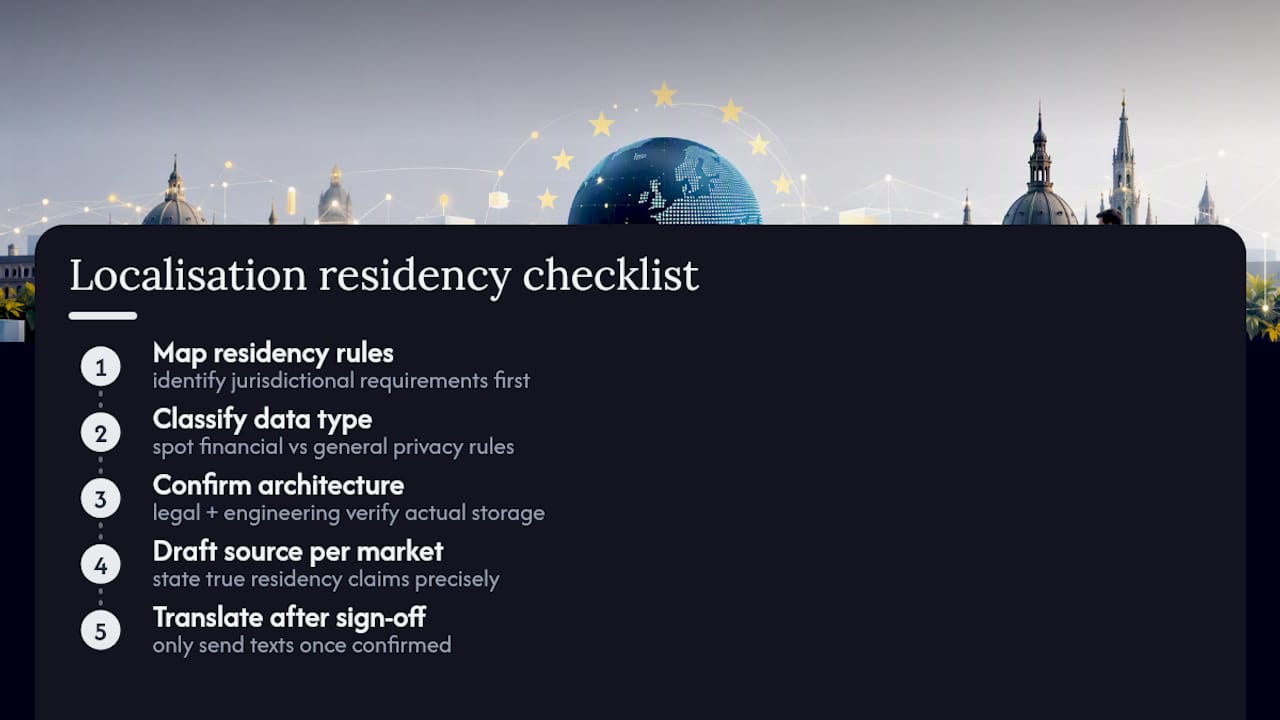
Privacy law doesn’t just dictate what your consent text says, it dictates where the data behind that consent physically lives. Data residency requirements differ by jurisdiction, and getting this wrong is a compliance failure that no amount of good translation fixes.
Within the EU, GDPR sets baseline requirements for data handling, but individual member states can layer additional rules on top, particularly for financial data, which often falls under sector-specific regulation alongside general privacy law. Markets outside the EU frequently mandate that certain categories of financial data stay within national borders entirely, regardless of where your servers are otherwise located.
This matters directly for localisation teams because translated consent language has to accurately reflect where data actually goes. A privacy notice that says data “may be processed internationally” when your architecture actually stores everything locally isn’t just imprecise, it’s a misrepresentation that regulators can flag. The reverse is worse: promising local storage you don’t actually provide.
Practically, this means your legal and engineering teams need to align before translation even starts. Localisation can’t invent compliance your infrastructure doesn’t support, and it shouldn’t paper over infrastructure gaps with vague language either. Build your source text market by market, confirm the residency claims with whoever owns your data architecture, and only then send it for translation. Skipping that step is how apps end up quietly non-compliant in a market nobody checked properly before launch.
Should you localise for languages or for dialects within one market?
A single country rarely speaks with one voice, and treating a market as linguistically uniform is a common localisation mistake. Switzerland alone runs German, French, Italian and Romansh officially. Belgium splits between Dutch and French with real regional sensitivity attached. Even within a single official language, regional vocabulary for financial terms can differ enough to confuse users, “current account” versus regional banking terms is a familiar example.
The question isn’t whether to localise for every dialect, that’s rarely proportionate, but where dialect differences intersect with legal or financial meaning. A term that’s colloquial in one region and formally defined in another needs deliberate handling, not a single blanket translation. Your glossary should flag these cases explicitly rather than leaving translators to pick whichever variant feels natural.
Practically, most fintechs pick one standard variant per official language for a market and accept that some regional flavour gets lost. That’s a reasonable trade-off, provided legal and financial terminology, the parts that actually carry risk, stay precise regardless of dialect. Where a market has genuinely distinct regulatory zones tied to language (federal systems, for instance), treat each as close to a separate localisation project as your resources allow.
How do you keep localisation current after launch?
Launch day is the easy part. Regulations change, products add features, and your localised content needs a maintenance process, not a one-off delivery.
The teams that handle this well treat regulatory text as a living, versioned asset rather than a document that gets translated once and forgotten. Every regulatory change triggers a defined workflow: legal reviews the new source text, translators receive it with full context, compliance signs off before release, and the update ships through the same CI/CD gates as any other content change. Same-day regulatory updates aren’t a luxury in fintech, they’re occasionally a legal requirement.
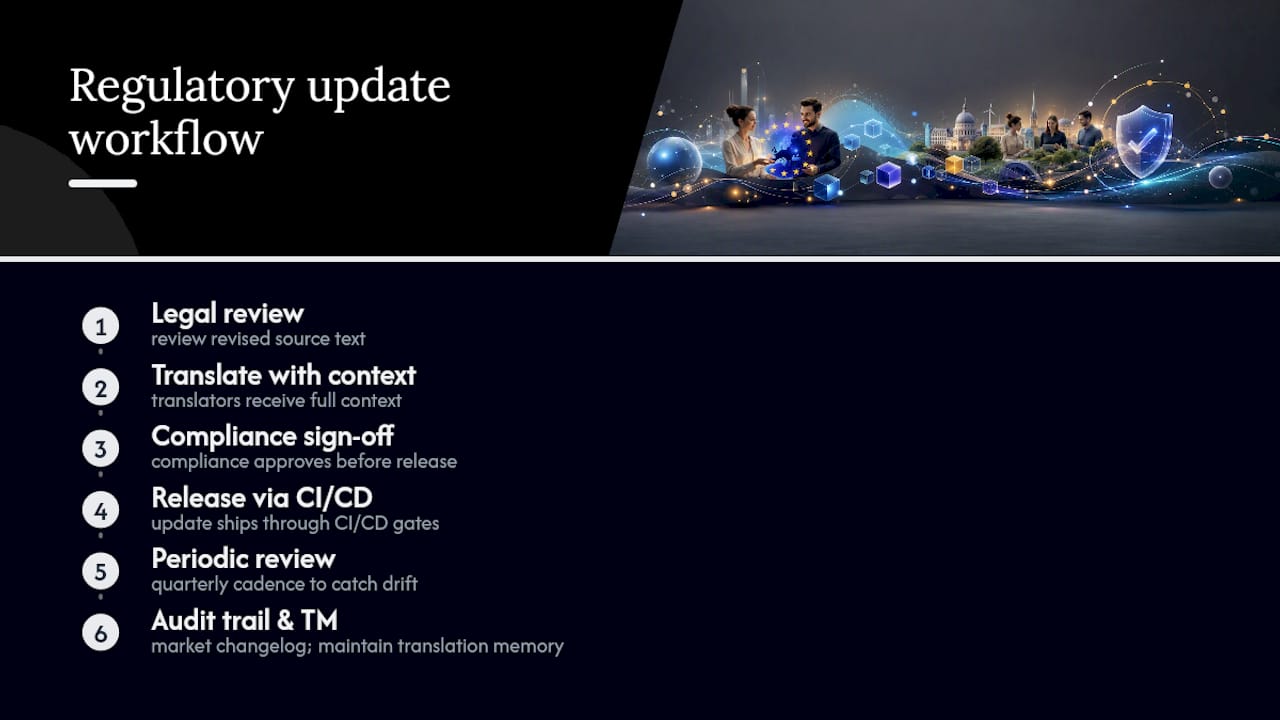
Set a review cadence even without a trigger event, quarterly is common, to catch drift between what the app says and what current regulation actually requires. Keep a changelog per market showing what legal text changed, when, and who approved it. That audit trail matters if a regulator ever asks how you handled a specific update.
Post-launch maintenance is also where translation memory earns its keep. A well-maintained glossary means updates to one term propagate consistently rather than requiring a full re-translation pass every time something shifts.
glocco® perspective: running fintech localisation without the guesswork
Here’s what we’ve learned watching fintech localisation projects go right and wrong: the ones that struggle almost always skipped the boring bit, the glossary and legal review, in favour of shipping fast. Speed matters, but not at the cost of a consent clause nobody actually checked.
Our approach follows a simple order: discovery and terminology mapping first, glossary and translation memory second, legal review of anything compliance-sensitive third, then API integration so updates flow continuously rather than in painful batches.
Pro Tip: If a translator has to guess what a legal term means, a user will too. Fix the ambiguity in the source text before it ever reaches translation.
— glocco®
How glocco® can help with fintech localisation
Right, let’s talk next steps. If you’ve read this far, you already know the hard part isn’t translating words, it’s translating them without breaking a regulatory disclosure or a decimal point. That’s exactly the gap glocco® sits in.
We handle translation, legal localisation, and AI-assisted drafting workflows with human review built in where it actually matters, consent text, fee disclosures, dispute language. API integration means your strings flow into our process without manual handoffs, and continuous updates mean regulatory changes don’t sit in a backlog for three weeks.
A sensible way to start: run a small audit on your highest-risk strings (KYC, disclosures, error messaging), pilot one new market, then expand your localisation workflow once it’s proven. Curious what that looks like for your app? Have a look at how glocco®’s localisation approach works and get a quote for your next market.
Sources
- A guide on fintech localization for driving international growth
- Fintech Localization: Translating financial apps for global markets
- Building multilingual financial apps: a developer’s guide to i18n for FinTech
FAQ
What does fintech app localisation actually include?
It covers UI text, legal and compliance copy, UX microcopy, and correct date, currency and number formatting, adapted for each target market’s language and regulation.
Is machine translation safe for financial apps?
Machine translation works fine for high-volume, low-risk copy, but legal disclosures, consent text and fee language need human legal review before release.
What’s the biggest compliance risk in localisation?
Ambiguous translated consent or disclosure text, which under GDPR and PSD2/PSD3 can leave user consent legally invalid.
Should currency formatting be handled by translators?
No. Formatting belongs in code, using locale-aware libraries at the display layer, while storage always uses explicit currency codes and decimal-safe types.
How does glocco® handle compliance-sensitive localisation?
Glocco® combines glossary management, translation memory, and human legal review with API-based CI/CD integration, so regulatory text stays accurate and auditable as it changes.


