


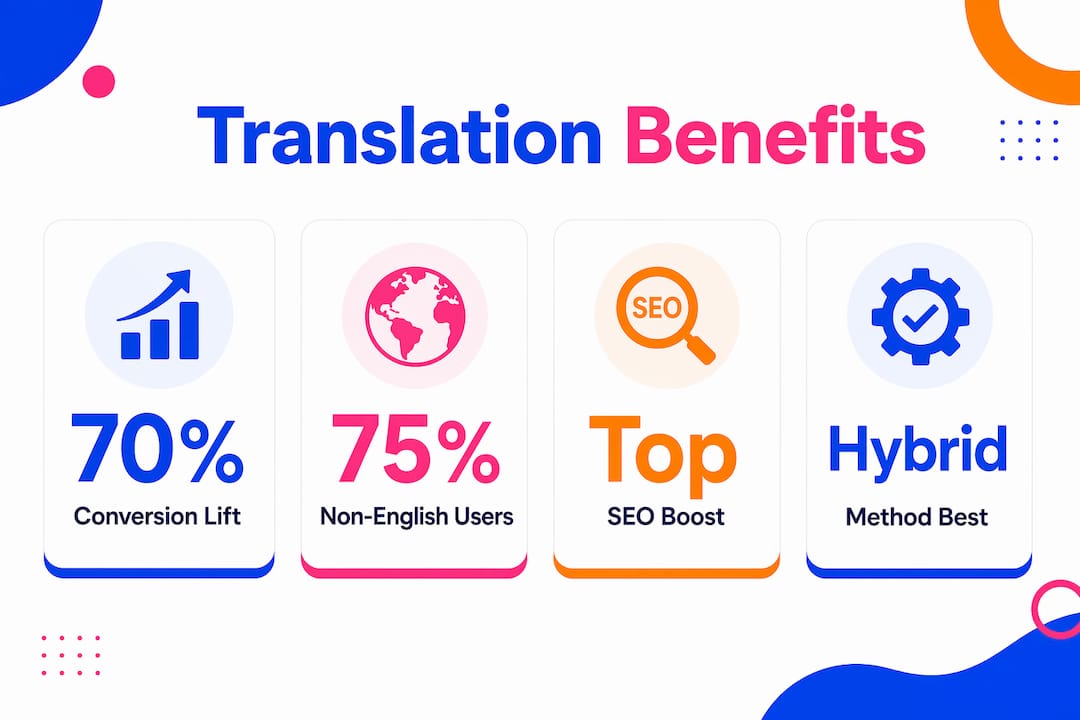
Translating product descriptions means adapting your product messaging into your customers’ native languages to increase trust, reduce friction, and drive more sales internationally. This is the single most underleveraged growth lever in e-commerce, and the data backs it up. Around 75% of global internet users do not have English as their first language. That means English-only listings are invisible to most of the world’s online shoppers. If you are asking why translate product descriptions, the short answer is: because your customers are not reading them.
Why translate product descriptions: the real business case
The numbers here are not subtle. E-commerce stores that localise product content into native languages see conversion increases up to 70% over English-only sites. That is not a marginal improvement. It is the difference between a product that sells and one that sits.
Here is what drives those numbers:
- Higher purchase confidence. Customers prefer shopping in their native languages, which reduces cognitive load and increases the likelihood of completing a purchase.
- Better organic search rankings. Translated and localised listings index for local-language search queries. A German shopper searching for “Laufschuhe Herren” will not find your English product page.
- Fewer returns. Ambiguous descriptions cause mismatched expectations. Localised content that adapts sizing charts and measurement units reduces returns and negative reviews.
- Stronger brand credibility. Multilingual product content builds global brand trust and reduces friction at every stage of the buying journey.
The importance of product description translation goes beyond words on a page. It signals to international customers that you respect their language, their culture, and their time.
“Localised content converts 1.5x–3x better than literal translations. The gap between translation and localisation is where most e-commerce brands leave money on the table.”
Translation vs localisation: what is the actual difference?
This distinction matters more than most e-commerce teams realise. Translation converts words from one language to another. Localisation converts the entire experience, including cultural nuances, tone, and intent. The difference between the two is fundamental, and confusing them is expensive.

Here is a practical comparison:
| Factor | Translation | Localisation |
|---|---|---|
| Scope | Word-for-word conversion | Full cultural and contextual adaptation |
| Measurement units | Kept as source (e.g. inches) | Converted to local standard (e.g. centimetres) |
| Tone | Mirrors source language tone | Adapted to local expectations |
| SEO keywords | Translated from source terms | Researched for local search intent |
| Cultural references | Carried over literally | Replaced with locally relevant equivalents |
A German audience expects precision and technical detail. A Japanese audience expects formal, deferential language and exhaustive product specifications. A Brazilian audience responds to warmth and social proof. Applying the same translated text to all three markets is not a strategy. It is a shortcut that costs you sales.
Literal machine translations often produce technical, uninspiring copy that reduces trust and drives up return rates. That is the pitfall of treating localisation as a translation problem.
Pro Tip: Before translating any product description, document your brand tone guidelines in English first. A clear brief in the source language produces far better localised output, whether you use human translators or AI tools.
Human translation vs AI generation: which method wins?
The honest answer is: it depends on your catalogue size, budget, and quality requirements. Both approaches have real strengths, and the best results usually come from combining them.
Human translation
Human translators produce culturally accurate, brand-consistent copy. They catch nuance, humour, and register that machines miss. For premium brands or culturally sensitive markets, human translation remains the gold standard. The trade-off is speed and cost, particularly for large catalogues.
AI content generation
AI tools calibrated with cultural briefs can capture market-specific search intent better than direct translation that mirrors source structure. This is a meaningful distinction. Generating content directly in the target language, rather than translating from English, produces descriptions that feel native rather than imported. You can explore the latest AI translation tools to understand which platforms support this approach.
The hybrid model
Transcreation is the specialist skill required for premium or culturally sensitive brand messaging. It is resource-intensive. The practical solution for most e-commerce brands is AI generation with human cultural oversight. This gives you scale without sacrificing quality.
Here is how to choose:
- Small catalogue, premium brand: Use human translators or transcreation specialists.
- Large catalogue, mid-market brand: Use AI generation with human review.
- SEO-first strategy: Generate content directly in the target language rather than translating from English.
- Regulated or sensitive products: Always use qualified human translators with subject-matter expertise.
How to implement a product description translation strategy
Getting this right requires more than sending a spreadsheet to a translator. Here is a practical process that works:
- Audit your product data first. Clean, structured product data produces better translations. Remove jargon, fix inconsistencies, and standardise terminology before any translation begins.
- Write brand tone guidelines. Define your voice, your key messages, and any terms that must not be translated. Share this with every translator or AI tool you use.
- Prioritise markets by revenue potential. Do not translate everything at once. Start with the two or three markets where you already see organic traffic or sales.
- Adapt measurement systems and sizing. Clothing sold in the UK uses different sizing conventions to Germany or Japan. Adapting these details is not optional. It directly affects return rates.
- Optimise for local SEO. Research keywords in the target language independently. Do not translate English keywords. Local search intent differs significantly from market to market.
- Test and measure. Track conversion rates, return rates, and bounce rates by language. Use this data to iterate. Localisation is not a one-time task.
For a structured approach, Glocco’s localisation checklist covers the full process from preparation to post-launch review.
Pro Tip: Add hreflang tags to your localised product pages. This tells search engines which language version to serve to which audience, and it prevents your translated pages from competing with each other in search results.
Glocco’s take: translation is a revenue decision, not a language decision
We have worked with e-commerce brands across Europe, the Middle East, and Asia since 2014, and the pattern is consistent. The brands that treat translation as a cost cut corners and pay for it in returns, low conversion rates, and poor search visibility. The brands that treat it as a revenue decision invest in quality localisation and see measurable results.
The most common mistake we see is treating the first translation as the finished product. Localisation requires ongoing optimisation. Search intent shifts. Products change. Cultural expectations evolve. The brands winning in international markets are the ones reviewing and updating their localised content regularly, not the ones who translated once and moved on.
The AI and localisation combination is genuinely exciting right now. When AI generation is paired with cultural oversight from native-speaking editors, the output quality has improved dramatically. Speed is no longer the trade-off it once was. Quality localisation at scale is achievable for brands of all sizes.
If you are still asking whether you should translate product descriptions, consider this: your competitors in local markets are already speaking your customers’ language. The question is not whether to localise. It is how quickly you can do it well.
— glocco®
Ready to localise your product content?
Glocco has supported e-commerce brands with professional translation and localisation since 2014, working across European, Middle Eastern, North American, and Asian markets. Whether you need human translators for a premium catalogue or an AI-assisted workflow for thousands of SKUs, Glocco’s team of native-speaking editors and language specialists delivers content that converts. Our document and product translation guide is a practical starting point for understanding what a professional localisation process looks like. You can also explore the role of AI in localisation to see how modern tools fit into a quality-first workflow. Get in touch with Glocco to discuss your multilingual product content needs.
FAQ
Why translate product descriptions if english is widely spoken?
75% of global internet users do not use English as their primary language. Shoppers buy more confidently in their native language, so English-only listings exclude the majority of the global market.
What is the difference between translation and localisation for product listings?
Translation converts words; localisation adapts the full experience including tone, cultural references, measurement units, and local search keywords. Localised content converts 1.5x–3x better than literal translations.
How much can translating product descriptions improve conversion rates?
E-commerce stores that localise product content into native languages see conversion increases up to 70% compared to English-only sites.
Should i use AI or human translators for product descriptions?
The best approach depends on catalogue size and brand positioning. Large catalogues benefit from AI generation with human cultural review. Premium or regulated products require qualified human translators. AI tools calibrated with cultural briefs outperform standard machine translation for both quality and SEO.
Does translating product listings help with SEO?
Yes. Localised product pages index for native-language search queries that English pages cannot rank for. Generating content directly in the target language, rather than translating from English, better captures local search intent and improves organic visibility.


