


Digital legal translation is the process of converting legal documents into another language using digital technologies, while preserving legal precision, compliance, and enforceability. This is not simply running a contract through a translation app. It combines AI-assisted tools, human-verified workflows, and secure digital infrastructure to produce translations that hold up in court, satisfy regulators, and protect your business. Whether you are dealing with contracts, patents, regulatory filings, or court evidence, the stakes are too high for guesswork. Providers like Glocco and TransPerfect have built entire service models around this reality.
What is digital legal translation and how does it differ from traditional methods?
Digital legal translation is the industry term for legally precise document translation delivered through digital workflows, as opposed to paper-based or purely manual processes. The older approach relied on a single translator working in isolation, posting physical documents, and returning a typed or handwritten output. Digital workflows change every part of that process.
| Feature | Traditional Legal Translation | Digital Legal Translation |
|---|---|---|
| Speed | Days to weeks | Hours to days |
| Consistency | Translator-dependent | Translation memory enforced |
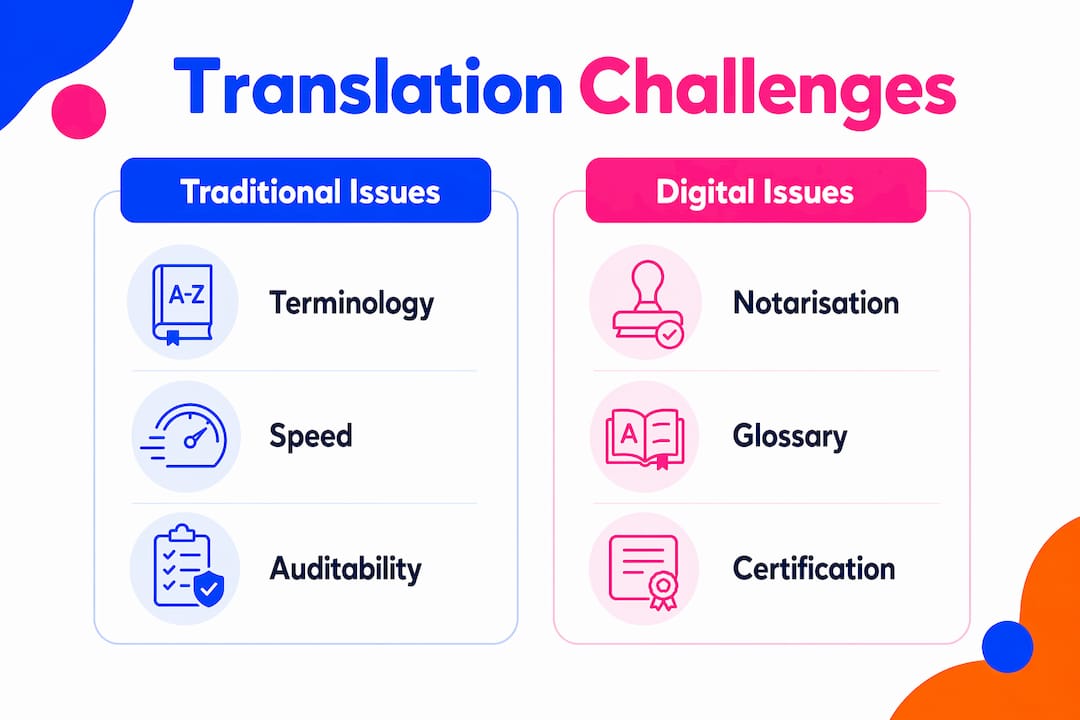
| Auditability | Minimal | Full audit logs |
| Security | Physical document risk | Encrypted file transfer |
| Collaboration | Single translator | Multi-reviewer workflows |

The shift to digital is not just about speed. Auditability in translation workflows transforms translation from a functional service into a strategic, defensible process. Every reviewer, every edit, and every approval is logged. That matters enormously when a document faces litigation or a regulatory audit.
Translation memory software stores previously approved legal phrases and reuses them automatically. This reduces inconsistency across large document sets, which is a common failure point in traditional methods. Tools like SDL Trados and memoQ are widely used in professional legal translation services for exactly this reason.
Pro Tip: Ask any digital translation vendor whether their platform produces a full audit log. If they cannot show you one, their workflow is not truly defensible.
What are the main challenges in digital legal translation?
Legal translation is one of the hardest translation disciplines. Digital tools help, but they do not eliminate the core challenges. Here is what legal teams and regulated businesses consistently run into.
- Preserving legal nuance. A single mistranslated clause in a contract can trigger costly disputes or compliance failures. Legal terms carry jurisdiction-specific meanings that AI cannot always interpret correctly.
- Data security. Legal documents contain privileged, sensitive, and commercially valuable information. Sending them through unsecured channels is a serious risk. Encrypted file transfers and NDAs are the minimum standard for any reputable digital legal service.
- Certification requirements. Courts generally reject AI-generated translations that lack human certification. A certified translation requires a signed statement of accuracy from a qualified human translator.
- Jurisdictional compliance. Legal systems differ across countries. A term that is legally precise in English law may carry a different meaning under French or German civil law.
- AI limitations. AI cannot interpret jurisdiction-specific compliance requirements fully. Human review is not optional for high-stakes documents.
One thing that surprises many clients: notarisation does not guarantee translation quality. Notarisation confirms the translator’s identity, not the accuracy of the translation itself. Legal teams must verify linguistic quality separately. This is a distinction that catches businesses out regularly, particularly when filing documents with overseas courts.
Pro Tip: Always request a centralised glossary from your translation provider. Consistent terminology across all documents in a matter is one of the most effective ways to reduce risk.
Which digital tools support legal translation accuracy and security?
The right combination of technology and human expertise is what separates a reliable digital legal translation service from a risky one. Here are the core tools and what they actually do.
- AI-assisted translation engines. Platforms like DeepL Pro and Google Cloud Translation API accelerate first-draft output significantly. They work best on high-volume, lower-complexity documents. AI accelerates translation but requires human validation before any legal document is finalised.
- Translation memory software. Tools like SDL Trados, memoQ, and Phrase store approved legal terminology and reuse it consistently. This is critical for large contracts or multi-document litigation sets.
- Terminology management systems. Centralised glossaries reduce mistranslation risks and enhance uniformity across all documents in a project.
- Quality assurance tools. Tools like Grammarly and Xbench assist with consistency checks, flagging terminology deviations and formatting errors before final review.
- Secure file management systems. Encrypted portals with restricted access and full audit logs protect client privilege and satisfy data privacy standards such as GDPR.
| Tool Category | Example Tools | Primary Benefit |
|---|---|---|
| AI Translation | DeepL Pro, Google Cloud Translation | Speed and volume |
| Translation Memory | SDL Trados, memoQ, Phrase | Consistency |
| Quality Assurance | Grammarly, Xbench | Error detection |
| Secure File Transfer | Encrypted portals, restricted-access systems | Data protection |
The role of technology in legal translation is to support human expertise, not replace it. The most effective workflows use AI for speed and humans for accuracy, certification, and legal judgement. That combination is what makes a translation defensible.
Best practices for digital legal translation in regulated industries
Getting digital legal translation right in a regulated environment requires more than choosing the right software. It requires a structured workflow that every stakeholder follows consistently.
- Define your workflow before you start. Map out every step from document intake to final delivery. Include who reviews, who approves, and how changes are tracked. A defensible legal translation workflow must be documented, security-minded, and include audit logs.
- Use certified translators for all high-stakes documents. Contracts, court filings, patents, and regulatory submissions all require a human translator to sign a certificate of accuracy. AI output alone will not satisfy courts or regulators.
- Implement NDAs and data security protocols from day one. Every translator, reviewer, and project manager handling your documents should be bound by a non-disclosure agreement. Encrypted transfers are non-negotiable.
- Build and maintain a centralised legal glossary. Update it after every project. Consistent terminology across documents in the same matter protects you from contradictions that opposing counsel or regulators will exploit.
- Select vendors with demonstrable compliance credentials. Ask for evidence of GDPR compliance, ISO 17100 certification, and a sample audit log. If a vendor cannot provide these, look elsewhere.
- Conduct a final human review before submission. No matter how good the AI output is, a qualified legal translator must review and certify the final document. This is the step that makes the translation legally enforceable.
For a practical step-by-step approach to translating legal documents accurately, Glocco’s resource library covers the full process in detail.
Glocco’s view: the human element will always win
We have been working in legal translation since 2014, and here is something we have noticed: the businesses that get into trouble are almost never the ones that skipped the technology. They are the ones that skipped the human review.
AI tools have improved dramatically. DeepL Pro produces first drafts that would have taken a junior translator hours. Translation memory systems have made large-scale legal projects far more consistent. These are genuine advances, and we use them every day. But the moment a client assumes that speed equals accuracy in a legal context, problems follow.
The uncomfortable truth about digital legal translation is this: the technology is a multiplier, not a replacement. A skilled legal translator using the right tools produces better, faster, faster work. An AI tool without a skilled legal translator produces a liability. The legal translation trends shaping 2026 point firmly toward hybrid models, and that is exactly where we have always sat.
Our advice for 2026 and beyond: invest in your glossaries, demand audit logs from every vendor, and never let a document go to court or a regulator without a certified human signature on the translation certificate. The technology will keep improving. The legal standard will not change.
— glocco®
How Glocco supports your legal translation needs
Glocco works with legal teams, regulated businesses, and compliance professionals across Europe, the Middle East, and North America. Our digital legal translation service combines AI-assisted tools with certified human translators, encrypted file management, and full audit trails. Every project is built around your specific jurisdiction, document type, and compliance requirements. If you are new to the process, our document translation guide for EU businesses is the clearest starting point available. It covers everything from certification requirements to GDPR-compliant workflows. You can also explore why multilingual legal support matters for businesses operating across EU jurisdictions. Get in touch with Glocco to discuss your specific needs.
FAQ
What is digital legal translation in simple terms?
Digital legal translation is the process of converting legal documents into another language using digital tools and certified human translators, while preserving legal accuracy and compliance. It covers contracts, court documents, patents, and regulatory filings.
Do courts accept ai-generated legal translations?
Courts generally reject AI-generated translations that lack human certification. A certified translation requires a signed statement of accuracy from a qualified human translator before it is accepted for legal filings.
What does a defensible legal translation workflow include?
A defensible workflow includes documented steps, encrypted file transfers, certified translators, centralised glossaries, and full audit logs. These elements ensure the translation can withstand litigation or regulatory scrutiny.
How does notarisation differ from certified translation?
Notarisation confirms the identity of the translator, not the accuracy of the translation. Certified translation provides a signed guarantee of linguistic accuracy, which is what courts and regulators actually require.
Which industries need digital legal translation most?
Regulated industries including fintech, pharmaceuticals, engineering, and e-commerce rely heavily on legal document translation for cross-border contracts, compliance filings, and intellectual property protection.


