


Choosing the right language service provider is one of the most consequential decisions an EU business in a regulated sector will make. Language services cover translation, localisation, and interpreting, and the wrong choice creates compliance failures, costly errors, and reputational damage. Providers certified to ISO 17100 and equipped with CAT software and translation management systems (TMS) are the baseline. The real differentiator is whether a provider genuinely understands your sector. Get this right, and you get cleaner communication, fewer regulatory headaches, and faster market entry.
What are the essential criteria for selecting language services?
The criteria for language selection go well beyond price per word. For legal, pharmaceutical, and technical businesses operating across the EU, the stakes are too high for a generic approach.
Here is what to evaluate before signing anything:
- Industry expertise. Specialised domain knowledge reduces errors in complex texts. Translators working in pharma, for example, use sector-specific glossaries and translation memories tuned to regulatory terminology.
- Certified professionals. Look for translators and interpreters with verifiable credentials in your field, not just general language qualifications.
- Technology integration. Providers should work with CAT tools, TMS platforms, and AI-assisted workflows that connect with your systems without creating extra manual work.
- Quality assurance processes. Multi-step review cycles, including translation, editing, and proofreading (TEP), are the standard for regulated content.
- GDPR compliance and data security. Any provider handling sensitive documents must demonstrate encryption practices, secure storage, and signed NDAs.
- Transparent pricing. Vague pricing models lead to budget surprises. Insist on a clear service scope and fixed or predictable cost structures from the start.
Pro Tip: Ask every shortlisted provider to walk you through their QA process step by step. If they cannot describe it clearly, that tells you everything.
ISO 17100 is worth understanding here. It is recognised as a process standard for translation, meaning it confirms procedures are in place but does not guarantee the accuracy of your specific content. Client-side evaluation remains non-negotiable.
How do LSPs compare to freelance translators for business needs?
This is a question that comes up constantly, and the answer depends on your project scale, sector, and compliance requirements.

| Factor | Language service provider (LSP) | Freelance translator |
|---|---|---|
| Project scale | Large, multi-language, ongoing | Small, single-language, one-off |
| Quality assurance | Multi-step TEP process | Self-reviewed or peer-reviewed |
| Technology | CAT tools, TMS, AI integration | Variable, often limited |
| Scalability | Dedicated teams or vetted networks | Limited capacity |
| Cost | Higher, but predictable | Lower, but variable |
| Sector compliance | Structured processes for regulated content | Depends on individual expertise |
LSPs provide multi-step QA, manage larger multi-language projects, and maintain consistent output across teams. Freelancers offer flexibility and a more personal relationship, which suits niche or low-volume work. For a pharmaceutical company translating clinical trial documentation into 12 EU languages, an LSP is the only sensible choice. For a small legal firm needing a one-off contract translated into German, a highly qualified freelancer may do the job well.
The critical point is consistency. When your brand, regulatory language, or technical terminology must remain uniform across markets, an LSP with a centralised TMS and translation memory gives you that control. A freelancer cannot replicate it at scale.
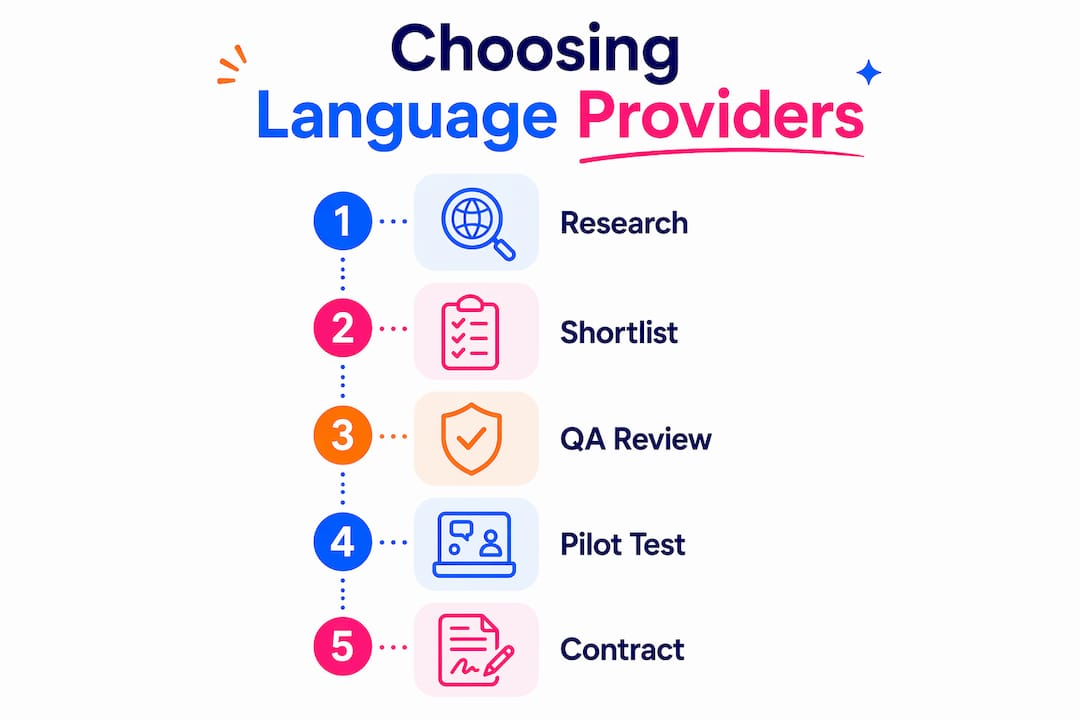
What steps should you take to evaluate and choose a language provider?
A structured evaluation process saves time and prevents expensive mistakes. Follow these steps in order.
- Define your requirements. List your content types (legal contracts, medical leaflets, technical manuals), target languages, volumes, and deadlines. This shapes every subsequent decision.
- Request sector-specific samples. Work samples allow assessment of accuracy, style, and regulatory terminology. Ask for samples in your exact content type, not generic marketing copy.
- Interview shortlisted providers. Ask directly about their QA methodology, technology stack, and how they handle volume spikes. Scalability depends on a provider’s capacity model and contingency planning.
- Check references and retention rates. A provider with long-term clients in your sector is a strong signal of consistent quality. Ask for references from businesses with similar regulatory needs.
- Review your language services checklist. A structured checklist prevents you from overlooking critical factors during evaluation.
- Negotiate pricing and service scope. Pin down rates, revision policies, rush fees, and what happens when a project grows mid-delivery.
Pro Tip: Run a paid pilot project before committing to a long-term contract. A small, real-world test in your content type reveals more than any portfolio or reference call.
What mistakes should you avoid when choosing language services?
Even experienced procurement teams make avoidable errors when selecting language providers. Here are the most common ones.
- Choosing on price alone. The cheapest option almost always lacks the domain expertise your sector requires. A mistranslated pharmaceutical label or a legally ambiguous contract clause costs far more than the saving.
- Ignoring technology fit. Providers that cannot integrate with your CMS, document management system, or regulatory submission platform create manual workarounds that slow everything down.
- Accepting vague contracts. Unclear service scopes lead to disputes over revisions, turnaround times, and fees. Get everything in writing.
- Overlooking communication quality. Named customer service managers and clear escalation paths are indicators of a well-run operation. If a provider is slow to respond during the sales process, expect the same during delivery.
- Skipping GDPR checks. For any provider handling personal data or confidential documents, verify their data security practices before sharing a single file.
“The warning signs are always there during the pitch. A provider who cannot answer direct questions about their QA process or data security is not ready for regulated-sector work.”
How do you measure the ongoing value of your language service partnerships?
Selecting a provider is the beginning, not the end. Measuring ongoing performance keeps quality high and justifies the investment.
Track these indicators regularly:
- Error rates and revision frequency. A rising revision rate signals a quality problem. Set a baseline after the first three months and monitor it quarterly.
- Turnaround adherence. Late deliveries in regulated sectors can delay product launches, court filings, or regulatory submissions. Track on-time delivery as a hard metric.
- Cost per word versus output quality. Cost effectiveness is not just about the rate. Factor in revision time, internal review hours, and any compliance incidents linked to translation errors. Glocco’s work on EU compliance language services shows that quality-focused providers can reduce errors by 35%.
- Reporting and analytics. Ask your provider for project-level reporting. Good LSPs provide data on turnaround times, word volumes, and quality scores.
- Scalability alignment. As your business grows into new markets, your provider must grow with you. Review capacity annually and discuss upcoming language needs before they become urgent.
Glocco’s honest take on choosing the right language partner
Glocco has been working with EU businesses in legal, pharmaceutical, and technical sectors since 2014, and the pattern is consistent. Businesses that struggle with language services almost always made one of two mistakes. They either chose a provider without verifiable sector expertise, or they prioritised cost so heavily that quality and compliance became secondary.
The technology question is equally important. CAT tools, TMS platforms, and AI-assisted translation genuinely improve speed and consistency when integrated properly. But technology without qualified human oversight is a liability in regulated content. The role of AI in localisation is real and growing, but it works best as a support layer for expert translators, not a replacement.
The providers worth working with are transparent about their processes, honest about their limitations, and proactive about communication. If a provider cannot tell you exactly who will work on your content and how quality is verified, keep looking. The right partner treats your compliance requirements as their own.
— glocco®
How glocco® supports EU businesses with specialist language services
Glocco® works with legal, pharmaceutical, and technical businesses across the EU, providing document translation, interpretation, and AI-assisted localisation built around your sector’s requirements. Every project combines certified human translators with CAT and AI tools, backed by a multi-step QA process and full GDPR compliance. Pricing is transparent, service scopes are fixed in writing, and you get a named contact from day one. Whether you need legal translation quality assurance or medical interpretation for patient-facing content, glocco® has the expertise and the processes to deliver. Get in touch to discuss your requirements.
FAQ
What does ISO 17100 actually guarantee?
ISO 17100 confirms that a provider follows a defined translation process, but it does not guarantee the accuracy of your specific content. Client-side evaluation using sector-specific work samples remains the only reliable quality check.
When should an EU business use an LSP rather than a freelancer?
Use an LSP when your projects involve multiple languages, regulated content, or ongoing volume. Freelancers suit small, one-off tasks where a single specialist with the right credentials is sufficient.
How do you verify a provider’s GDPR compliance?
Ask for their data processing agreement, encryption policy, and evidence of signed NDAs with all staff and subcontractors. Any reputable provider handling sensitive EU business data should produce these without hesitation.
What is the fastest way to test a new language provider?
Commission a paid pilot project using real content from your sector. This reveals accuracy, terminology handling, and turnaround reliability far more effectively than reviewing a portfolio.
How often should you review your language service provider’s performance?
Review error rates, turnaround adherence, and cost effectiveness quarterly for the first year, then annually once a reliable baseline is established.


