


Translation in e-commerce is defined as the full adaptation of your online store’s content, from product pages to checkout flows, into the language and cultural context of each target market. The role of translation for e-commerce extends far beyond swapping words. It determines whether international shoppers trust your brand, find you on Google, and complete a purchase. Multi-language stores generate 47% higher revenue on average than single-language equivalents. That figure alone should settle the debate. Tools like Shopify Markets and Lara Translate now make multilingual management accessible to businesses of every size, but the strategy behind them still matters enormously.
What content actually needs translating in your e-commerce store?
Product descriptions are the obvious starting point, but they are far from sufficient. Comprehensive localisation covers the entire buying experience, including navigation menus, checkout flows, transactional emails, legal content, and SEO metadata. Miss any of these and you create friction at exactly the moment a customer is ready to buy.
Here is what a complete translation scope looks like in practice:
- Product pages: titles, descriptions, specifications, and customer reviews
- Navigation and UI: category labels, filter options, search prompts, and error messages
- Checkout and payment: currency display, address fields, payment method names, and confirmation screens
- Transactional emails: order confirmations, shipping updates, and return instructions
- Legal content: privacy policies, terms and conditions, and cookie consent notices
- SEO metadata: page titles, meta descriptions, alt text, and structured data
Checkout localisation deserves special attention. A shopper who reads fluent French product copy but then hits an English-only payment screen is very likely to abandon their basket. The same logic applies to transactional emails. A German customer receiving a post-purchase email in English feels like an afterthought, not a valued buyer.
Pro Tip: When briefing translators, share screenshots of each page alongside the source text. Context prevents costly mistranslations, particularly for short UI strings like button labels where a single word carries enormous weight.
How does translation affect e-commerce SEO?
Translation and international SEO are inseparable. Combining translation with technical SEO, particularly correct hreflang implementation, is mandatory for attaining search visibility in foreign markets. Without the right technical setup, even a perfectly translated store can be completely invisible to local shoppers.

The table below summarises the four technical pillars every multilingual store must address:
| Technical element | What it does | Common mistake |
|---|---|---|
| Hreflang tags | Signals language and region to Google | Missing self-referencing or reciprocal tags |
| URL structure | Organises language versions clearly | Using query parameters instead of subdirectories |
| Localised metadata | Matches local search intent | Direct translation of English keywords |
| Canonical tags | Prevents duplicate content penalties | Pointing all versions to the English canonical |
Missing hreflang tags cause Google to ignore translated pages entirely, even when the translation quality is excellent. Every hreflang set must include a self-referencing tag and reciprocal links across all language versions. One missing link breaks the entire set.
Local keyword research is equally critical. Searching for “running shoes” in German does not simply translate to “Laufschuhe.” German shoppers may use “Joggingschuhe” or search by brand and feature combination. Strategic URL structure using subdirectories (for example, /de/ or /fr/) combined with fully localised metadata gives each language version the best chance of ranking independently.
Pro Tip: Use Google Search Console’s International Targeting report to audit hreflang errors before they cost you rankings. Fix missing reciprocal tags first. They are the most common cause of international SEO invisibility.
What workflows support scalable, ongoing e-commerce translation?
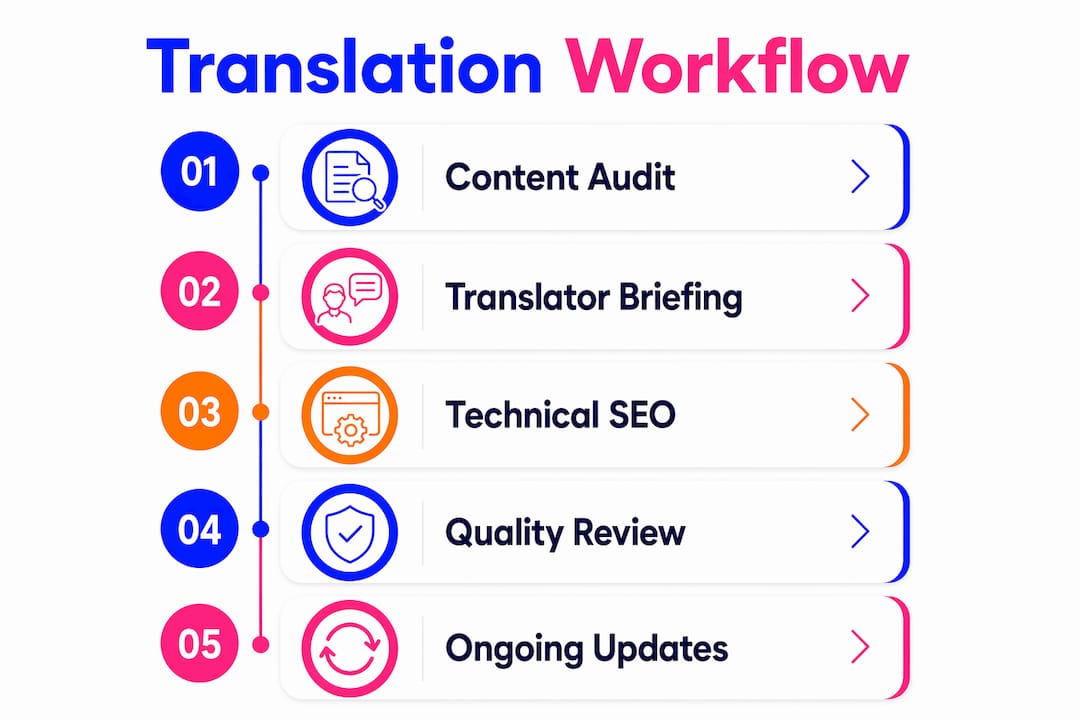
Translation is not a one-off project. Every new product launch, seasonal campaign, and policy update requires fresh content in every active language. Embedding translation into operational cycles rather than treating it as an ad hoc task is what separates businesses that scale internationally from those that stall.
A practical workflow for continuous translation management looks like this:
- Audit your content calendar at the start of each quarter and flag every asset requiring translation, including product launches, promotional banners, and email sequences.
- Build a centralised glossary covering brand terms, product names, and tone-of-voice guidelines. Centralised glossaries maintain consistent terminology across languages and translators, protecting brand recognition.
- Use batch translation for large product catalogues. Batch workflows integrated via APIs or MCP allow translation management systems to work directly inside e-commerce platforms, cutting manual tasks significantly.
- Schedule translation deadlines at least two weeks before any campaign goes live. Planning translation into campaign timelines eliminates last-minute bottlenecks and the rework that follows rushed approvals.
- Monitor multilingual site health monthly. Crawl errors and broken links in one language version can affect the performance of others, so vigilant upkeep is non-negotiable.
The businesses that get this right treat their translation workflow the same way they treat their inventory management: structured, scheduled, and reviewed regularly. Those that do not end up with outdated French product pages sitting alongside a freshly updated English store.
What are the most common e-commerce translation challenges?
Even experienced international retailers make predictable mistakes. Knowing them in advance saves a great deal of time and money.
- Literal translation of product descriptions: Word-for-word translation ignores local search behaviour and cultural tone. Native speaker review and transcreation are required to align descriptions with how local customers actually search and speak.
- Ignoring checkout and payment localisation: An untranslated checkout is one of the highest-impact causes of cart abandonment in cross-border e-commerce. Localising payment method names and confirmation messages alone can recover meaningful revenue.
- Relying solely on machine translation: Automated translation without human review damages trust, brand reputation, and conversion rates. Machine translation is a useful starting point, not a finished product.
- Incomplete hreflang implementation: As noted above, a single missing reciprocal tag renders an entire language version invisible to Google. This is the most underestimated technical risk in multilingual SEO.
- No localisation strategy for legal content: Privacy policies and terms and conditions must comply with local regulations, not just be translated. A GDPR-compliant English policy does not automatically satisfy French or German legal requirements.
glocco®’s honest take on translation as a growth lever
We have worked with e-commerce businesses across Europe, the Middle East, and North America since 2014, and the pattern is consistent. The brands that treat content localisation as a growth investment from day one outperform those that bolt it on as an afterthought.
The area most consistently underestimated? Checkout and payment localisation. Clients often arrive with beautifully translated product catalogues and then wonder why conversion rates in new markets are disappointing. Nine times out of ten, the checkout is still in English. Fixing that single touchpoint regularly produces the fastest measurable uplift.
The other thing worth saying plainly: translation quality and technical SEO are not separate workstreams. A perfectly localised store that nobody can find because hreflang tags are broken is not a localised store. It is an expensive exercise in futility. Build both into your international expansion plan from the start, and you will avoid the costly rework that so many businesses face six months into a new market launch.
— glocco®
How glocco® helps e-commerce businesses go global
glocco® has supported e-commerce brands with professional translation and localisation since 2014, working across product catalogues, SEO metadata, checkout flows, and legal content in markets across Europe, the Middle East, North America, and Asia. If you are planning international expansion or auditing an existing multilingual store, glocco®’s team of specialist translators and localisation experts can help you build a workflow that scales. Explore the localisation benefits for growth your business can achieve, or start with glocco®’s EU translation guide to understand exactly what professional localisation involves and where it delivers the greatest return.
FAQ
What is the role of translation in e-commerce?
Translation in e-commerce is the process of adapting your entire store, including product content, checkout flows, legal pages, and SEO metadata, into the language and cultural context of each target market. It directly affects conversion rates, search visibility, and customer trust in international markets.
How does translation affect online sales?
Multi-language e-commerce stores generate 47% higher revenue on average compared to single-language stores. Localising the checkout experience and transactional communications reduces cart abandonment and builds post-purchase confidence.
What are the biggest translation challenges for e-commerce?
The most damaging challenges are literal translation that misses local search intent, incomplete hreflang implementation that causes SEO invisibility, and reliance on machine translation without native speaker review. Each of these directly reduces traffic and conversion in foreign markets.
How do hreflang tags relate to e-commerce translation?
Hreflang tags tell Google which language version of a page to serve to which audience. Missing or incorrect tags, particularly absent self-referencing and reciprocal links, cause translated pages to be ignored by search engines entirely, regardless of translation quality.
How should e-commerce businesses manage ongoing translations?
Build translation into your content calendar as a scheduled workflow step, use centralised glossaries for brand consistency, and plan translation deadlines at least two weeks before any campaign launch. Batch translation integrated via API or MCP significantly reduces manual effort and improves consistency at scale.


