


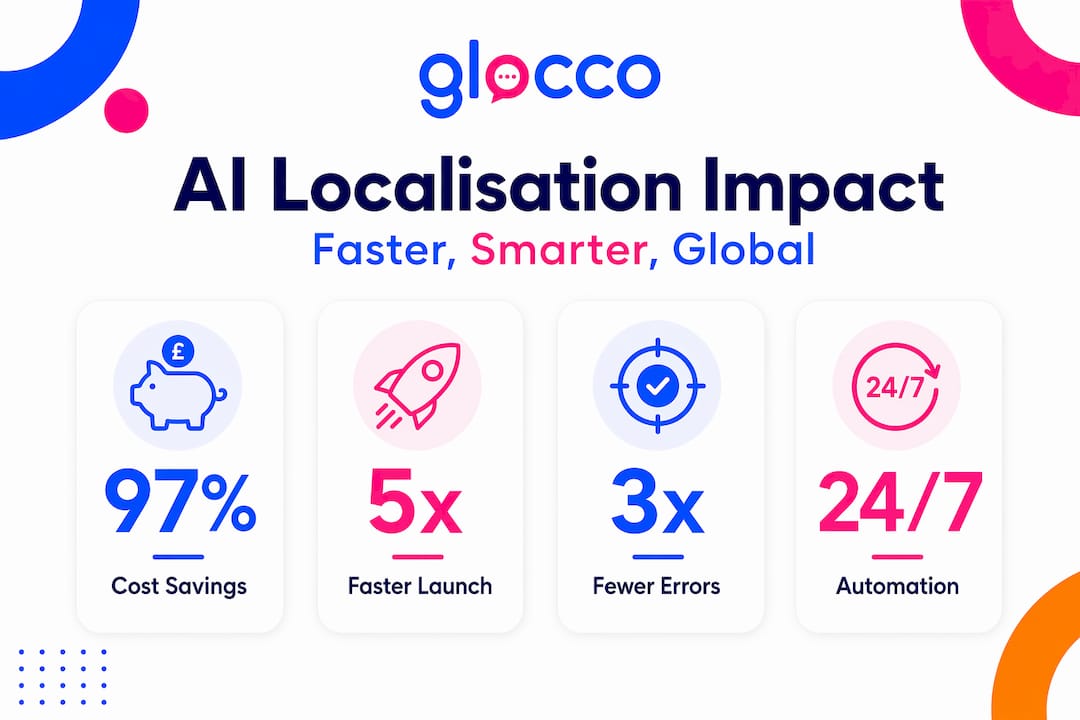
AI-driven localisation is cutting enterprise translation costs by up to 97%, dropping per-million-word spend from £120,000 to under £4,000. That figure alone reshapes how corporate teams in fintech, e-commerce, and IT should think about their global content strategy. Yet many organisations still treat AI as a direct replacement for human translators, leading to costly compliance failures and cultural missteps. The reality is more nuanced: the businesses achieving the best results are those that understand precisely where AI excels and where specialist human oversight remains non-negotiable.
Key Takeaways
| Point | Details |
|---|---|
| AI transforms localisation | AI dramatically boosts speed and cuts costs, but requires thoughtful implementation for quality results. |
| Human review is essential | Expert intervention remains critical for compliance, nuance, and accuracy, especially in regulated sectors. |
| Balanced workflows win | Combining robust AI automation, specialist oversight, and compliance audit ensures reliable global communication. |
| Follow best practices | Adhering to standards like ISO 18587, TM/glossaries, and layered QA protects against costly mistakes. |
Why AI is revolutionising localisation
The machine translation market is projected to reach $2.7 billion by 2030, growing at a compound annual growth rate (CAGR) of 13.5%, driven largely by large language models (LLMs) and neural AI adoption across e-commerce, fintech, and IT. This growth reflects real, measurable demand, not speculative hype.
To understand why adoption is accelerating, it helps to clarify the key technologies involved:
- Neural Machine Translation (NMT): AI systems that analyse entire sentences for context rather than translating word by word, producing far more natural output.
- Large Language Models (LLMs): Deep learning models trained on vast text datasets, capable of generating and adapting language across multiple contexts and registers.
- Retrieval-Augmented Generation (RAG): A technique that feeds AI models with relevant reference material at the point of translation, improving accuracy and contextual consistency.
- Human-in-the-loop (HITL): Workflow stages where specialist human translators review, edit, and approve AI-generated content to ensure quality and compliance.
AI translation workflows now integrate NMT and LLMs with automated quality scoring, terminology enforcement via glossaries and style guides, RAG for contextual grounding, and HITL post-editing. For corporate clients in regulated sectors, this architecture is not optional; it is the baseline. Exploring the right AI tools for translators is the natural first step when planning this kind of infrastructure.
The key industry drivers are straightforward: speed, volume, and regulatory requirements. A fintech firm launching across seven European markets cannot wait twelve weeks for human-only translation of its product documentation. An e-commerce platform scaling to Asia needs thousands of product descriptions localised within days. AI makes this operationally viable, provided the workflow is designed correctly.

How modern AI localisation workflows operate
With the scale and efficiency AI offers established, it is worth examining how these workflows actually function in practice. A well-designed AI-powered translation process follows a clear sequence that balances speed with quality control.
A typical AI localisation pipeline looks like this:
- Content ingestion: Source content is imported into a translation management system (TMS), where it is segmented and prioritised.
- Translation memory ™ matching: The system checks existing approved translations for repeated or similar segments, instantly applying them to reduce both time and cost.
- NMT or LLM translation: New segments are processed by the AI engine, using RAG to pull relevant glossary terms, brand guidelines, and prior approved content as context.
- Automated quality scoring: The system flags segments with low confidence scores, unusual terminology, or potential compliance issues for human review.
- Human-in-the-loop review: Specialist translators and subject-matter experts review flagged and high-priority segments, applying post-editing to correct errors and refine tone.
- Final QA and delivery: A final quality assurance pass checks formatting, numerical accuracy, and multi-language QA standards before the content is published or delivered.
| Workflow stage | Primary actor | Key benefit |
|---|---|---|
| TM matching | Automated | Eliminates repeated translation costs |
| NMT/LLM translation | AI | High-speed processing at scale |
| RAG contextualisation | AI + knowledge base | Improves accuracy and consistency |
| HITL post-editing | Human expert | Ensures compliance and cultural fit |
| Final QA | Automated + human | Catches errors before publication |
The RAG layer is particularly valuable for highly regulated content. Rather than relying solely on what the model was trained on, RAG pulls live reference material, including regulatory glossaries, product-specific terminology, and approved phrasing, directly into the translation context. This dramatically reduces terminology drift, where AI begins substituting approved terms with plausible but incorrect alternatives.
Pro Tip: Always configure your TMS to flag segments containing numerical data, regulatory references, or legal clauses for mandatory human review. These are the areas where AI errors carry the highest business risk.
A robust language localisation workflow reduces error rates and ensures that compliance documentation, user interfaces, and marketing content all maintain consistent quality across markets.
Limitations of AI: Where human expertise still matters
Understanding how these systems work exposes their inherent limitations. NMT produces fluent translations but consistently struggles with sarcasm, culturally specific references, implicit tone, and low-resource languages where training data is sparse. Fluency and accuracy are not the same thing.
Consider a fintech firm localising its risk disclosure documents for the German market. An AI model may produce grammatically correct German that nonetheless uses phrasing a local compliance officer would immediately flag as imprecise or ambiguous under MiFID II requirements. The text reads well but fails regulatory scrutiny. This is not a hypothetical; it is a scenario Glocco’s teams encounter regularly.
AI hallucinations represent an even more serious threat in sensitive sectors. These occur when an AI model fabricates plausible-sounding facts, figures, or references that simply do not exist in the source material. In a standard blog post, a hallucinated statistic is embarrassing. In a regulated financial document, it can carry legal consequences. Additional failure modes include:
- Context loss: Long documents processed in segments lose narrative coherence if the AI does not retain context between sections.
- Token truncation: AI models have processing limits; very long segments may be cut short, producing incomplete translations.
- Locale-specific tone failures: Formal register requirements differ significantly across markets, and AI models frequently default to an inappropriate level of formality.
- Semantic drift: Gradual substitution of approved terminology with plausible alternatives across a large project.
“AI can produce fluent output that passes a casual reading but fails the precise compliance and cultural standards that regulated markets demand. The risk is that it looks correct until a specialist checks it.”
Ensuring legal translation quality requires multi-layer QA processes, constrained prompts, few-shot examples to guide model behaviour, and mandatory post-editing by domain specialists. This is why human translators in compliance settings are not a legacy cost but an active risk-management tool.
Pro Tip: For any content subject to EU or North American regulatory oversight, treat human expert review as a non-negotiable quality gate, not an optional enhancement.
Best practices for harnessing AI in localisation
With both strengths and limitations clearly mapped, the question becomes practical: how do you maximise AI’s value and remain compliant as you scale globally?
For fintech, e-commerce, and IT clients, the most effective approach combines AI orchestration with carefully governed human oversight. The following practices consistently deliver the best outcomes:
- Integrate translation memories and glossaries: These assets constrain AI output to approved terminology and reduce the risk of semantic drift across large projects.
- Apply ISO 18587 post-editing standards: This international standard governs the process of human post-editing of machine translation output, ensuring consistent quality benchmarks across vendors and teams.
- Enforce EU AI Act compliance: Conduct regular vendor audits to confirm that AI tools used in your localisation supply chain meet EU AI Act obligations, particularly around transparency and data governance.
- Mandate HITL review for high-risk content: Any content relating to regulatory filings, legal terms, financial disclosures, or privacy notices must pass through specialist human review.
- Conduct data governance reviews: Ensure that source content and translated assets are handled in compliance with GDPR and equivalent North American data protection frameworks.
In fintech specifically, AI is highly effective for the initial translation of standard financial terminology, but domain-expert human review remains essential for regulatory filings, compliance documentation, and anything where precision carries legal weight.
Reviewing proven localisation strategies and working from a structured localisation checklist ensures that your teams implement these practices systematically rather than reactively.
Our take: Why the human + AI partnership will define localisation
There is a version of the AI localisation conversation that treats the human element as a transitional phase, something to be gradually automated away as models improve. We think this fundamentally misreads the direction of regulated markets.
Fintech, IT, and e-commerce clients operating across Europe and North America face compliance landscapes that are becoming more detailed, not less. The EU AI Act, evolving data protection frameworks, and sector-specific financial regulations all place explicit obligations on the organisations producing localised content. An AI model, however sophisticated, does not hold professional accountability. A qualified human translator or legal language specialist does.
The brands that will lead in international markets are those that treat specialist human oversight as a genuine competitive advantage rather than a constraint on speed. They hire and retain domain experts who understand both language and sector-specific regulatory requirements. They build workflows where AI handles volume and speed while human expertise provides accountability and cultural precision.
Exploring EU localisation strategies designed for regulated markets makes clear that the most successful organisations are not the ones with the most AI; they are the ones with the best-governed combination of AI and human expertise.
Ready to optimise your localisation strategy?
Glocco® works with corporate clients across fintech, e-commerce, and IT to build localisation workflows that combine AI efficiency with compliance-first human oversight. Whether you are scaling across European markets or expanding into North America or Asia, our team provides tailored support at every stage. Explore our AI tools for translators resource to benchmark your current setup, and visit our guide on how to optimise your AI translation strategy for measurable business growth. Contact Glocco® to discuss how our AI-powered, compliance-driven platform can support your next global launch.
Frequently asked questions
How much does AI localisation reduce translation costs?
AI orchestration can cut costs by up to 97% versus traditional localisation workflows, reducing spend from approximately $150,000 to $5,000 per million words through RAG and automation.
Can AI alone handle regulated financial translations?
No. Domain-expert human review is essential for compliance, regulatory filings, and precision in fintech, where errors carry direct legal and financial consequences.
What are the main risks of AI-only localisation?
NMT struggles with sarcasm, cultural references, and low-resource languages, while AI hallucinations can fabricate facts, making human review critical for any high-stakes content.
How do you ensure AI localisation meets EU regulatory standards?
Combining AI with ISO 18587 post-editing, EU AI Act compliance measures, and rigorous vendor audits provides the multi-layer assurance regulated markets require.


