International players account for more than half of revenue for the world’s most successful games, yet many studios still treat localisation as an afterthought bolted on after launch. That approach costs money, time, and market share. Localisation is a revenue multiplier rather than a cost centre, with international markets routinely delivering 50 to 80 per cent of a game’s total income. This article sets out exactly what localisation involves, why it must be planned from day one, and which strategies give development teams and localisation managers the clearest path to sustainable global growth.
Key Takeaways
| Point | Details |
|---|---|
| Localisation is holistic | Adapting games for global audiences means considering language, culture, UI/UX, and legal compliance. |
| Early planning saves time | Integrating localisation from pre-production prevents rework and supports efficient global launches. |
| ROI can be dramatic | Games with thoughtful localisation see revenue lifts of 35–65% or even 5–10x in certain markets. |
| Cultural nuance matters | Balancing creative adaptation with authentic context helps avoid fan backlash and unlock deeper player engagement. |
| Continuous improvement is key | Feedback loops, testing, and checklists help studios optimise localisation and maintain high standards post-launch. |
What does localisation in gaming involve?
Many studios assume localisation means sending a spreadsheet of dialogue to a translator. The reality is far broader. Game localisation adapts games beyond translation to include UI/UX changes, cultural adaptations, audio localisation, legal compliance, and rigorous testing for global markets.
Consider what that means in practice:
- Cultural adaptation: Imagery, humour, and symbolism that work in one country may confuse or offend in another. Colour choices, character gestures, and even font styles carry cultural weight.
- UI and UX redesign: German text routinely expands by 30 to 40 per cent compared to English. Japanese requires a completely different character display system. Both require flexible interface design from the start.
- Audio and voiceover: Lip-sync, tone, and regional accent choices all affect how authentic a game feels. Voiceover in localisation is one of the most technically demanding elements to get right, requiring careful casting and studio direction.
- Legal and regulatory compliance: Age rating systems differ across territories. China, for example, requires specific content reviews and censorship checks. Ignoring these can block a release entirely.
- Testing: Functional bugs, cosmetic text overflow, and cultural missteps must all be caught before players encounter them.
The connection between game design and player experience means that any element handled poorly in localisation directly degrades immersion and satisfaction.
“Localisation is not a final stage — it is a layer woven throughout the entire creative process.”
Now that you understand localisation’s scale, let’s explore how planning ahead transforms game launches.
Why planning localisation from day one matters
Retrofitting a game for multiple markets after development is expensive and slow. The smarter approach begins before a single line of dialogue is written.
Key methodologies start with internationalisation (i18n), which means externalising all text strings, supporting Unicode encoding for global scripts, and building UI with flexible containers from pre-production onward. This foundation allows localisation teams to work in parallel with developers rather than waiting for a completed build.
Here is a practical sequence to follow:
- Externalise all text strings during pre-production so translators never need to access raw code.
- Design UI with expansion headroom of at least 40 per cent to accommodate languages like German, Finnish, and Polish.
- Choose Unicode and right-to-left script support early, because adding Arabic or Hebrew support retrospectively requires significant rework.
- Involve linguists during content creation, not only at the end, so cultural issues are flagged before they are embedded in assets.
- Run linguistic quality assurance (LQA) testing covering linguistic accuracy, cosmetic layout, functional behaviour, cultural appropriateness, and legal compliance.
Pro Tip: Build a game localisation workflow that treats each locale as a parallel workstream rather than a sequential task. This alone can cut production time by weeks on larger titles.
| Approach | Timeline impact | Cost impact | Launch flexibility |
|---|---|---|---|
| Localisation from pre-production | Minimal rework | Lower overall spend | Simultaneous global launch |
| Localisation post-launch | Significant rework | Higher per-locale cost | Staggered regional releases |
| No structured i18n | Major rebuild required | Highest total cost | Delayed or limited reach |
Effective software localisation strategies applied to games follow the same logic: invest early, reduce friction later.

With a localisation-first mindset established, it is time to examine the business impact and practical returns developers can expect.
The business case: ROI and real-world results
Numbers matter when making the case for localisation investment to stakeholders. The data is compelling.
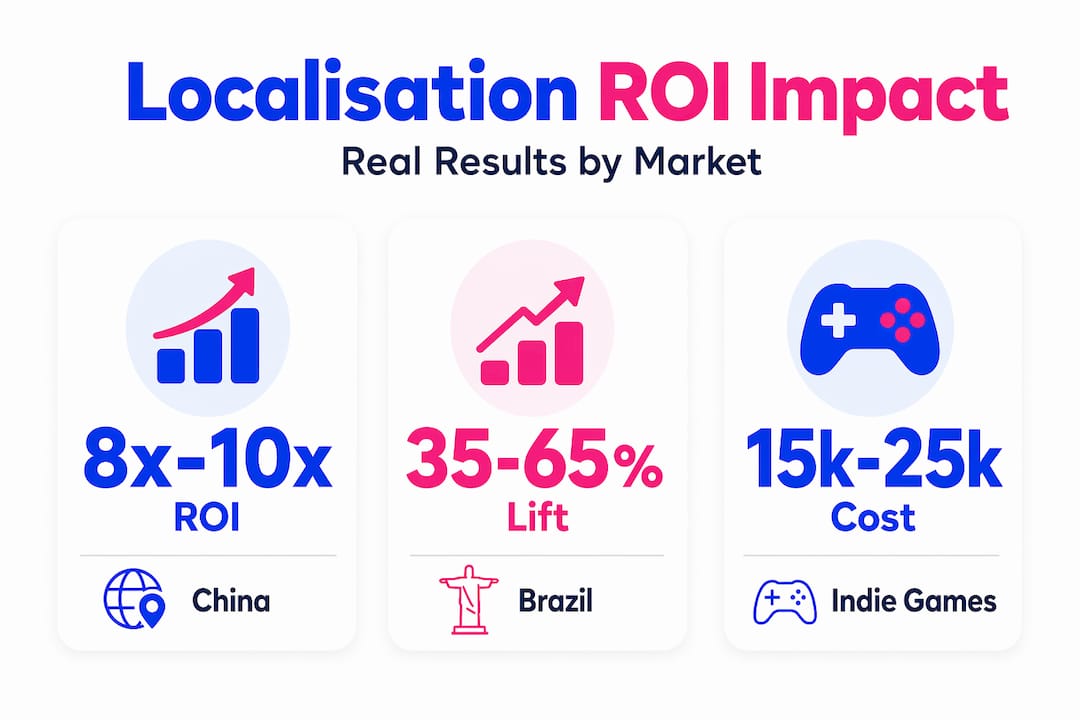
Indie game localisation costs between £0.08 and £0.12 per word for common European languages, rising to £15,000 to £25,000 for a 50,000-word game with full voice production. Against those figures, the returns are significant. Studios report a 35 to 65 per cent revenue lift in markets such as China, Brazil, and Germany following proper localisation, with a 5x to 10x return on spend achievable in the Chinese and Brazilian markets specifically.
The case of Vampire Survivors is instructive. After investing in Chinese localisation, the studio saw China become its top revenue market, a result that would have been impossible without culturally tailored content and platform-compliant submission materials.
| Market | Typical revenue lift | Estimated ROI multiplier |
|---|---|---|
| China | 50 to 65% | 8x to 10x |
| Brazil | 35 to 50% | 5x to 7x |
| Germany | 20 to 35% | 3x to 5x |
| France | 15 to 25% | 2x to 4x |
These figures illustrate why the benefits of localisation extend well beyond language. Strategic localisation is a market entry mechanism, a player retention tool, and a brand-building asset simultaneously.
Hard numbers drive decisions, but navigating localisation’s creative challenges is just as vital to long-term success.
Creative, cultural, and commercial pitfalls
Not every localisation decision is straightforward. Two of the most debated questions in the industry are: when should you translate literally, and when should you transcreate? And how much cultural adaptation is too much?
Contrasting viewpoints on localisation as cultural adaptation versus erasure are well documented in the gaming community. Fan communities have loudly criticised certain titles for what they describe as over-Westernisation, where original cultural references, character names, or storyline nuances are replaced entirely rather than adapted thoughtfully. The result is a backlash that can damage a game’s reputation before word of mouth has a chance to build positively.
Key considerations to avoid these traps include:
- Define the adaptation brief clearly before work begins. Is the goal to be faithful to the source culture, accessible to the target audience, or both?
- Hire linguists with genre expertise, not just language fluency. A translator unfamiliar with gaming conventions will miss idiomatic player language.
- Prioritise high-ROI markets first. Concentrating initial effort on China and Brazil before expanding to traditional European markets (often called EFIGS: French, Italian, German, Spanish) is increasingly sound strategy.
- Create player feedback channels post-launch so localisation quality can be monitored and refined through actual market response.
Pro Tip: When optimising the localisation process, build a glossary and style guide for every target language. Consistent terminology across text, audio, and UI reduces errors and speeds future updates significantly.
Having outlined common localisation stumbling blocks, it is time to translate theory into actionable strategy.
Actionable localisation strategies for global games
The following steps give development teams and localisation managers a reliable framework for turning localisation investment into measurable returns.
- Audit your game’s content volume early. Calculate word counts across UI strings, dialogue, tutorials, and marketing copy. This determines budget and resource requirements before work begins.
- Rank markets by revenue potential and cultural proximity. Use platform sales data and competitor performance to prioritise languages. China and Brazil typically merit early investment; smaller language pairs can follow with proven revenue.
- Integrate linguists into creative reviews. A localisation specialist reviewing quest design or character naming during development prevents expensive changes later.
- Establish a translation memory and terminology database. These tools maintain consistency across updates, DLC releases, and sequel titles while reducing per-word translation costs.
- Run LQA before every major release and update. Expert nuance on localisation as a revenue multiplier confirms that testing mechanics and UI per locale catches failures that automated tools miss entirely.
- Monitor player sentiment by region post-launch. Social media, review platforms, and community forums in each target market provide signals for where the localisation is succeeding and where refinement is needed.
A thorough localisation checklist covering every stage from pre-production to post-launch support keeps teams aligned and reduces the risk of costly oversights.
With practical actions in hand, let us challenge some industry assumptions and share a sharper perspective on strategic localisation.
Why real localisation requires more than translation budgets
Here is an uncomfortable truth the industry rarely states plainly: most localisation failures are not translation failures. They are stakeholder failures.
Studios that treat localisation as a line item controlled solely by the production budget routinely underinvest in the research, creative direction, and feedback infrastructure that make localised games genuinely resonate. A technically accurate translation of dialogue means nothing if the character’s humour lands wrong, the tutorial reads like a legal document in the target language, or the UI clips at every menu screen.
What separates games that build loyal international audiences from those that feel imported is cultural credibility. That credibility is earned through linguists who understand the genre, community managers who monitor local player sentiment, and creative leads who respect what language localisation genuinely means for a product’s identity.
Studios that embed localisation thinking into their creative and production cycles do not just reach more players. They earn the kind of loyalty that drives word-of-mouth growth in markets where advertising alone cannot penetrate. Player engagement is driven by cultural subtlety, not word count.
Take your game global with expert localisation support
Effective localisation is one of the most reliable routes to sustainable international revenue, and the strategies outlined here provide a solid starting point. For studios ready to act, Glocco® provides tailored language services that span translation, cultural adaptation, voiceover, and LQA testing across Europe, Asia, North America, and the Middle East. Whether you are entering your first international market or scaling across multiple regions, our team works with game developers and localisation managers to build workflows that deliver measurable results. Explore the benefits of localisation for your studio and start your localisation checklist to map the priorities that matter most to your next release.
Frequently asked questions
What is the difference between localisation and translation in gaming?
Localisation adapts a game’s UI, audio, cultural references, and legal compliance for a target market, whereas translation only converts written text. Game localisation goes beyond translation to cover every player-facing element of the experience.
How early should localisation be planned in game development?
Localisation should begin in pre-production so that internationalisation foundations are in place before content is created. Planning i18n before content creation ensures UI space for 30 to 40 per cent text expansion and avoids expensive retrofitting later.
Which markets offer the highest ROI for localised games?
China and Brazil consistently deliver the strongest returns, with revenue lifts of 35 to 65 per cent and return-on-spend multiples of 5x to 10x for well-localised titles.
How do players react to over-Westernisation in localised games?
Player communities often respond critically, framing excessive adaptation as cultural erasure. Fan critiques of over-Westernisation can generate sustained negative sentiment that undermines a game’s launch momentum in key markets.
What is LQA and why is it important?
LQA is linguistic quality assurance, a structured testing process that checks translation accuracy, UI layout, cultural appropriateness, and regulatory compliance before release. LQA testing covers linguistic, cosmetic, and compliance checks to ensure nothing undermines the player experience in a new market.