


Localization for labelling is one of the most direct routes to winning in new markets. Get it right and your product feels native. Get it wrong and you lose the sale before the customer even reads the price. Here is the short version of why it matters:
- Cultural fit: Localised labels speak the customer’s language, literally and culturally, lifting purchase likelihood and trust.
- Regulatory compliance: Every market carries its own labelling laws. Localization keeps you on the right side of them.
- Brand relevance: Culturally adapted messaging prevents the kind of missteps that go viral for the wrong reasons.
- Discoverability: Locale-specific keywords and structured data help your products surface in local search and AI-driven results.
- Workflow efficiency: Well-organised labels reduce errors during translation cycles and keep content management clean across product versions.
Top reasons why localization matters for your labelling
1. It drives real revenue growth
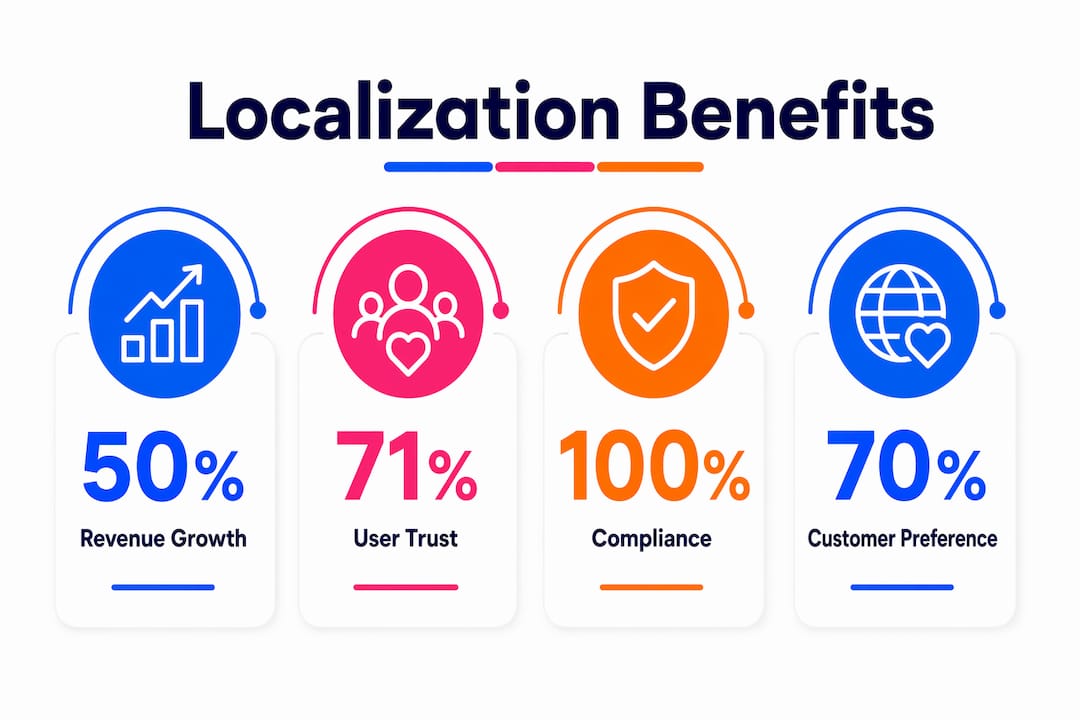
Localization drives a 20–50% revenue increase depending on quality and how deeply it is woven into the customer journey. That is not a marginal uplift. It reflects what happens when a product genuinely resonates rather than merely existing in a new market. For UK businesses expanding into Europe, the Middle East, or Asia, localised labelling is often the first touchpoint a customer encounters, so the stakes are high from the start.
2. Seven in ten users prefer their native language
71% of users report a lack of trust when they encounter poorly translated content. Separately, seven out of ten users choose content in their native language when given the option. Those two facts together tell you everything about conversion. A label that reads like it was run through a free translation tool signals carelessness, and carelessness costs you the sale.
3. Localised labelling keeps you legally compliant
Every market has its own labelling requirements, covering ingredients, safety warnings, units of measurement, and more. The EU’s General Food Law, the UK’s Food Information to Consumers Regulation, and equivalent frameworks across Asia and North America each carry specific obligations. Adapting labels to meet those requirements is not optional. Businesses that treat localization as a compliance tool, not just a marketing one, avoid costly recalls and regulatory fines.
4. It protects your brand from cultural missteps
Failing to localise cultural nuances wastes budget and damages brand reputation as customers reject inauthentic products. A colour that signals celebration in one market signals mourning in another. A phrase that is playful in British English can be offensive in a direct translation. Localised labelling and cultural adaptation catch these issues before they reach the shelf.
5. Localised labels improve international SEO
Over 41% of websites use languages other than English, and AI-powered search engines increasingly surface content that speaks natively to the user. Localised labels feed locale-specific keywords into your product pages and structured data, which directly improves discoverability. For businesses investing in multilingual SEO content, this is where labelling and marketing strategy converge.
6. It builds lasting customer loyalty
Customers notice when a brand has made the effort to speak their language properly. Consistent, culturally aware labelling across product lines signals respect and professionalism. That consistency compounds over time, turning first-time buyers into repeat customers and advocates. It is a quieter benefit than a sales spike, but it is durable.
7. Localised labelling supports supply chain efficiency
Standardised, localised labelling workflows reduce errors at every stage of the product lifecycle, from manufacturing to distribution to retail. When labels are correctly versioned and tagged for each market, warehouse teams, logistics partners, and retailers all work from accurate information. The alternative, ad hoc label updates pushed late in the process, creates costly reprints and delays.
How localization actually differs from translation
Translation swaps words from one language to another. Localization adapts the entire experience for a new market. That distinction matters enormously in practice, especially for labelling.
A translated label might correctly render the words “best before” into French. A localised label also adjusts the date format (from “12/06/2026” to “12 juin 2026”), the units (from ounces to grams), the regulatory phrasing required by French law, and the tone appropriate for French consumers. Translation handles one layer. Localization handles all of them.

The failures that make headlines are almost always translation-only jobs. A product name that sounds fine in English but carries an unfortunate meaning in Mandarin. A safety warning that is technically accurate but formatted in a way that violates local packaging law. These are not translation errors. They are localization gaps.
glocco® works beyond word-for-word conversion, adapting labelling and cultural adaptation to cover tone, imagery, regulatory language, and format for each target market. The goal is a label that feels as though it was written for that market, not exported to it.
Pro Tip: When briefing a localization partner, share your target market’s regulatory requirements alongside your brand guidelines. The two need to coexist on the label, and surfacing conflicts early saves significant rework.
Why labelling is a crucial part of any localization workflow
Labelling in localization is not just about what appears on a physical product. In software, content management, and AI-driven platforms, labels are the metadata that keeps everything organised and functional across languages. Here is why that matters operationally:
- Prevents UI breakage: System labels act as metadata to maintain consistent UI functionality during translation cycles, stopping hard-coded text from breaking interface elements when a new language is deployed. Microsoft’s Power BI, for instance, uses Localized Labels tables to manage report titles and button captions separately from the data model, precisely to avoid this problem.
- Supports version control: Localisation-aware labelling lets teams track which version of a string belongs to which market, preventing outdated translations from slipping into live products.
- Improves AI training data quality: Locale-specific labelling in AI and machine learning datasets prevents semantic drift, ensuring models understand user intent accurately across languages and cultures. The role of AI in localisation depends heavily on this foundation.
- Gives translators context: Labels that carry screenshots, usage notes, and glossary references reduce ambiguity. A translator who knows a string appears on a checkout button will make a different word choice than one working blind.
- Label granularity affects efficiency: Choosing the right level of label specificity, neither too broad nor too granular, reduces annotation effort while preserving accuracy across multi-language workflows.
How to implement localization for labelling in your business
The biggest mistake businesses make is treating localization as a post-launch fix. Integrating it from day one produces better cultural alignment and far less rework. Here is how to do it properly:
- Start with internationalisation principles at design stage. Separate translatable strings from functional code before you build, not after. Microsoft’s software localization guidance recommends storing translatable content in resource files from the outset, keeping it cleanly separated from registry keys and system functions.
- Use both system labels and user labels. System labels organise UI elements and metadata. User labels categorise content for translators and reviewers. Both are needed for a clean, scalable workflow.
- Work with a platform that manages labelling natively. glocco® recommends tools that integrate labelling management directly into the translation workflow, so labels, translations, and version history live in one place. Check the localisation checklist for a practical starting framework.
- Give translators rich context. Screenshots, style guides, glossaries, and character limits all reduce errors. A translator working with full context produces a label that fits the UI and the culture.
- Review labels regularly. Markets change. Regulations update. A label that was compliant in 2024 may need revision by 2026. Build a review cycle into your product lifecycle.
- Combine AI translation with human review for sensitive content. AI handles volume and speed. Human reviewers catch the nuance that matters in regulated or culturally sensitive categories. The combination delivers quality at scale.
Pro Tip: Assign a localization owner at the product level, not just the marketing level. When labelling decisions sit with one accountable person, consistency across markets improves dramatically.
Real-world examples of localised labelling done well
The most instructive examples of label localization come from industries where the stakes are high and the margin for error is small.

Food and beverage: A UK snack brand expanding into Germany adapted not just the language on its packaging but the nutritional labelling format, the allergen declaration order, and the portion size units to meet German food law. The result was a product that cleared customs and sat comfortably alongside domestic competitors on the shelf.
Software and SaaS: A fintech platform launching across five European markets used a Localized Labels table approach to manage its dashboard UI. By keeping button captions and report titles in a separate localisation layer, the team pushed language updates without touching the underlying data model, cutting deployment time per market significantly.
E-commerce: A UK retailer entering the Japanese market discovered that its existing size labelling (S, M, L) mapped differently to Japanese sizing conventions. Adapting the labels to include both the original notation and the local equivalent reduced returns and improved customer satisfaction scores in that market.
glocco® has supported clients across e-commerce, fintech, legal, and manufacturing with exactly these kinds of industry-specific localisation challenges. The pattern across all of them is consistent: businesses that treat labelling as a core part of their localisation strategy, rather than an afterthought, enter new markets faster and with fewer costly corrections.
Ready to take your labelling further? glocco®’s team works with businesses across the UK and beyond to build localisation workflows that hold up under regulatory scrutiny and cultural pressure alike. Explore the full picture of what localisation can do for your growth and see where your labelling strategy stands today.


