


Crowd-sourced translation is the practice of distributing translation tasks across a large group of contributors, typically via an online platform, to produce content in multiple languages at speed and scale. Unlike traditional agency workflows, it draws on communities, volunteers, or managed crowds rather than a single professional translator. Platforms like clickworker have made this model enterprise-ready, connecting businesses to contributors worldwide with built-in quality controls. The industry term you will also encounter is community translation, which describes the same distributed model with a stronger emphasis on volunteer engagement. Whether you are a gaming studio, a non-profit, or an e-commerce brand, understanding how this model works is the first step to using it well.
How does crowd-sourced translation work?
Crowd-sourced translation works by breaking content into smaller segments and assigning those segments to contributors via an open call or managed platform. Each contributor translates their portion independently. A review layer, either peer review by other contributors or a professional editor, then checks the output before it is published.
The workflow typically follows these steps:
- Content segmentation. Source text is divided into strings, sentences, or paragraphs using a translation management system.
- Contributor assignment. Tasks are pushed to a crowd via platforms like clickworker, which offer Crowd as a Service with API integration and GDPR-compliant workflows.
- Translation. Contributors work asynchronously, each handling their assigned segment.
- Peer review. Other contributors or community members check translations for accuracy and tone.
- Professional oversight. A professional translator or editor reviews high-stakes content before final publication.
This is distinct from collaborative translation, where multiple translators work simultaneously in a shared environment using cloud tools. Crowdsourcing focuses on task distribution; collaboration focuses on synchronous teamwork. Both models can run in parallel on the same project.
Pro Tip: Set clear contributor guidelines before launch. Vague briefs produce inconsistent output. Specify tone, glossary terms, and character limits upfront to cut revision time significantly.

What are the benefits and challenges of crowd-sourced translation?
The benefits of crowd-sourced translation are real and measurable. The challenges are equally real, and ignoring them is where projects go wrong.
Key benefits:
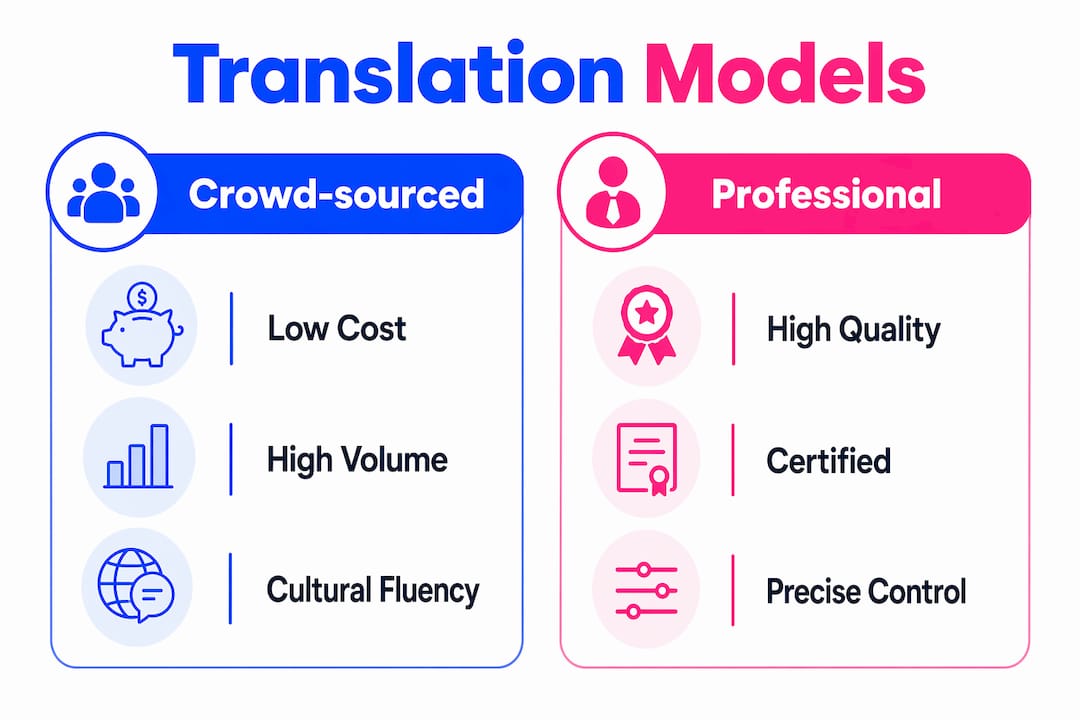
- Cost reduction. Eliminating agency fees and enabling community contributions can dramatically lower per-word costs at scale.
- Speed. Distributing tasks across hundreds of contributors compresses turnaround times for large volumes.
- Cultural fluency. Community contributors bring insider knowledge of tone, humour, and local memes that outsourced professionals often miss.
- Scalability. A crowd can handle content volumes that would overwhelm a small professional team.
Key challenges:
- Quality inconsistency. Contributors vary widely in skill. Without structured review, output quality is unpredictable.
- Contributor drop-off. Engagement falls when community members feel like unpaid labour rather than valued collaborators.
- Brand risk. Mistranslations in marketing or legal content can damage reputation or create compliance issues.
- Management overhead. Coordinating a crowd requires platform tools, clear workflows, and active moderation.
| Factor | Crowd-sourced translation | Professional translation |
|---|---|---|
| Cost | Low to near-zero for community models | Higher per-word rates |
| Speed | Fast for high volume | Moderate, depends on team size |
| Accuracy | Variable, review-dependent | Consistently high |
| Cultural fluency | High for community contributors | Varies by translator background |
| Scalability | Very high | Limited by team capacity |
| Best for | Volume content, updates, community projects | Legal, medical, brand-critical text |
The table makes one thing clear. Neither model is universally superior. The right choice depends on the content type and the stakes involved.
How does crowd-sourced translation compare to professional and collaborative translation?
These three models solve different problems. Knowing which to use, and when to combine them, is what separates effective localisation from expensive mistakes.
Professional translation uses certified or experienced translators working individually or in small teams. It delivers the highest accuracy and is the right choice for legal translation quality, medical content, and regulated documents.
Crowd-sourced translation distributes tasks via open calls to a large group. It handles volume efficiently but requires oversight. Collective intelligence across a crowd overcomes the limitations of any single translator, particularly for culturally specific content.
Collaborative translation uses shared platforms where translators work together in real time or asynchronously. It suits mid-size projects where consistency across contributors matters.
| Model | Task distribution | Best use case | Quality control |
|---|---|---|---|
| Professional | Single translator or small team | Legal, medical, brand-critical | Editor review |
| Crowd-sourced | Open call to large group | Volume content, community projects | Peer review + professional check |
| Collaborative | Shared platform, synchronous or async | Mid-size projects, software localisation | Built-in platform tools |
The most effective approach combines models. Repetitive strings go to the crowd; precise or legally sensitive text goes to professionals. This hybrid model captures the cost and speed advantages of crowdsourcing without sacrificing quality where it matters most.
Pro Tip: Run a professional translator over your contributor style guide before the project starts. One hour of expert input at the brief stage prevents weeks of inconsistent output downstream.
Which industries use crowd-sourced translation effectively?
Crowd-sourced translation is widely used across gaming, open-source, social media, non-profits, and AI training datasets. Each industry uses it differently, but the common thread is volume and speed.
- Gaming. Studios engage player communities to localise in-game text, patch notes, and community forums. Players bring cultural context that professional translators outside the community often lack. This is particularly effective for ongoing content updates where speed matters.
- Open-source software. Projects like Mozilla Firefox and LibreOffice rely on volunteer contributor communities to translate interfaces and documentation into dozens of languages. The community owns the product, so they are motivated to get the language right.
- Social media platforms. Large platforms have used crowd translation services to localise interface strings rapidly across hundreds of languages, often supplemented by machine translation for the first pass.
- Non-profits and NGOs. Organisations with limited budgets use volunteer translation communities to reach wider audiences. The mission-driven nature of the work sustains contributor engagement.
- E-commerce and marketing. Brands managing high volumes of product description translation use crowd models for repetitive content, freeing professional translators for brand-critical copy.
- AI training datasets. Technology companies use managed crowds to generate multilingual training data at scale, where volume and language diversity matter more than literary precision.
The gaming industry offers the clearest proof of concept. Community contributors produce culturally authentic translations at a fraction of the cost of outsourced agencies, and they do it faster because they are already immersed in the product.
Glocco’s take: crowd-sourcing is a tool, not a shortcut
Crowd-sourced translation gets misused more often than it gets used well. The temptation is to treat it as a free or near-free solution to a translation budget problem. That framing almost always leads to poor outcomes.
At Glocco, we have seen projects where contributor engagement collapsed because the community felt exploited rather than valued. Engagement drops sharply when contributors are treated as a source of cheap labour rather than as stakeholders with genuine ownership of the output. Recognition, clear roles, and real feedback loops are not optional extras. They are what keeps a crowd functioning as a team.
The other mistake is using crowd-sourced translation for content that demands professional precision. Crowd models work brilliantly for volume, speed, and cultural authenticity. They are not the right tool for human translators in legal contexts, medical documentation, or anything where a mistranslation carries legal or safety consequences.
The hybrid model is where the real value sits. Use the crowd for what it does best. Use professionals for what they do best. Build governance into the workflow from day one, not as an afterthought. In 2026, with AI tools accelerating first-draft translation, the crowd’s role is shifting towards review, cultural validation, and community ownership rather than raw translation volume. That shift makes contributor engagement even more critical, not less.
— glocco®
How Glocco can support your translation workflow
Glocco works with businesses across e-commerce, gaming, fintech, and the public sector to build translation workflows that actually hold up under pressure. Whether you need managed crowd translation services for high-volume content or professional oversight for brand-critical text, Glocco combines human expertise with AI translation tools to deliver quality at scale. The team has been doing this since 2014, across Europe, the Middle East, North America, and Asia. If you are weighing up crowd-sourced localisation strategies and want a clear-eyed view of what will work for your content type and budget, Glocco is a good place to start. Explore the benefits of localisation for your business and see where crowd-sourced models fit your goals.
FAQ
What is crowd-sourced translation in simple terms?
Crowd-sourced translation is the practice of distributing translation tasks to a large group of contributors via an online platform, rather than using a single professional translator or agency. It is cost-effective for high-volume content and works best when paired with professional quality review.
What is the difference between crowd-sourced and collaborative translation?
Crowdsourcing distributes tasks via open calls to a broad group working independently; collaborative translation involves multiple translators working together in a shared digital environment. Both models can be used on the same project for different content types.
What are the main benefits of crowd-sourced translation?
The main benefits are cost reduction, speed at scale, and cultural fluency from community contributors who understand local tone, humour, and context. These advantages are strongest for volume content such as game updates, software strings, and social media localisation.
Which industries use crowd-sourced translation most?
Gaming, open-source software, social media platforms, non-profits, and AI dataset development are the most active users of crowd translation services. Each relies on the model for rapid, large-volume localisation where community knowledge adds genuine value.
When should you use professional translation instead of crowd-sourcing?
Professional translation is the right choice for legal documents, medical content, regulated communications, and any text where accuracy carries legal or safety consequences. A hybrid model, crowd for volume and professionals for high-stakes content, delivers the best results overall.


