


Industry-specific translation is the process of tailoring translations to the specialised terminology, regulatory requirements, and communication standards of distinct professional fields. Generic translation treats language as a simple word-swap exercise. That works fine for a holiday postcard. It fails spectacularly in a medical device manual, a legal contract, or a financial prospectus. The reason why industry-specific translation is non-negotiable comes down to one uncomfortable truth: identical words carry different meanings depending on professional context, and in regulated industries, that difference can cost you far more than a retranslation fee.
How does industry-specific translation differ from general translation?
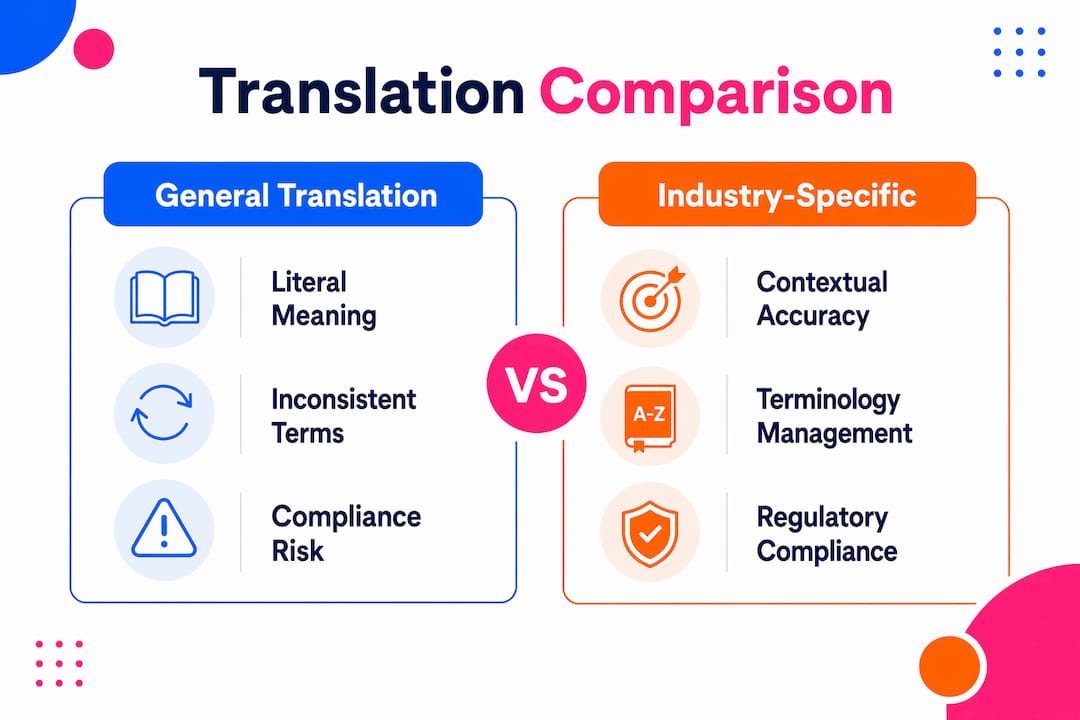
General translation converts words from one language to another. Specialised translation converts meaning, and that distinction matters enormously.
Take the word “execution.” In a software workflow, it describes a process running. In a legal contract, it means signing a binding document. Translate the wrong sense into a German commercial agreement and you have a problem that no amount of apologetic emails will fix. The same applies to “culture”: in a laboratory report, it refers to a biological sample; in a marketing brief, it describes consumer behaviour and social norms. Context determines meaning, and a general translator without domain knowledge cannot reliably distinguish between the two.

| Term | General meaning | Industry-specific meaning |
|---|---|---|
| Execution | Carrying out a task | Legal: signing a contract / Tech: running a process |
| Culture | Society and customs | Lab: biological specimen / Marketing: consumer behaviour |
| Indication | A sign or hint | Medical: approved therapeutic use of a drug |
| Consideration | Thoughtfulness | Legal: payment or benefit in a contract |
Terminology management is the other major dividing line. Regulated industries require consistent use of approved terms across every document in a product lifecycle. Regulators and auditors expect that consistency. Inconsistent terminology raises compliance concerns even when the overall text is broadly understandable. General translation services rarely maintain glossaries or termbases across projects. Specialised providers build them as standard.
Pro Tip: Ask any translation provider whether they maintain a project-specific termbase and style guide. If they look confused, that tells you everything you need to know.
What are the risks of neglecting specialised translation?
The risks are operational, financial, and in some sectors, life-threatening. That is not an exaggeration.
In healthcare, 82.4% of patient safety events involved interpretation challenges, with translation-related issues causing 31.8% of reported translation problems, according to a 2024 Pennsylvania study. That figure represents real patients who experienced delayed or missed treatments and medication errors. Poor translation in this sector is not a quality issue. It is a patient safety issue.
Regulatory consequences are equally serious. Medical device translations frequently fail compliance checks due to:
- Loss of regulatory meaning through literal translation that ignores clinical intent
- Inconsistent terminology affecting traceability across instructions for use and product labels
- Market-specific phrasing differences that increase divergence risk under EU MDR scrutiny
- Omission of safety warnings that are implied in the source language but must be explicit in the target
Financial and legal exposure follows the same pattern. A mistranslated clause in a cross-border contract can render an agreement unenforceable or expose your business to liability you never intended to accept. Legal and financial documents require the same precision and standards as the source material. Treating translation as a commodity purchase in these contexts is a false economy.
“Businesses that treat translation as interchangeable risk exposure and costly corrections. Industry-specific translation is not perfectionism. It is a practical necessity for precision industries.”
Which industries benefit most from specialised translation?
The short answer is any industry where a misread document causes harm, loss, or legal liability. The longer answer is more useful.
-
Healthcare and pharmaceuticals. Patient-facing documents, clinical trial protocols, and drug labelling all carry regulatory obligations. Language barriers increase risks of surgical delays, medication errors, and misdiagnoses. Accuracy here is non-negotiable.
-
Medical devices. Under EU MDR, every instruction for use must meet market-specific linguistic requirements. Literal translations that ignore safety intent fail regulatory approval and put patients at risk.
-
Legal services. Contracts, court documents, and compliance filings require certified translators with legal domain expertise. A certified legal translation carries legal weight that a general translation simply does not.
-
Finance and fintech. Prospectuses, fund documentation, and regulatory filings must meet the standards of each jurisdiction. Terminology errors in financial documents create liability and erode investor confidence.
-
Engineering and manufacturing. Technical manuals, safety data sheets, and certification documents require translators who understand the subject matter, not just the language.
| Industry | Primary risk from poor translation | Key document types |
|---|---|---|
| Healthcare | Patient safety incidents | Clinical protocols, patient records |
| Medical devices | Regulatory rejection | IFUs, labels, submissions |
| Legal | Unenforceable agreements | Contracts, court filings |
| Finance | Regulatory liability | Prospectuses, compliance reports |
| Engineering | Safety failures | Manuals, data sheets |
Cultural and market-specific nuance adds another layer. A financial product marketed in Germany carries different regulatory language expectations than the same product in France or Poland. Localisation, not just translation, is what makes the difference in these markets. Glocco works across all five sectors listed above, which is why the team is built around domain specialists rather than generalists.
How to choose reliable industry-specific translation services
Choosing the right provider is where many businesses go wrong. Price is the wrong filter. Domain expertise is the right one.
- Verify translator credentials. Certified translators with domain-specific qualifications are the baseline for regulated industries. For legal documents, check whether the provider works with certified legal translators who understand jurisdiction-specific requirements.
- Ask about terminology management. Glossaries and termbases maintain consistency across instructions for use, labels, and submissions to keep key regulatory meanings intact. A provider without these tools cannot guarantee compliance-grade consistency.
- Check quality assurance workflows. Reputable providers use a review stage with a second specialist, not just a spell-check. Look for ISO 17100 certification as a minimum quality signal.
- Request sector-specific references. A provider who has translated medical device documentation for EU MDR submissions understands the stakes. Ask for examples, not just testimonials.
- Assess their localisation capability. Translation and localisation are related but distinct. If your business operates across multiple EU markets, you need a provider who handles both. A structured localisation workflow reduces errors and keeps your documentation consistent across languages.
Pro Tip: Request a sample translation of a short, terminology-heavy document from your sector before committing to a provider. The quality of that sample tells you more than any sales conversation.
Glocco’s view: why getting this right changes everything
Here is what a decade of working with businesses across healthcare, fintech, legal, and engineering has taught us at Glocco. The businesses that get burned by poor translation almost never chose a bad provider deliberately. They chose a fast one, or a cheap one, or one that said “yes” to everything without asking the right questions.
The most common mistake is treating translation as the final step in a process rather than an integral part of it. When a medical device manufacturer brings us in after the regulatory submission has already failed, the cost of correction is always higher than the cost of getting it right the first time. The same pattern appears in legal and financial work.
Linguistic precision is not about being fussy. It is about protecting your business from avoidable risk. When Glocco assigns a translator to a medical or legal project, that person has domain knowledge in the subject matter, not just language fluency. That distinction is what separates a compliant document from a costly one. We also maintain termbases for every client, because terminology control is compliance, not a nice-to-have extra.
— glocco®
How Glocco supports businesses that need expert translation
Glocco has worked with businesses in healthcare, legal, fintech, engineering, and manufacturing since 2014, delivering translations that meet regulatory and operational standards across Europe, the Middle East, North America, and Asia. Whether you need document translation for EU compliance or sector-specific localisation across multiple markets, the team brings certified domain expertise to every project. Glocco’s quality assurance workflows include terminology management, specialist review, and compliance-oriented processes built for regulated industries. If your business operates in a sector where accuracy is not optional, Glocco is the provider worth talking to. Get in touch to discuss your specific requirements and find out how the right translation partner protects your business.
FAQ
What is industry-specific translation?
Industry-specific translation tailors language conversion to the terminology, regulatory standards, and communication norms of a particular professional field. It differs from general translation by prioritising domain accuracy over word-for-word equivalence.
Why does general translation fail in regulated industries?
General translation lacks the domain knowledge and terminology management needed for compliance. Inconsistent terminology across regulated documents can trigger audit concerns and regulatory rejection even when the text is broadly readable.
Which sectors need specialised translation most urgently?
Healthcare, medical devices, legal services, finance, and engineering carry the highest risk from poor translation. In healthcare alone, translation-related issues contributed to 31.8% of reported patient safety problems in a 2024 Pennsylvania study.
How do I verify a translation provider’s sector expertise?
Ask for domain-specific credentials, a sample translation from your sector, and evidence of terminology management tools such as glossaries or termbases. ISO 17100 certification is a reliable baseline quality indicator.
Is localisation the same as industry-specific translation?
Localisation goes further than translation by adapting content to cultural, regulatory, and market-specific expectations. For businesses operating across multiple EU markets, both are needed. You can learn more about translation in legal compliance and how the two processes work together.


