


Legal translation is one of the highest-stakes language tasks in existence. A misplaced word in a contract can void a clause. A missed negation can reverse a prohibition. Despite this, a surprisingly common belief persists: that AI and machine translation can handle legal texts reliably on their own. The role of technology in legal translation is real and growing, but the full picture is far more nuanced than “just use AI.” This article cuts through the noise and gives you a clear, evidence-based view of what technology can and cannot do for legal translation in 2026.
Technologies transforming legal translation today
The toolkit available to legal translators has expanded dramatically. Understanding what each tool does helps you make smarter decisions about where to use them.
Here is a breakdown of the main technologies in play:
- Machine translation (MT): Systems like DeepL and GPT-4 use neural networks to produce translations automatically. GPT-4 scores 8.5/10 for legal translation quality overall, while DeepL excels with European language pairs and glossary integration.
- Translation memory ™: Software that stores previously translated segments and reuses them in new documents. For law firms producing high volumes of similar contracts, TM cuts both time and cost significantly.
- Glossary management tools: Domain-specific glossaries lock in approved terminology so that “force majeure” is never rendered inconsistently across a 200-page agreement.
- AI-powered quality assurance: Tools that flag inconsistencies, missing segments, and formatting errors before a document reaches a reviewer.
These technologies do not operate in isolation. The most effective setups pair AI tools with qualified human translators, creating a workflow where technology handles volume and humans handle judgement. If you want a deeper look at which platforms work best, glocco® has covered the top AI tools worth considering for legal work.
AI accuracy: strengths and real limitations

Here is where things get interesting. And a little alarming.
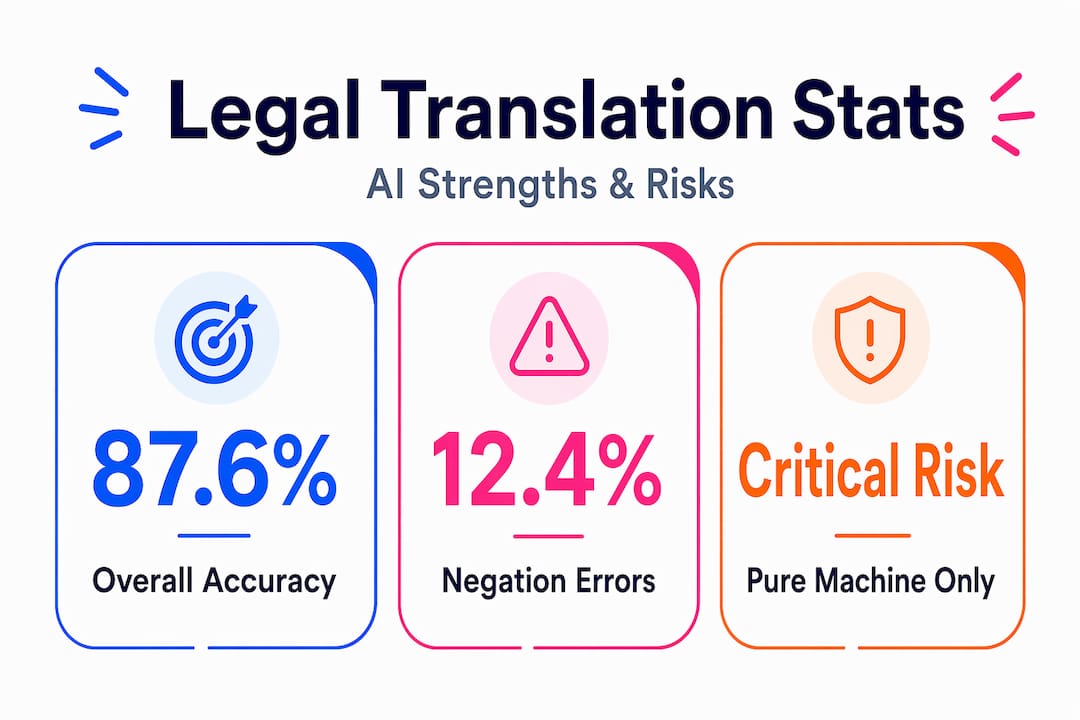
A study testing 500 contracts for accuracy found that AI-assisted legal translation achieved 87.6% overall accuracy. Sounds reasonable. But buried in that figure is a 12.4% negation error rate. In legal language, negation is everything. “The licensor shall not be liable” becoming “The licensor shall be liable” is not a translation quirk. It is a liability catastrophe.
| Error type | Risk level | Example impact |
|---|---|---|
| Negation errors | Critical | Reverses prohibitions or obligations in contracts |
| Jurisdiction-specific concepts | High | Legal terms with no direct equivalent are mistranslated |
| Conditional logic errors | High | “Unless” and “provided that” clauses misread |
| Formatting inconsistencies | Medium | Clause numbering and structure lost or altered |
| Inconsistent terminology | Medium | Same legal term rendered differently within one document |
The data is clear. Pure machine translation is not acceptable for legally binding documents. The risks are not theoretical. They are measurable, repeatable, and costly.
Pro Tip: Before sending any AI-generated legal translation for signing, run a targeted review specifically focused on negation, conditionals, and jurisdiction-specific terms. These are the areas where errors are most likely and most damaging.
Hybrid workflows that actually work
The good news: you do not have to choose between speed and accuracy. The answer is a hybrid workflow, and it is already proving itself in practice.
Over 55% of legal firms now use AI-assisted translation, reporting a 60% reduction in turnaround time and 40% cost decreases. Those numbers come from combining AI with human review, not from using AI alone.
A well-designed hybrid workflow looks like this:
- AI first draft: Machine translation produces the initial translation, handling volume at speed.
- Terminology check: Glossary tools verify that all key legal terms match approved definitions.
- Human post-editing (MTPE): A qualified legal translator reviews the full document, correcting errors with particular attention to negation, conditionals, and jurisdiction-specific language.
- Quality assurance pass: Automated QA tools flag any remaining inconsistencies before final review.
- Certification: A certified translator signs off on the final document for court filings, notarised documents, or regulatory submissions.
This structure achieves over 95% accuracy when applied properly. It is also flexible. Internal review documents might only need steps one through three. Court filings need all five.
“Hybrid machine translation post-editing workflows offer the best balance of speed, cost savings, and quality in legal translation.” — NLLB Research, 2026
The upcoming 2026 ISO 18587 revision formally expands its scope to cover AI-assisted post-editing, which means hybrid workflows are not just best practice. They are becoming the regulated standard.
Why human translators remain irreplaceable
Technology advancements in legal translation are real. But they have not changed one fundamental truth: legal language is human language, shaped by culture, history, and jurisdiction.
Consider what a human translator brings that no AI currently replicates:
- Cultural mediation: Legal concepts do not travel cleanly across borders. A qualified translator understands that “good faith” in English common law and “bonne foi” in French civil law carry different legal weights.
- Contextual judgement: Humans read a document as a whole. AI reads it segment by segment, which is why conditional logic across clauses can break down.
- Confidentiality awareness: Human translators operate under professional codes of conduct. AI platforms processing sensitive documents raise legitimate data protection concerns.
- AI training and correction: Experienced translators are the people who identify AI errors, feed corrections back into systems, and improve future outputs.
As Prof. Sandra Hale notes, machines process patterns but cannot understand meaning. For legal translation, that distinction is not philosophical. It determines whether a document holds up in court.
“AI cannot fully grasp nuanced legal concepts or cultural context; human translators act as cultural mediators and AI trainers.” — ATA, 2026
If you want a thorough breakdown of why human expertise still defines legal translation quality, it is worth reading in full.
Optimising legal translation for your business
Knowing the tools exist is one thing. Deploying them well is another. Here is what separates teams that get results from those that accumulate risk.
Choose platforms that have been trained on legal corpora specific to your practice areas. A general-purpose MT engine will not understand the difference between “shall” and “may” the way a legally trained model will. Legal AI systems struggle primarily due to a lack of structured cross-jurisdictional data, so client-specific glossaries and traceability features matter enormously.
Establish a glossary from day one. Define approved translations for every key term your organisation uses repeatedly, and update it as legislation evolves. This single step alone eliminates a large category of consistency errors.
Build multi-stage review into your process as a non-negotiable. Not a nice-to-have. If your current workflow sends AI output directly to a client without human review, you are carrying risk that no cost saving justifies.
Pro Tip: Audit your existing legal translation workflow every six months. Map where AI is used, where human review occurs, and where the handoff points are. Most workflow failures happen at those handoffs, not within the tools themselves.
Glocco® has produced a practical guide on translating legal documents accurately that covers these workflow decisions in detail for EU and global teams.
My honest take on technology in legal translation
I have seen both sides of this. The excitement when AI cuts a 10-day turnaround to two. And the quiet dread when someone spots a negation error in a signed agreement that no one caught.
What I have learned is this: AI is a genuinely powerful tool for legal translation, but its power is only safe when it is contained within a well-designed human process. The teams that get the best results are not the ones using the most advanced AI. They are the ones who have thought hardest about where human judgement must sit in the workflow.
The future of technology in legal translation belongs to AI as a collaborator, not a replacement. Translators who build technical skills alongside cultural and legal expertise will define what excellent legal translation looks like in the years ahead. That is not a threat to human expertise. It is an upgrade of it.
The organisations I have seen struggle are the ones treating MT as the end of the process rather than the beginning. Do not make that mistake.
— glocco®
How glocco® supports legal translation teams
At glocco®, we combine certified human legal translators with the right AI and translation memory tools to give your documents both speed and accuracy. Whether you need document translation for EU businesses, court-ready certified translations, or a full glossary management setup, our team is built for exactly this kind of work. We follow hybrid MTPE workflows aligned with the latest ISO standards, so your translations hold up whether they are heading to a boardroom or a courtroom. Explore how glocco® can support your legal translation needs across Europe, the Middle East, and beyond.
FAQ
Can AI translate legal documents accurately?
AI-assisted translation achieves around 87.6% overall accuracy, but carries a 12.4% negation error rate that makes pure machine translation unsuitable for legally binding documents without human review.
What is a hybrid legal translation workflow?
A hybrid workflow pairs AI-generated first drafts with multi-stage human post-editing and certification. This approach achieves over 95% accuracy and significantly reduces both cost and turnaround time compared to fully manual translation.
Which AI tools are best for legal translation?
GPT-4 rates highest overall for legal translation quality with prompt customisation, while DeepL performs particularly well for European language pairs combined with glossary features for terminology consistency.
Do I still need a certified translator if I use AI?
Yes, especially for court filings, notarised documents, and regulatory submissions. Certified translators provide the legal accountability and cultural judgement that AI cannot replicate, and their review is what transforms a draft into a reliable, compliant document.
What are the new ISO standards for AI translation in 2026?
The ISO 18587 revision expands its scope to formally include AI-assisted translation post-editing, reflecting the growing acceptance of hybrid workflows as the regulated standard for professional translation quality.


