


You have a great product. You have ambition. But half your potential customers are reading in a language your website does not speak. That is the reality for thousands of EU businesses right now. A well-built multilingual website is not a luxury; it is the difference between being found and being invisible. This multilingual website guide covers everything from planning and technical setup to content localisation and SEO, so you can build something that genuinely works across borders and languages.
Planning your multilingual website project
Before you write a single line of code or translate a single word, you need a plan. Rushing into multilingual expansion without data behind you is how companies waste months and money.
Start by analysing your existing audience. Where is your traffic already coming from? Which markets are showing organic demand you are not yet serving? Google Analytics, Search Console, and CRM data can reveal surprising pockets of interest. An EU e-commerce business, for example, might find that 18% of its traffic is from the Netherlands despite the site being English only. That is a signal, not a coincidence.
From there, think strategically about which languages to add:
- Prioritise by commercial potential, not geography alone. Portuguese in Brazil and Portuguese in Portugal are different markets with different purchasing behaviours.
- Factor in cultural nuances early. French spoken in France versus Belgium carries different idioms, legal references, and consumer expectations.
- Check EU accessibility obligations. The EU Directive 2019/882 requires businesses to meet digital accessibility standards, effective from 28 June 2025. Your multilingual design must account for this from the start.
- Define localisation scope. Decide upfront whether you need full transcreation or functional translation per market.
Pro Tip: Use glocco®’s localisation checklist to map your target languages against market size, competitive gap, and localisation complexity before committing resources.
Technical architecture and URL structure
This is where most businesses make their costliest mistakes. Get the architecture wrong and no amount of great content will save your multilingual SEO.
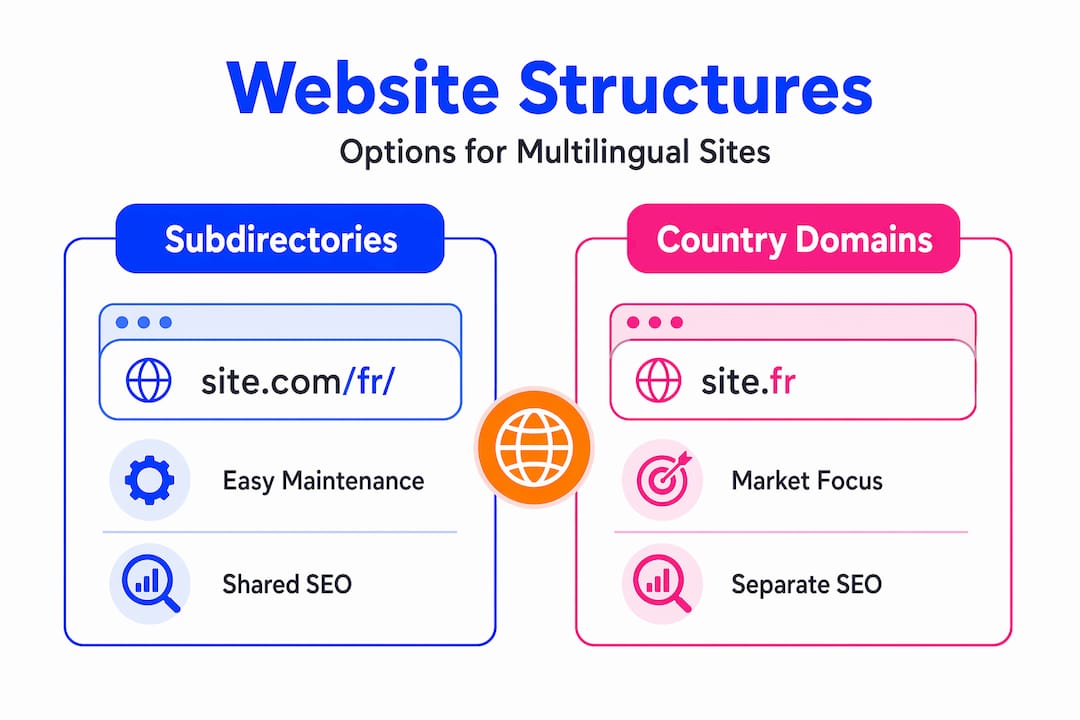
You have three structural options, each with genuine trade-offs:
| Structure | Example | Pros | Cons |
|---|---|---|---|
| Subdirectory | site.com/fr/ | Easy to maintain, shares domain authority | Less regional signal than ccTLD |
| Subdomain | fr.site.com | Flexible hosting per locale | Treated as separate site by some crawlers |
| ccTLD | site.fr | Strongest local trust signal | Expensive, complex to manage across many markets |
For most EU businesses starting out, subdirectories offer the best balance of SEO benefit and maintenance practicality.
Once your structure is sorted, hreflang tags become non-negotiable. Here is how to implement them correctly:
- Add hreflang annotations to every page in every language version.
- Make sure the tags are reciprocal, meaning the French page must reference the German page and vice versa. Hreflang reciprocity is one of the most commonly broken rules in multilingual SEO.
- Use "x-default` as a fallback for users whose language or region has no matched version. The x-default tag should point to an indexable page such as a language selector, not just default to English.
- Avoid IP-based redirects. They confuse crawlers, block indexing, and frustrate users on VPNs.
- Canonicalise each locale page to itself, not to a master language version.
Cultural SEO signals matter just as much. Use locale-specific variants like es-ES and es-MX rather than treating Spanish as one monolithic block. Pair this with structured data that includes areaServed and priceCurrency so AI-driven search engines can correctly associate your content with the right market.
Pro Tip: Avoid keyword cannibalisation from the start by planning which pages target which locale keywords. This is not just good practice; fixing cannibalisation issues can double catalogue traffic within six weeks.
Creating localised content that actually connects
Translation is not localisation. This distinction sounds simple but businesses ignore it constantly, and their conversion rates show it.

Transcreation goes beyond swapping words. It adapts tone, cultural references, humour, legal context, and even the examples used to match a specific market’s expectations. A French audience expects GDPR references framed differently than a Spanish one, where local legal references like LOPDGDD are expected. A Mexican audience will look for PROFECO references and local payment methods. Getting these details right builds instant credibility.
Here is what a solid content localisation process looks like in practice:
- Conduct locale-specific keyword research. Do not translate your English keywords directly. Search behaviour differs. “Cheap flights” in English does not map neatly to the equivalent phrase in Polish or Romanian.
- Write market-specific FAQs. What Germans ask about a product is often structurally different from what Italians ask. Build these in from scratch per locale.
- Use native copywriters or post-edit AI output. Pure machine translation damages credibility. The best approach combines AI speed with human cultural oversight.
- Set up a content update workflow. When the English version changes, a trigger should notify the localisation team for each affected language.
The role of AI in multilingual SEO content creation has expanded dramatically. AI tools now handle first drafts, terminology consistency, and translation memory management at scale. But they still need human judgement for cultural accuracy, especially in regulated sectors like legal, medical, or fintech.
Pro Tip: Tag your CMS content by locale and last-updated date. Stale translated content is worse than no translation. It signals neglect to both users and search engines.
SEO and technical optimisation for the long term
A multilingual site is never truly finished. It requires consistent attention to stay competitive. Here are the most impactful areas to maintain:
- Structured data per locale. Implement
LocalBusiness,FAQPage, andAggregateRatingschemas in JSON-LD format for each language version. Structured data schemas directly impact voice search results and rich snippets, both increasingly important in AI-powered search. - Use IndexNow for faster indexing. After adding IndexNow, URLs get indexed within 72 hours on Bing and Yandex rather than waiting weeks for a crawl.
- Build regional backlinks. Link equity from a Spanish .es domain carries more cultural SEO weight for the Spanish market than a generic .com link. Reach out to local industry associations, press, and directories per locale.
Here is a quick-reference table for ongoing SEO tasks:
| Task | Frequency | Priority |
|---|---|---|
| Hreflang audit | Quarterly | High |
| Locale keyword refresh | Every 6 months | High |
| Structured data validation | After any CMS update | Medium |
| Content freshness check | Monthly | Medium |
| Regional backlink outreach | Ongoing | High |
Multilingual SEO is now a full marketing function. It integrates translation, localisation, metadata, and market-specific keyword strategy. Treat it like one.
My take on AI, cultural SEO, and what businesses still get wrong
I have worked with businesses across Europe, the Middle East, and North America on multilingual digital projects. What I keep seeing is this: companies invest heavily in the technical side and then skimp on the cultural layer. They think once the hreflang tags are in place, the work is done. It is not.
Cultural SEO is where the real differentiation happens. AI-driven search engines are getting better at associating content with specific markets, but only if you give them the right signals. Generic, literally translated content gets treated as noise, not relevance.
AI tools have genuinely changed how multilingual sites get built. Traditional development costs for multilingual websites ranged from $50,000 to $500,000+. AI has reduced those barriers significantly. But speed without quality assurance is a trap. I have seen brands publish AI-translated content that was grammatically correct but culturally tone-deaf, and they lost trust in markets they had spent years trying to enter.
The businesses that succeed treat localisation as a continuous, human-led process supported by smart tools. Not the other way around.
— glocco®
How glocco® can help you build it right
Building a multilingual website that ranks, converts, and complies takes more than a good CMS plugin. glocco® combines AI-enhanced translation technology with expert human localisation specialists who understand the cultural and legal nuances of each EU market. Whether you need document translation for EU businesses to support compliance, a localisation strategy for a new market entry, or ongoing content management across multiple languages, glocco® has the tools and the team. From fintech to e-commerce to legal services, glocco® has helped organisations across Europe reach the audiences they were missing. Ready to stop leaving markets on the table?
FAQ
What is a multilingual website guide?
A multilingual website guide is a practical resource covering how to plan, build, and manage a website in multiple languages. It typically covers language selection, technical architecture, content localisation, and SEO.
How do hreflang tags help multilingual SEO?
Hreflang tags tell search engines which language and regional version of a page to serve to which users. Incorrect or missing reciprocal tags are one of the most common causes of poor multilingual search performance.
Should I use machine translation for my multilingual site?
Machine translation can speed up first drafts, but pure machine translation often produces errors that damage brand credibility. Human review and cultural editing are needed for accuracy and trust.
What is the difference between translation and localisation?
Translation converts text from one language to another. Localisation adapts content to suit the cultural, legal, and behavioural expectations of a specific market, including terminology, examples, legal references, and tone.
How many languages should an EU business prioritise first?
Start with the languages where you have existing organic traffic or clear commercial demand. Use audience data rather than assumptions. Two or three well-localised languages will outperform ten poorly translated ones every time.


