


Manual translation workflows are quietly draining resources from businesses that should be growing. You commission a translation, wait days or weeks, chase approvals, and then realise the source content changed. Sound familiar? This is exactly why use cloud translation is a conversation happening in boardrooms across every sector. Global markets are expanding fast, multilingual content demand is surging, and the old way of handling translation simply cannot keep pace. This article covers what cloud translation is, its benefits, cost realities, practical adoption steps, and why it matters more now than ever.
How cloud translation works
Cloud translation means processing and managing your multilingual content via internet-connected servers and platforms rather than desktop tools or manual file exchanges. The real muscle here sits in the cloud-based Translation Management System, or TMS. Think of it as your translation control centre. Everything lives in one place: your source files, translated strings, terminology glossaries, contributor access, and project history.

A cloud TMS does more than store files. It centralises localisation workflows, giving managers real-time progress dashboards, live contributor collaboration, and the ability to shift timelines based on actual data rather than guesswork. Tasks are allocated automatically, version control prevents costly overwrite errors, and translation memory banks reuse previously approved segments to save time and budget.
Here is what a modern cloud TMS typically connects to:
- CMS platforms (WordPress, Contentful, Drupal) for automatic content ingestion
- Customer support tools (Zendesk, Intercom) for multilingual help content
- E-commerce systems to localise product listings across markets
- Developer pipelines via API for software localisation in real time
- Chatbots and conversational AI for localised automated responses
This integration layer is what separates cloud translation from simply using a browser-based translation app. It is a connected, automated ecosystem that fits into how your business already operates.
Key benefits of cloud translation
The benefits of cloud translation are concrete and measurable. Let us go through the most significant ones.
-
Speed at scale. Projects that once took weeks can now be completed in minutes using cloud TMS automation. Repetitive tasks like file preparation, task assignment, and delivery notifications happen without manual input.
-
Real cost efficiency. Translation memory means you never pay twice for the same approved sentence. Combined with AI suggestions for first drafts, the actual human effort drops significantly.
-
Collaboration without borders. Your in-house linguists, freelance reviewers, and subject-matter experts all work from the same central dashboard with live updates. No more emailing spreadsheets back and forth.
-
Genuine scalability. Adding languages and contributors requires zero extra infrastructure. The system handles the volume increase without slowing down.
-
Better quality output. Hybrid translation that combines AI suggestions with expert human review delivers both speed and accuracy. Neither alone gets you there as reliably.
-
Security you can trust. Centralised cloud environments with role-based access protect sensitive content far better than sending Word documents over email ever could.
Pro Tip: Start by calculating how many words your business translates per month and what percentage are repeated segments. You will likely find translation memory alone covers the cost of your cloud TMS subscription within the first quarter.
Cloud translation technologies and costs in 2026
Not all cloud translation is built the same. Understanding the technology options helps you spend wisely.
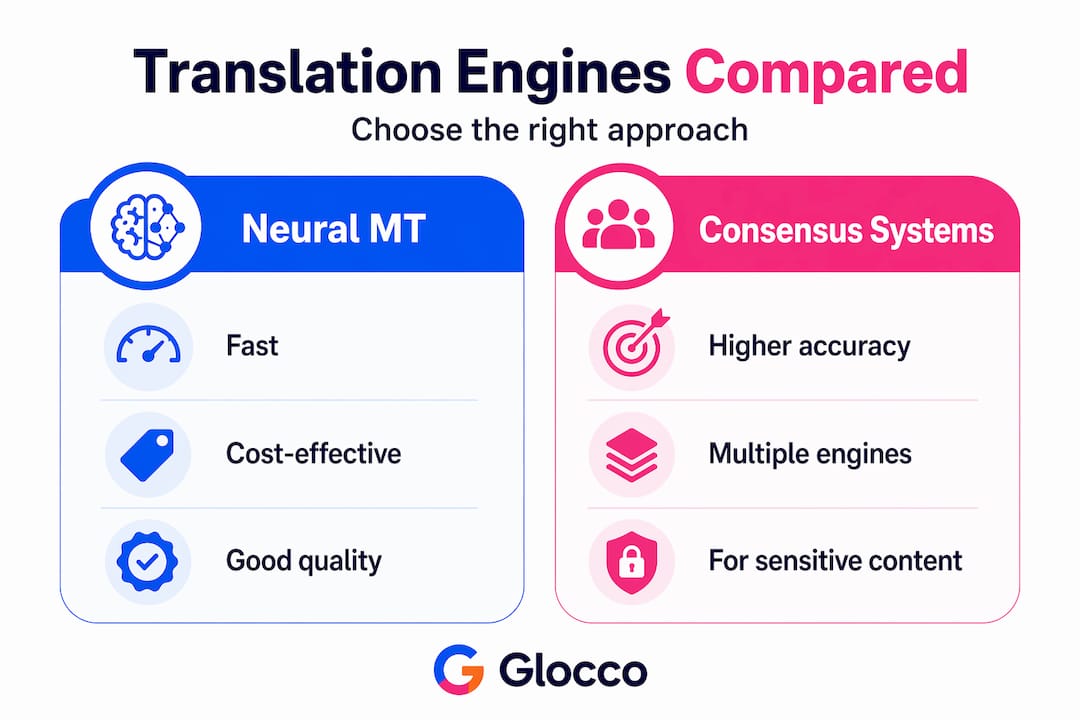
There are two dominant translation engine types right now. Neural Machine Translation (NMT) models are fast and cost-predictable. Large Language Model (LLM) based translation is more context-aware and better for nuanced or marketing copy. Standard NMT APIs cost around £16 per million characters, while LLM-based models range from £4 to £40 per million characters depending on complexity and provider.
Where things get really interesting is in consensus-based systems. Rather than relying on one engine, these systems run your text through multiple models and compare outputs. Consensus translation can reduce errors by up to 90%, with accuracy scores reaching 98.5 out of 100. For regulated industries like legal, medical, or fintech, that gap between 85% and 98.5% accuracy is not trivial. It is the difference between a usable document and a liability.
Here is a quick comparison to help you choose:
| Technology | Cost range | Best for | Speed | Quality |
|---|---|---|---|---|
| Standard NMT API | ~£16/M chars | Bulk, low-risk content | Very fast | Good |
| LLM-based translation | £4–£40/M chars | Marketing, legal, nuanced copy | Moderate | Excellent |
| Consensus-based AI | Variable | Regulated, high-risk content | Moderate | Highest |
| Human-only review | Per word/hour | Final approval layer | Slowest | Gold standard |
Google Cloud Translation offers over 130 languages with a permanent free tier of 500,000 characters per month, which is genuinely useful for testing or low-volume use cases before you commit to a paid plan.
One of the most overlooked cost tactics is batching. Grouping up to 2,048 strings into a single API call reduces both latency and per-call charges meaningfully. It requires a small amount of technical configuration, but it pays back quickly.
Pro Tip: Tier your content by risk. Fast, cheap NMT models work well for internal communications or product metadata. Save premium LLM or human review for customer-facing legal documents, product safety information, or brand campaigns where accuracy directly affects trust.
Applying cloud translation effectively
Knowing the technology is one thing. Getting it to work in your organisation is another. Here is a practical framework to get started.
- Audit your content volume and types first. Know what you are translating, how often it changes, and what the quality stakes are for each content category.
- Design your workflow before you choose your tools. Effective implementation requires clear workflows integrated with your existing content systems, not the reverse.
- Build and maintain consistent glossaries. Custom glossaries and terminology models in cloud platforms protect your brand voice across all languages.
- Train your team on the platform. Cloud TMS tools are only as good as the people using them. Even a two-hour onboarding session makes a noticeable difference to output quality.
- Monitor your dashboards and act on the data. Most platforms give you quality scores, turnaround times, and translator performance metrics. Use them.
- Avoid the two most common pitfalls. Do not spend premium LLM budget on low-stakes internal content. And never skip human review entirely on content that represents your brand externally.
The future of translation is genuinely hybrid: AI handles the volume and speed, humans handle the nuance and final judgement. The organisations winning at global communication right now have accepted both sides of that equation.
Why cloud translation is the future
The importance of cloud translation will only grow. Language diversity in global markets is increasing, not stabilising, and regulatory requirements for multilingual content are tightening across the EU and beyond. Customers expect to be spoken to in their language, in real time, with cultural sensitivity. That expectation is now a baseline, not a differentiator.
The cloud translation advantages that matter long-term are adaptability and speed of iteration. When AI models improve, a cloud-connected platform adopts them. When you enter a new market, you add a language without rebuilding your infrastructure. Automated cloud workflows orchestrate machine translation, review, and publishing in a continuous cycle, meaning your localised content stays current rather than perpetually catching up.
Our take on cloud translation
I have worked with businesses across e-commerce, fintech, and legal sectors on translation adoption, and the pattern is always the same. The ones who held back on cloud translation were not sceptical about quality. They were worried about losing control. What I have learned is that cloud translation actually gives you more control, not less. Live dashboards, role-based access, version history, and quality metrics tell you exactly what is happening at every stage.
The pitfall I see most often is overconfidence in AI alone. A client once pushed a full product catalogue live using only NMT output without human review. The translations were technically accurate but culturally flat, and conversion rates in the new market suffered for it. The blend of AI tools and expert linguist oversight is not a nice-to-have. It is what makes the difference between content that converts and content that just exists.
My honest advice: start with one content type, one language pair, one integrated workflow. Get that right. Then scale it with confidence.
— glocco®
How glocco® can help you get there
If you are weighing up whether cloud translation is the right move for your organisation, glocco® has been helping businesses across Europe, the Middle East, and North America make that shift since 2014. From document translation for EU businesses to AI-integrated localisation workflows, the approach glocco® takes is always tailored to your content types, risk levels, and markets. Whether you are just beginning to explore cloud-based tools or ready to overhaul a fragmented translation process, glocco® can map out a workflow that works. Explore the AI translation resources on the glocco® website, or get in touch to discuss your specific needs with the team directly.
FAQ
What is cloud translation?
Cloud translation is the process of translating content using internet-connected platforms and servers, rather than local software or manual file exchanges. It typically involves a cloud-based Translation Management System that centralises workflows, contributors, and assets in one place.
Why choose cloud translation over traditional methods?
Cloud translation offers faster turnaround times, lower costs through automation and translation memory, and better collaboration across distributed teams. It also scales easily as your content volume or language requirements grow, without additional infrastructure investment.
How does cloud translation work with existing systems?
Cloud TMS platforms integrate directly with content management systems, e-commerce platforms, customer support tools, and developer pipelines via API. This means translated content can be published automatically without manual file handling.
What does cloud translation cost?
Costs vary by technology. Standard NMT APIs cost roughly £16 per million characters, while LLM-based models range from £4 to £40 per million characters depending on complexity. Many providers also offer free tiers for low-volume or testing use cases.
Is cloud translation secure enough for sensitive business content?
Yes. Cloud translation platforms use encrypted environments and role-based access controls to protect sensitive content. This is significantly more secure than emailing translation files or sharing documents through uncontrolled channels.


