


A software licence is a contract, so its translation has to work like one. Every defined term, cross-reference and limit must mean the same thing in Slovak as in the original. That takes a translator who knows software law, not just both languages. glocco® translates legal and technical content for companies in the EU, and our HumanLegal service exists for exactly this kind of document. Here is what to check, and where it goes wrong.
What a licence says, and what must survive translation
First, a quick refresher. A software licence normally gives the customer a limited permission to use the software, not ownership. According to BLG’s practical guide to software licence agreements, it sets out who may use the software, for what purpose, in what manner, where and for how long. It also covers restrictions, fees, warranties, liability and termination. Use beyond that scope is a breach, and that can mean financial liability or early termination.
So the clauses that carry the most risk in translation are:
- The licence grant: users, territory, duration, number of installations.
- Restrictions: reverse engineering, modification, sublicensing.
- Fees and metrics: what counts as a user, a seat or a transaction.
- Warranty, liability and termination: where a wrong verb can shift the risk.
A mistranslated “may” or “shall” is not a typo. It changes who is allowed to do what.
Keeping terms and structure consistent
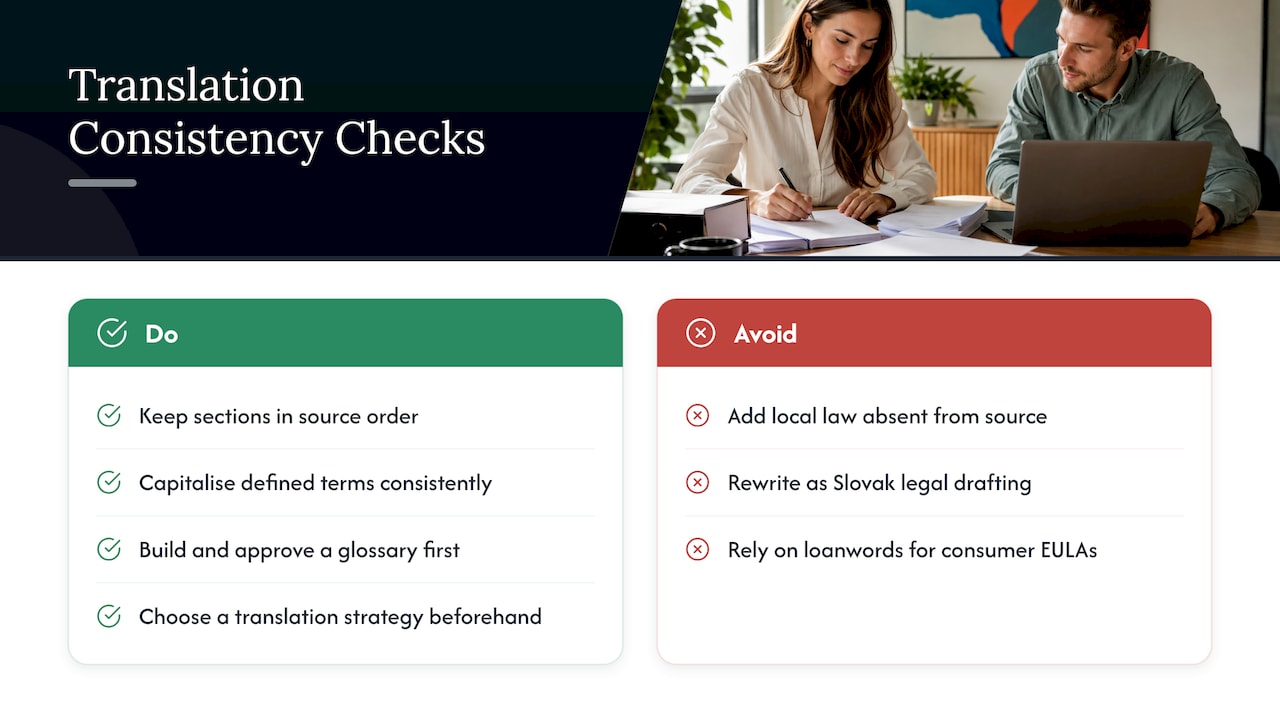
The Creative Commons legal tools translation guide gives a sensible baseline. Keep definitions and sections in the same order so cross-references stay valid. Translate each defined term the same way and capitalise it throughout. Do not add references to local legislation that the original does not contain.
That last point matters. The translation should say what the English says, not what a Slovak lawyer would have drafted from scratch.
There is also a style choice. A study of EULA translation into Spanish recommends functional equivalents, meaning terms that do the same legal job in the target system. It warns that loanwords can be treated as void or irrelevant by judges. For consumers protected by EU law, the translated EULA becomes the only contract. For business users, a more documentary translation that stays close to the source can be enough. Decide which one you need before the work starts.
Practical tip: build a glossary of defined terms (“Licensed Software”, “Authorised User”, “Affiliate”) before translating. Then approve it once. It saves a week of back and forth.
Slovak law checks before you publish or sign
For Slovakia, the anchor is the Copyright Act 185/2015 Z.z. Under § 65 of the current text (effective 1 September 2026), a licence agreement gives the acquirer the author’s consent to use the work. An exclusive licence must be in writing. Part of the content can be set by reference to licence terms that were known or available to the parties when the contract was concluded. That is the legal basis for click-wrap EULAs and general terms used by Slovak vendors.
What that means for your translation:
- Scope, duration and remuneration must be clear. Vague wording in Slovak is as risky as vague wording in English.
- The work must be identified precisely. The authors’ society LITA stresses that a licence agreement which does not identify the work lacks a basic element and is invalid. It also says the title of a contract is not decisive, only its content.
- Put commercial licences in writing. The same LITA guide notes that the law requires written form only for exclusive licences, but recommends a written contract for commercial use.
Slovak vendors show the local pattern. InterWay’s 2025 terms limit the licence to the EU territory, tie it to installations and version, and prohibit translation into other languages and decompilation without written consent. If your own licence has a territory clause, make sure the Slovak version states it identically.
Selling software online across the EU? The product pages that lead to the licence need to be found in each language too. A multilingual SEO method helps there. Your terms and conditions deserve the same care, and our guide to Slovak T&Cs translation covers it.
When you need an official Slovak translation
Most of the time, a high-quality professional translation is all you need. Three situations call for more.
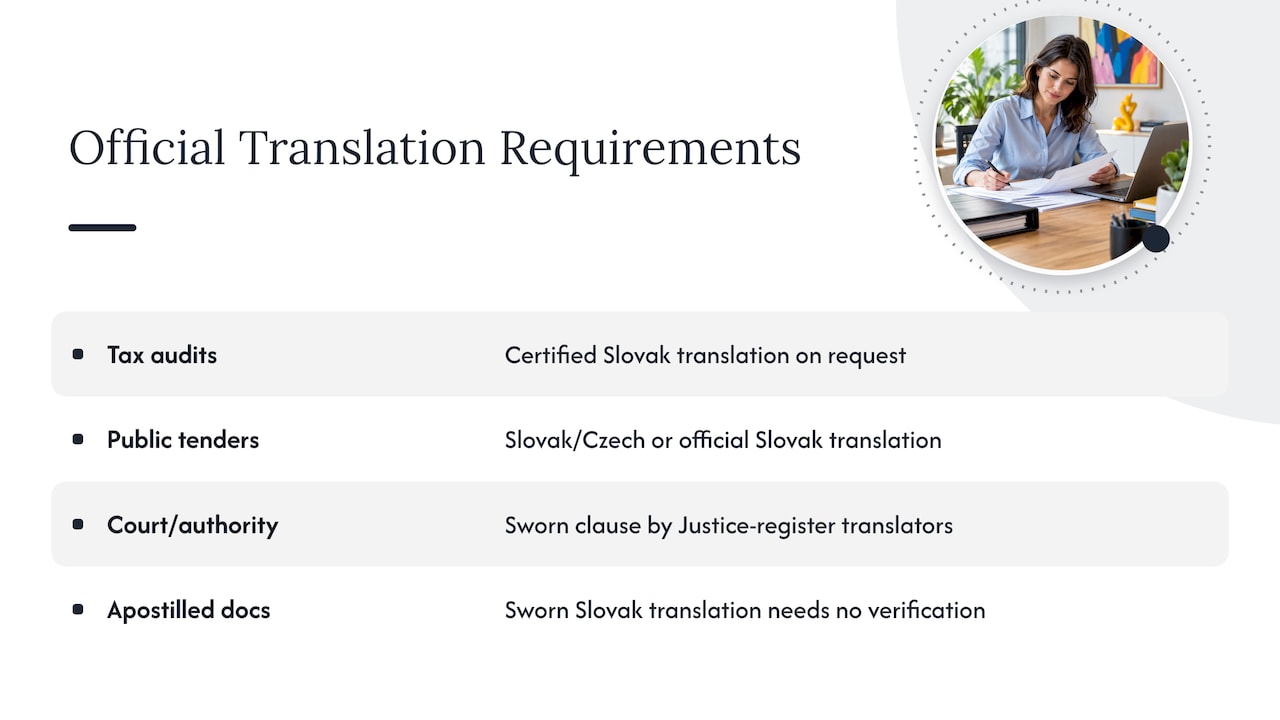
Tax audits. Under the Tax Code (563/2009 Z.z.), documents in a foreign language must, on the tax authority’s request, be submitted with an officially certified translation into Slovak. The administrator may agree with the taxpayer to waive it. During an audit you must also give access to the software used in your business, so a foreign-language licence in your records can end up on the request list.
Public tenders. Under the Public Procurement Act, as summarised in the European Commission’s Slovakia assessment, bids must be in Slovak or Czech, or come with an official translation into the state language. The same document notes that Slovak contracting authorities often ask for very broad software licensing rights. These are terms worth translating with great care.
Court and authority use. Only translators entered in the Ministry of Justice’s register of sworn translators and interpreters may use the translator’s clause. The register is searchable by language, name and region.
For a foreign public document that has been apostilled, the sworn Slovak translation needs no further verification. A licence is usually a private contract, so ask the receiving authority what form it expects before ordering.
Related reading: legal translation costs in Slovakia and what makes a translation of a law legally valid.
Reviewing a translated licence
Translation does not change the original agreement. The English (or other source) version is still the document the vendor drafted, and the translation is how your Slovak-speaking teams, auditors or authorities read it. So a good review checks fidelity, not fresh legal drafting.
A quick review routine:
- Compare the numbers: fees, user counts, dates, notice periods, liability caps.
- Check the glossary: each defined term appears identically everywhere.
- Check the cross-references: clause 7.2 in the original is still clause 7.2.
- Read the restrictions and termination clauses twice: these are where a soft verb does the most damage.
- Ask your lawyer to confirm which language prevails if the two versions differ. A language clause belongs in the contract itself.
For regulated sectors, add a second human reader. Our guide to legal translation quality in the EU walks through that approach.
Where glocco® fits
Software, legal, fintech, pharma and defence teams send us documents where the wording carries legal weight. For licences, our HumanLegal service is built for legal content. Need technical manuals or UI strings alongside the licence? HumanPro covers specialist texts. We work across 76 languages, so the same licence can go to several EU markets in one project.
Perspective
Here is our take: a licence is the one document in your software package that nobody wants to read, and everyone is held to. That is exactly why it should not be treated as plain text.
At glocco® we like to pair modern technology with proven, traditional localisation practice. For licences, that means specialist legal linguists who know what a grant, a restriction and a termination clause do, supported by tools that keep every defined term identical from the first page to the last.
Our advice? Agree the glossary first, translate second, review third. Do it once, do it properly, and your Slovak version will stand next to the original without any awkward questions.
glocco®
FAQ
Does a software licence translation need to be certified?
Not always. It is needed when an authority asks for it, for example the tax office on request or a public tender that requires an official Slovak translation. For internal use or customer-facing terms, a professional translation is normally the right fit. Check with the receiving body first.
Should I translate defined terms literally?
Keep them consistent above all. Choose one Slovak equivalent per defined term, capitalise it throughout and keep the same clause order as the original. Where a Slovak term has the same legal function as the English one, use it rather than a loanword.
Does a Slovak licence have to be in writing?
The Copyright Act requires written form for exclusive licences. For other licences the law does not prescribe it, but a written contract is recommended for commercial use.
Can the translated licence replace the original?
It depends on what the contract says. Add a clause stating which language version prevails, and have your lawyer confirm it.
Sources
- BLG: Software License Agreements practical guide
- Creative Commons: Legal tools translation guide
- Translating End-User License Agreements from English into Spanish
- Slovak Copyright Act 185/2015 Z.z.
- Autorský zákon 2026, AUTORA
- LITA: 11 krokov k lepšej zmluve
- InterWay general terms 2025
- Tax Code 563/2009 Z.z.
- European Commission: Slovakia legal assessment on innovation procurement
- Ministry of Justice of the Slovak Republic: translators and interpreters
- EURAXESS Slovakia: authentication of documents


