


Most people assume translation in clinical trials is just swapping words from one language to another. It is not. The role of translators in clinical trials is far more nuanced, and the stakes could not be higher. Participant comprehension is the real measure of translation quality, not linguistic precision alone. Get it wrong and you risk invalid informed consent, ethical non-compliance, and costly trial delays. This guide unpacks what qualified translators and interpreters actually do, what the regulations demand, and how to get it right from day one.
The regulatory and ethical framework for translators
The legal case for qualified translation in clinical trials is not ambiguous. EU Regulation 536/2014 requires that all patient-facing trial documents be written in a language and style the participant can genuinely understand, tailored to their literacy level. This is not a box-ticking exercise. It is a legal condition for study authorisation.
The Clinical Trial Regulation (CTR) makes this explicit: study authorisation depends on demonstrating that participants correctly understand the trial and that their rights are protected. Translation quality is, therefore, an operational necessity, not an afterthought.
Good Clinical Practice (ICH GCP) standards add another layer. They require that informed consent materials be written at an appropriate reading level and that non-English-speaking participants receive the same quality of information as native speakers. Ethics committees now scrutinise translated documents not just for accuracy but for contextual understandability, asking whether a participant with limited formal education would genuinely grasp what they are agreeing to.
Here is what the regulatory framework demands of your translation process in practice:
- Linguistic accuracy: The translated text must faithfully reflect the source content without omissions or distortions.
- Cultural relevance: Medical concepts must be expressed in culturally appropriate terms that resonate with the participant’s background.
- Readability: Plain language is non-negotiable. Dense medical prose in translation is still dense medical prose.
- Ethics committee approval: Translated patient-facing materials must typically be submitted alongside source documents for review.
- Documentation: Translation processes, qualifications of translators, and review steps must be audit-ready.
How translators and interpreters protect informed consent
There is an important distinction that trial teams sometimes overlook. Written translation and interpreter-mediated communication are two separate services that serve different purposes, and both are needed.

A qualified translator produces the written informed consent form. A medical interpreter then facilitates the live conversation between the investigator and the participant. Neither role can substitute for the other. Think of it this way: the form gives the participant the information, and the interpreter makes sure they actually understand it.
The process for interpreter-enabled consent works like this:
- Pre-session preparation: The interpreter reviews the protocol summary and consent form ahead of the session to familiarise themselves with trial-specific terminology.
- Facilitated explanation: The investigator presents each section of the consent form, with the interpreter conveying the meaning accurately and in culturally appropriate terms.
- Comprehension checks: The investigator asks the participant questions through the interpreter to validate consent comprehension, per UCSF HRPP guidance. The interpreter is a conduit, not a decision-maker.
- Question time: Participants ask their own questions, which are interpreted back to the investigator for response.
- Documentation: The interpreter signs the consent form to confirm their involvement, creating an auditable record.
Pro Tip: Schedule interpreter-supported consent sessions with extra time built in. Rushed consent discussions risk invalid informed consent and can constitute ethical non-compliance. A 30-minute session often becomes 90 minutes with interpretation, and that is completely normal.
Cultural nuance is where the best interpreters earn their fee. A term like “placebo” may have no direct equivalent in some languages, or may carry misleading connotations. A qualified medical interpreter does not just translate the word. They explain the concept in a way that is meaningful for the participant.
Professional vs machine translation: what the data says
The comparison between professional human translation and machine translation in clinical trial contexts is not a matter of opinion. The numbers are quite clear.
| Criterion | Professional translation | Machine translation |
|---|---|---|
| Overall quality score (CIOL) | 73/100 | 51/100 |
| Critical meaning-changing errors | 1 | 11 |
| Suitability for consent forms | Yes | No |
| Cultural adaptation | High | Low |
| Audit-ready documentation | Yes | Variable |
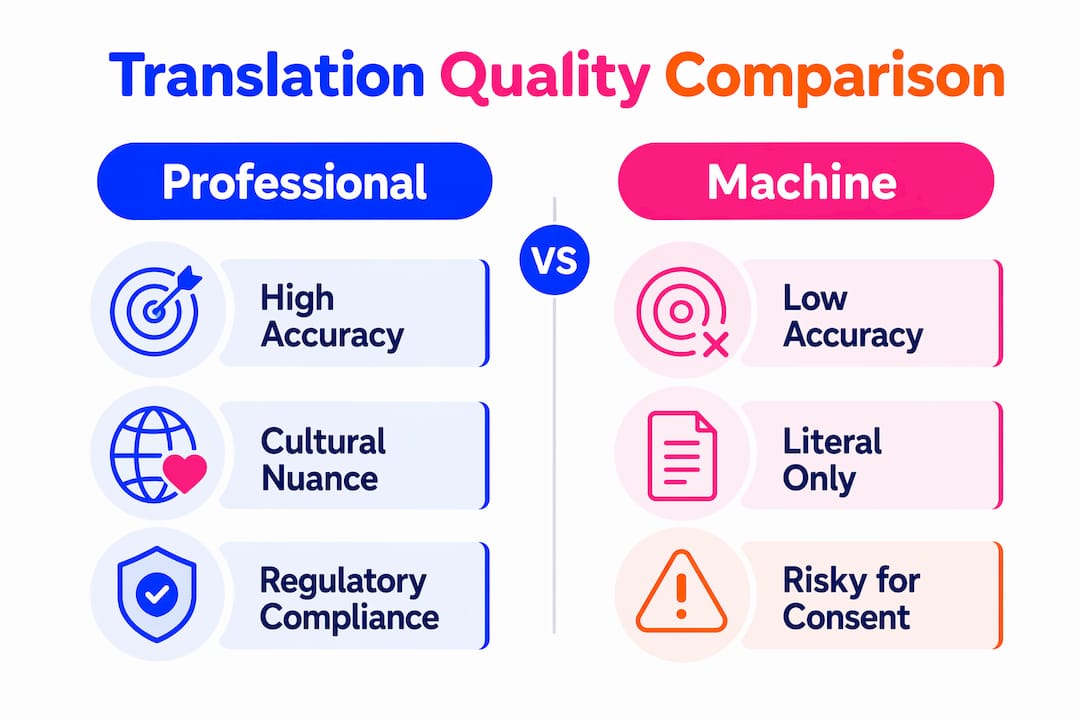
A 2026 UK simulation study using Chartered Institute of Linguists scoring found that professionally translated consent forms produced just one critical error, compared with eleven in machine-translated versions. Those eleven errors are not typos. They are meaning-changing mistakes that could directly undermine a participant’s ability to give valid consent.
Professionally translated bilingual consent forms significantly improve comprehension. In the same UK study, 60% of participants understood treatment intent with bilingual forms, compared with just 34.8% with English-only documents. That is a substantial gain. But here is the sobering part: 40% still misunderstood critical information even with professional bilingual forms. Translation alone is not the finish line.
Pro Tip: Pair professionally translated documents with interpreter support and, where possible, supplementary audio or video materials in the participant’s language. Combining these approaches consistently produces the best comprehension outcomes in clinical trial settings.
The takeaway is straightforward. Machine translation carries unacceptable risk in a consent context. Professional translation is necessary but not sufficient on its own. The gold standard is professional translation plus qualified interpreter support plus supplementary communication tools.
Best practices for engaging translators and interpreters
Getting the language services piece right requires deliberate planning at the protocol design stage, not a scramble when recruitment begins. Here is what best-in-class trial teams do:
- Hire specialists, not generalists: Clinical trial translators must have documented expertise in medical terminology and ideally in regulatory documentation. A general language professional with no life sciences background is not suitable for informed consent materials.
- Require back-translation: For all critical patient-facing documents, commission a back-translation by an independent translator. Discrepancies reveal conceptual drift that direct review might miss.
- Plan for readability reviews: After translation, have a native speaker from the target community review the document for plain-language clarity. Medical translation accuracy is about comprehension, not just technical correctness.
- Use full consent forms, not short forms: As of December 2021, the Short Form consent method for non-English speakers is limited to rare cases. Full translated informed consent documents are the required standard for repeated enrolment.
- Build interpreter time into budgets: Interpreter-enabled sessions take longer. Budget accordingly and build scheduling flexibility into your site workflows. Workflow planning for interpreter use must account for documentation requirements as well as session length.
- Partner with a specialised language service provider: Specialised language service providers reduce critical translation errors by up to 35% compared with ad hoc or unqualified solutions, with the added benefit of audit-ready quality control processes.
The strategic benefits of quality language services
Beyond ethics and compliance, there is a clear operational and commercial case for investing in quality translation in clinical trials. Better comprehension reduces participant refusal rates and supports the inclusion of underrepresented groups, which is increasingly important for diverse trial populations and regulatory acceptance.
Fewer misunderstandings mean fewer protocol deviations. Fewer deviations mean cleaner audit trails. Cleaner audit trails mean faster regulatory review. It is a straightforward chain of cause and effect that directly impacts your timeline and budget.
Clinical trial language barriers are not just a participant welfare issue. They are a risk management issue. One mistranslated consent form can trigger an ethics committee query that delays a trial by months.
Sponsors who invest in quality language services also protect their reputation. A trial associated with poor translation practices, or worse, an ethics finding related to inadequate consent, carries lasting consequences for future study approvals and site relationships. The impact of translation on research quality and regulatory outcomes is measurable, and it starts with the decision to treat translators as qualified professionals, not commodities.
| Key takeaway | Details |
|---|---|
| Comprehension is the real goal | Translation quality is measured by participant understanding, not linguistic accuracy alone |
| Regulations are non-negotiable | EU 536/2014 and ICH GCP make qualified translation a legal requirement for trial authorisation |
| Machine translation carries critical risk | Professional translation produces up to 10 times fewer critical errors than machine alternatives |
| Interpreters validate consent | Trained interpreters enable investigator comprehension checks, making consent legally defensible |
| Combined approaches work best | Bilingual forms plus interpreter support plus supplementary media deliver the strongest outcomes |
My perspective on translation in clinical trials
I have worked with enough clinical trial teams to notice a pattern. The ones who treat translation as a procurement decision, lowest cost, fastest turnaround, are usually the same ones calling us mid-trial with a consent documentation problem.
What I have learned is this: translation in clinical trials is not about words. It is about whether a participant sitting across from an investigator, in a hospital they may find intimidating, in a process they may not fully understand, walks away with genuine comprehension of what they have agreed to. That is the standard.
I have seen teams allocate six-figure budgets to trial technology and then baulk at the cost of a qualified medical interpreter. It is a false economy every single time. The cost of a consent form challenged by an ethics committee, or a protocol deviation traced to a misunderstood instruction, dwarfs any saving made on language services.
My advice: bring your language service provider in at the protocol design stage. Let them flag terminology that will not translate cleanly, identify languages where bilingual resources are scarce, and build a translation workflow that is audit-ready from the start. Speed matters in trials, but not more than getting the consent right.
— glocco®
How glocco® supports clinical trial teams
Clinical trial documentation demands the kind of precision that comes from specialisation, not generalisation. glocco® works with pharmaceutical and research organisations to deliver medical translation services that meet EU 536/2014 requirements, ICH GCP standards, and ethics committee expectations. From informed consent forms and patient information leaflets to protocol summaries and case report forms, glocco®’s team of qualified medical translators and interpreters handles the full scope of clinical trial documentation with audit-ready quality control built in. If your trial involves multilingual sites or non-English-speaking participants, let’s talk about how glocco® can support your language services strategy from day one.
FAQ
What is the role of translators in clinical trials?
Translators produce accurate, culturally adapted patient-facing documents such as informed consent forms, with the goal of genuine participant comprehension rather than literal word-for-word rendering. Their work directly affects consent validity and regulatory compliance.
Why is machine translation unsuitable for clinical trial consent forms?
A 2026 UK study found machine translation produced eleven critical meaning-changing errors compared with just one in professionally translated documents. Such errors undermine informed consent and can constitute ethical non-compliance.
How do interpreters support the informed consent process?
Trained medical interpreters facilitate live consent discussions, enabling investigators to explain the trial, answer questions, and conduct comprehension checks through interpreted dialogue, making consent legally defensible for non-English-speaking participants.
What qualifications should a clinical trial translator have?
Clinical trial translators should have documented expertise in medical or life sciences terminology, experience with regulatory documentation, and ideally formal qualifications in translation. Generalist translators without a life sciences background are not suitable for consent materials.
Do bilingual consent forms eliminate misunderstandings?
No. Research shows bilingual forms improve treatment intent understanding from 34.8% to 60%, but 40% of participants still misunderstood critical information. Bilingual documents should be combined with interpreter support and supplementary communication materials for best results.


