


For a reliable preklad finančných reportov, skip the generic translation tool and go straight to a specialist finance workflow, human, or a HumanAI hybrid, that keeps your numbers, terminology and confidentiality intact. Your next move? Gather your file formats and write a short terminology brief before you contact anyone. It saves everyone a week of back and forth.
Which financial documents and file formats need translating?
Financial report translation covers more ground than most people expect. Balance sheets, profit and loss statements, cash flow statements, notes to the accounts, auditor reports, prospectuses, management commentary and investor decks all show up on our desks regularly, and each one carries its own quirks.
File format matters just as much as the content. A scanned PDF needs OCR before anyone can touch it, an XLSX file needs formulas and formatting checked twice, and a DOCX brings its own layout headaches. Document-translation platforms can preserve numbers, tables and original layout for financial statements, which sounds obvious until you’ve seen a currency column collapse into gibberish because nobody checked the source formatting first.
Some quick things to flag before you send anything over:
- Scanned PDFs need OCR, and OCR quality directly affects how clean your numbers come out
- XLSX files with live formulas need someone to verify the maths survives translation
- Regulatory filings often require bilingual or tagged deliverables, not just a translated copy
- Investor decks usually need design and layout preserved alongside the text
How does a specialist financial translation workflow actually run?
Ask any vendor to walk you through their process before you sign anything. If they can’t explain it in five steps, that’s your answer.
- Brief. You tell them the audience, whether it’s for regulatory use, any required terminology, and your deadline.
- File prep. They run format checks, OCR where needed, and extract tables so nothing gets mangled in transit using an AI Document Analyzer that chats with your documents.
- Translation. A finance-specialist linguist takes the file, not a generalist who last translated a marketing brochure.
- Review. A subject-matter reviewer checks the numbers and terminology against the source.
- Delivery. You get a QA pass, formatting restored, and either a bilingual file or the final version, some platforms return both a translated and a bilingual review copy so you can check line by line.
Pro Tip: Include a short glossary of preferred terms and one example of a previous translation or template in your brief. It’s a five-minute job that cuts revision rounds dramatically.
The best briefs state the target audience and exact regulatory use up front, because a report going to a regulator needs different handling from one going to an internal board.
What quality, compliance and confidentiality checks matter?
Financial reports are sensitive by nature, so trust signals aren’t a nice-to-have. Here’s what to actually check before you hand over a set of accounts:
- Translator specialism. Ask whether the linguist has worked on financial statements before, not general business documents.
- NDAs as standard. If a provider hesitates to sign one, walk away.
- Secure transfer. Look for encrypted upload portals rather than email attachments, plus clear retention and deletion policies.
- Anonymisation options. Useful when a document needs internal review before names and figures are finalised.
- Sample pages. Ask for a short sample translation and the reviewer’s background before committing to the full project.
What does financial translation pricing and turnaround actually look like?
Pricing shapes vary more than people expect, so ask for the breakdown, not just a headline figure.
- Per word, per page, or per project. Per-project pricing usually suits fixed-scope reports; per-word suits ongoing work.
- DTP charges. If your investor deck needs design work reformatted, that’s a separate line item.
- Cost drivers. Complex tables, legalisation or certification requirements, tight deadlines, and large custom glossaries all push the price up.
- Turnaround. Standard jobs typically run a few days; express options exist but cost more, as most professional finance-translation vendors advertise.
Ask for a transparent quote broken down by these factors, and request a short sample deliverable before the full project starts. It tells you a lot about how the provider actually works.
Human, machine, or hybrid: which workflow fits your report?
The honest answer depends on what the document is for and how much risk you can tolerate.
Machine translation is fast and can hold formatting together reasonably well, but it stumbles on terminology nuance and regulatory phrasing, exactly the parts you can’t afford to get wrong. Full human translation is the safer bet for audit reports, investor-facing statements and anything filed with a regulator, where a mistranslated term could cause real problems. A hybrid HumanAI workflow, machine draft plus human specialist review, sits in the middle: it can cut cost and turnaround time while keeping a human accountable for final accuracy.
- Regulatory filing or audit report? Go human, every time.
- Large archive or internal reference material? Hybrid usually makes sense.
- Investor deck on a tight deadline? Hybrid, with a specialist review pass before it goes out.
Pro Tip: If you’re translating a large archive of historic reports, run a hybrid pass first and reserve full human review for the most recent, highest-stakes documents.
What should you ask before choosing a provider?
A good provider will answer these without hesitation. Vague answers are the red flag itself.
- How many financial reports has your team translated in the past year, and in which sectors?
- Who reviews the translation, and what’s their background in finance or accounting?
- Can I see a sample translation before committing to the full project?
- How do you build and maintain terminology glossaries across a project?
- What’s your file transfer and retention policy, and can documents be anonymised on request?
- Do you handle DTP and formatting in-house, or is that outsourced?
If a provider can’t answer the reviewer question or dodges the security question, that’s usually enough reason to keep looking.
Where clients lose time (and how to fix it fast)
Most delays trace back to two things: no brief, no glossary. Fix those two and the whole project moves faster.
— glocco®
How glocco® handles financial report translation
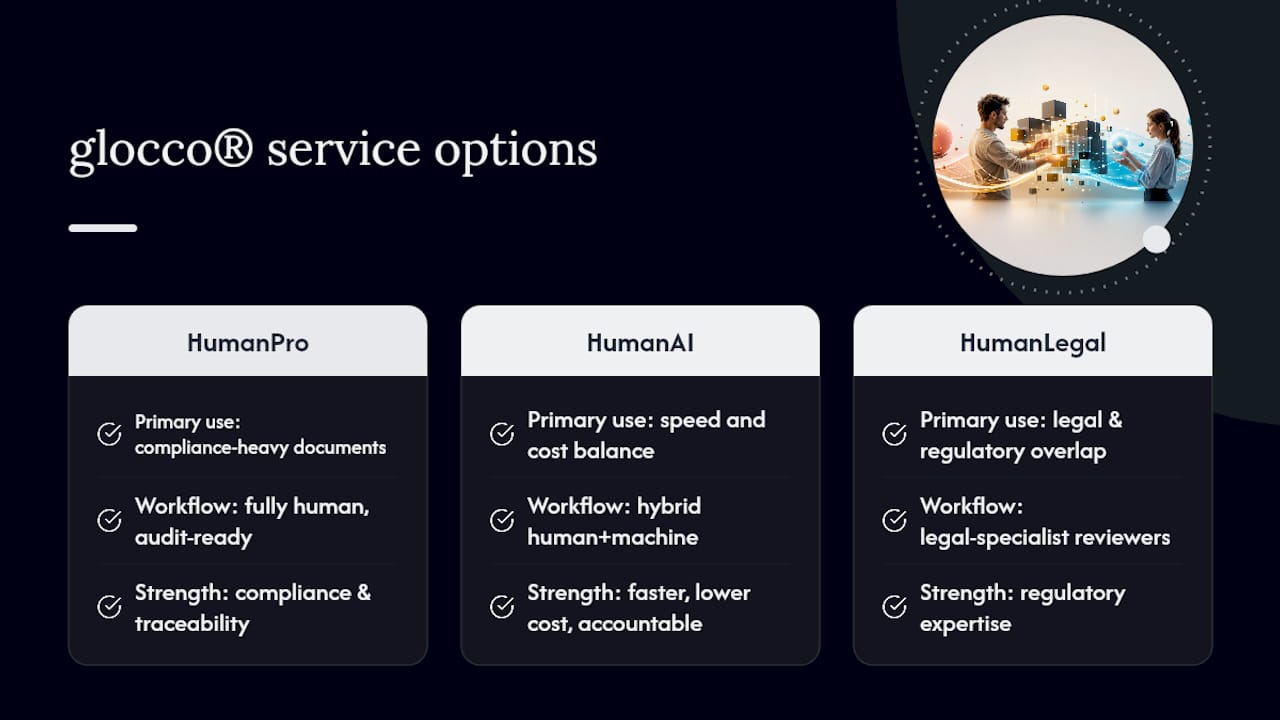
Here’s the bit where we tell you what we actually do. Glocco works with specialist finance translators, backed by HumanPro for compliance-heavy documents that need a fully human, audit-ready workflow, and HumanAI when you need a hybrid approach that balances speed against cost without dropping accountability. Every file goes through secure handling and comes back with formatting and numbers preserved. If your report crosses into legal or regulatory territory, HumanLegal covers that overlap too. Want a quote? Get in touch and tell us your file format, your deadline and whether the document is regulatory. That’s genuinely all we need to get started.
Sources
Want to see format preservation in action? OpenL Doc Translator demonstrates it directly on financial statements. For a wider view of translator networks, the Lexika vendor directory is a useful reference, and our own document translation guide covers the brief-writing basics in more depth.
FAQ
What is the best way to translate a financial report accurately?
Use a specialist finance translator or a HumanAI hybrid workflow, backed by a short glossary and a clear brief covering audience and regulatory use.
Can machine translation handle financial statements on its own?
It can preserve formatting reasonably well, but it often misses terminology nuance and regulatory phrasing, so full machine translation isn’t recommended for audit or investor-facing documents.
How much does financial report translation cost?
Pricing varies by per-word, per-page or per-project models, with costs rising for complex tables, certification needs and urgent deadlines. Current pricing information is available on the provider’s pricing page.
What file formats can be translated while keeping tables intact?
PDF, XLSX and DOCX are all commonly supported, though scanned PDFs need OCR first to avoid errors in the extracted numbers.
Do I need to sign an NDA before sending financial documents for translation?
Yes, a reputable provider should offer or accept an NDA as standard practice for sensitive financial documents.


