


Technical translation is the process of converting specialised documents from one language to another with complete accuracy, preserving both meaning and function. This is not general translation. It covers manuals, patents, engineering specifications, medical device instructions, and regulated content where a single mistranslated term can trigger legal liability or a safety incident. The definition of technical translation sits at the intersection of linguistic skill and deep subject-matter expertise. In 2026, the field is shaped by ISO standards, AI-assisted workflows, and the irreplaceable judgement of human specialists.
What is technical translation and how does it differ from other types?
Technical translation handles documentation like manuals, patents, and regulated instructions that require subject expertise, not just language fluency. That distinction matters enormously. A general translator converts meaning. A technical translator converts meaning and maintains the precise terminology that a specific industry depends on.

Here is how technical translation compares to related language services:
| Service type | Content focus | Key requirement | Risk if done poorly |
|---|---|---|---|
| Technical translation | Manuals, patents, specs, regulated docs | Domain expertise + linguistic accuracy | Safety failures, legal liability |
| Legal translation | Contracts, court documents, legislation | Legal terminology, jurisdictional knowledge | Invalid documents, compliance breaches |
| Medical translation | Clinical trials, patient records, labels | Medical terminology, regulatory compliance | Patient harm, regulatory penalties |
| Localisation | Websites, apps, marketing content | Cultural adaptation, UX consistency | Poor user experience, brand damage |
The table makes one thing clear: technical translation is not a subset of general translation. It is a specialised discipline in its own right.
What sets it apart further is the type of expertise required. Translating an aerospace maintenance manual into Arabic requires someone who understands hydraulic systems, not just Arabic grammar. Translating a pharmaceutical patent into German requires familiarity with EU patent law and biochemistry. The translator is, in effect, a subject-matter expert who also happens to be bilingual.
- Highly specialised terminology with no room for approximation
- Precision required across instructions, safety warnings, and compliance clauses
- Formatting and layout preservation to maintain document usability, since complex PDFs must be reconstructed into editable formats before translation begins
- Regulatory alignment with standards specific to the target market
How does human expertise integrate with AI in modern technical translation?
The honest answer is: carefully. AI is a powerful accelerant, but human review remains the core process for legal, medical, and regulated technical content.
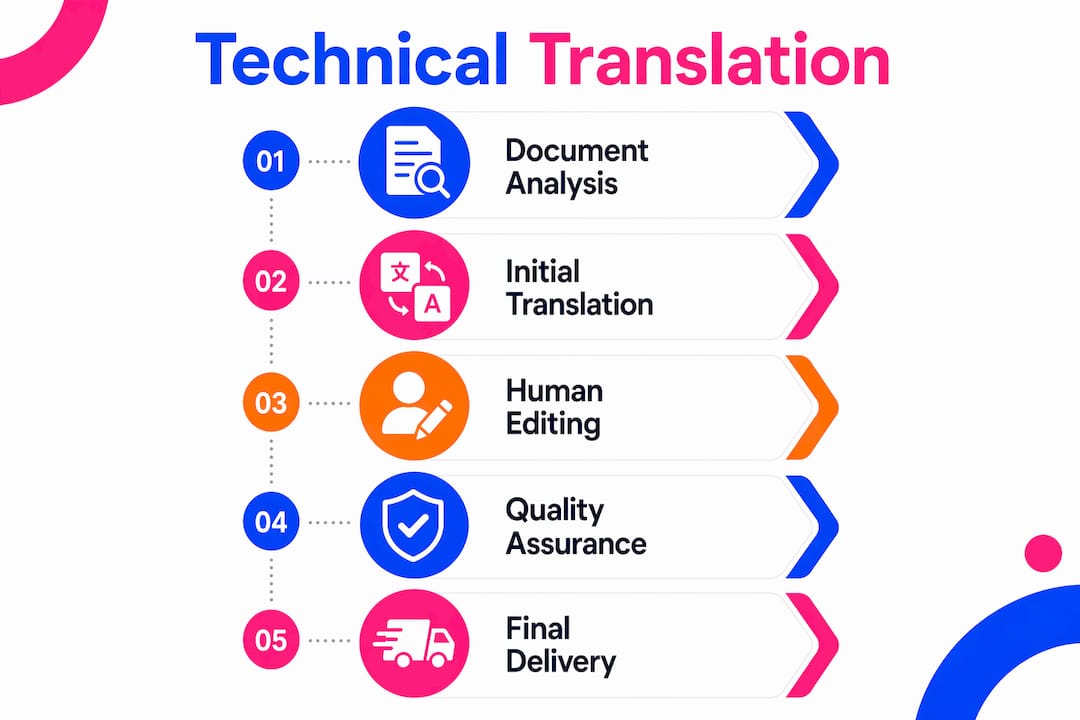
Machine translation post-editing (MTPE) is the standard hybrid workflow. AI generates a draft translation, and a qualified human translator reviews, corrects, and approves it. This catches the subtle errors that AI consistently misses: incorrect torque values in an engineering spec, a drug interaction warning rendered ambiguously, or a safety instruction that reads correctly in isolation but contradicts the diagram beside it.
ISO 18587 is being updated in 2026 to unify processes for human, machine-assisted, and hybrid translation workflows. This revision reflects where the industry actually is: not choosing between AI and humans, but defining how they work together. ISO 17100 continues to govern fully human translation workflows, and both standards together give businesses a clear quality benchmark to demand from their providers.
Here is how a risk-based workflow typically operates:
- Assess content criticality. Low-risk internal communications may suit raw AI output. High-volume technical documentation suits MTPE. Legal, medical, and safety-critical content requires full human translation with expert review.
- Select the appropriate workflow tier. Match the process to the risk level, not to the budget alone.
- Apply domain-specific glossaries. Consistent terminology across a product range is non-negotiable. Glossary management prevents the same component being called three different things across three translated manuals.
- Post-edit with a subject-matter expert. The reviewer must understand the content domain, not just the target language.
- Quality assurance and sign-off. Final review against the source document before delivery.
Modern AI tools like Lara Translate support context-aware translation with brand consistency across the full translation lifecycle, from ingestion through to publishing. They accelerate the process. They do not replace the expert who knows what the content actually means.
Pro Tip: When evaluating technical translation services, ask providers specifically whether their MTPE process is certified to ISO 18587 and whether their post-editors hold domain qualifications. A provider who cannot answer that question clearly is not the right partner for regulated content.
Why is technical translation important for businesses across sectors?
Poor technical translation exposes businesses to legal, financial, and reputational risks that go well beyond a clumsy phrase. Errors in medical or engineering documents carry consequences that are difficult to reverse.
Consider a practical example. A medical device manufacturer expanding into France and Germany must translate its instructions for use, safety warnings, and clinical data into French and German. A bilingual document covering both medical terminology and financial compliance data requires subject-matter experts familiar with both domains. One mistranslated contraindication can trigger a product recall. One incorrectly translated financial clause in a regulatory submission can delay market entry by months.
The sectors where quality technical translation services are non-negotiable include:
- Engineering and manufacturing: Safety manuals, maintenance procedures, and CE marking documentation
- Medical and pharmaceutical: Device instructions, clinical trial protocols, and patient-facing materials
- IT and software: API documentation, user guides, and data security compliance documents
- Legal and fintech: Contracts, patent filings, and regulatory submissions
- Energy and infrastructure: Technical specifications, environmental impact assessments, and operational procedures
“Errors in medical or engineering documents can lead to serious consequences beyond mere miscommunication.” — glocco®
The importance of technical translation is not abstract. It is the difference between a product that works safely in a new market and one that creates liability. Working with language service providers that specialise in your sector reduces that risk measurably.
How can businesses select and manage technical translation services?
Choosing the right provider is where most businesses underinvest their attention. Price is visible. Quality is not, until something goes wrong.
Here is a practical framework for selecting and managing technical translation services:
- Verify subject-matter expertise. Ask for evidence that translators hold qualifications or demonstrable experience in your specific domain. A provider who translates everything from marketing copy to nuclear safety manuals with the same team is a red flag.
- Check ISO certification. ISO 17100 for human translation and ISO 18587 for MTPE are the benchmarks. Certification signals that quality processes are documented and auditable, not just claimed.
- Confirm a human-in-the-loop approach. For any regulated or safety-critical content, AI-only output is not acceptable. Ask directly how human review is structured in their workflow.
- Establish glossary and style guide management. Your technical terminology should be consistent across every document and every language. A good provider builds and maintains a client-specific termbase from the first project.
- Integrate translation into your documentation workflow. The most efficient translation projects are those where source documents are well-structured, terminology is pre-agreed, and review cycles are planned in advance.
The localisation workflow matters as much as the translation itself. Businesses that treat translation as an afterthought, sending finished documents for translation at the last minute, consistently experience delays, inconsistencies, and higher costs.
glocco®’s take on technical translation in 2026
Having worked on technical translation projects across engineering, medical, legal, and IT sectors since 2014, we have seen one pattern repeat itself: the businesses that get this right treat translation as part of their quality management process, not as a final formatting step.
AI has genuinely changed the pace of technical translation. MTPE workflows that once took weeks now take days. But the human translator’s role has not shrunk. It has shifted. They are now risk managers as much as linguists, catching the errors that AI generates with alarming confidence. The AI tools for translators available in 2026 are impressive. The expertise required to use them responsibly is still very human.
Our honest advice: do not choose a technical translation provider based on turnaround time alone. Choose based on their ability to demonstrate domain knowledge, certified processes, and a clear answer to the question “who reviews this, and what are their qualifications?” That question separates providers who take quality seriously from those who do not.
— glocco®
How glocco® can support your technical translation needs
glocco® has delivered technical translation services across engineering, medical, IT, legal, and manufacturing sectors since 2014, working with clients across Europe, the Middle East, North America, and Asia. Every project follows ISO-aligned workflows with qualified human post-editors and domain-specific glossary management. Whether you need a single patent translated or an ongoing programme of multilingual documentation, glocco®’s document translation guide for EU businesses is a solid starting point for understanding what to expect and how to prepare. Get in touch with the team to discuss your specific requirements. We are straightforward about what we can do and how we do it!
FAQ
What is the definition of technical translation?
Technical translation is the accurate conversion of specialised documents, such as manuals, patents, and regulated instructions, from one language to another, requiring both linguistic skill and domain-specific expertise.
How does technical translation differ from general translation?
General translation focuses on conveying meaning. Technical translation must also preserve precise terminology, comply with industry standards, and maintain document formatting, making subject-matter expertise a core requirement.
Why is human review still necessary when AI tools are available?
AI-generated translation can produce subtle errors in technical and regulated content that carry serious consequences. Human post-editors with domain knowledge catch these errors before they reach the final document.
What ISO standards apply to technical translation services?
ISO 17100 governs human translation workflows, while ISO 18587 covers machine translation post-editing. Both are being aligned in 2026 to reflect hybrid AI and human workflows.
Which sectors benefit most from specialised technical translation?
Engineering, manufacturing, medical, pharmaceutical, IT, legal, fintech, and energy sectors all rely on technical translation for compliance, safety documentation, and market entry in multilingual regions.


