


Multilingual e-learning is defined as the delivery of digital training content fully adapted to multiple languages and cultures, so learners worldwide can study in their native tongue. This is not simply swapping menu labels into French or Spanish. It means every lesson, quiz, certificate, and interface element speaks the learner’s language. The industry term for this complete approach is localised e-learning, and it sits at the intersection of Learning Management System (LMS) technology, AI-assisted translation, and professional localisation practice. Get it right, and you get better comprehension and engagement across your entire global workforce.
What are the key benefits of multilingual e-learning?
The numbers make a compelling case. Organisations that implement multilingual training report a 25% productivity increase and a 30% improvement in retention rates. That is not a marginal gain. It is the difference between a workforce that remembers its compliance training and one that forgets it by Friday.
The reason is straightforward. Learning in a native language reduces cognitive load. When a learner does not have to translate concepts in their head while also absorbing new information, they make fewer mistakes. In global operations, fewer mistakes means fewer safety incidents.
There is also a cultural dimension that goes beyond productivity figures. Language-inclusive training sends a clear message to employees: their background is valued here. That message improves engagement and strengthens organisational credibility. It is hard to put a price on a workforce that genuinely feels respected.
Key benefits at a glance:
- Higher retention: Learners absorb and remember more when trained in their first language.
- Fewer errors: Reduced cognitive load leads directly to safer, more accurate work.
- Greater inclusivity: Diverse teams feel seen and supported, not just tolerated.
- Compliance confidence: Addressing language barriers improves knowledge retention and regulatory compliance rates.
- Stronger global cohesion: Teams across regions share consistent knowledge, even when they speak different languages.
How does multilingual e-learning work?
Modern multilingual learning platforms do far more than translate text. Advanced LMS platforms support over 120 languages with AI-assisted translation and native-reviewer workflows, enabling rapid global training rollouts. That combination of speed and human oversight is what separates professional localisation from a quick machine translation job.

Here is what a fully capable multilingual LMS typically covers:
| Feature | What it means in practice |
|---|---|
| Content localisation | Lessons, videos, and assessments adapted for each language |
| Interface translation | Menus, buttons, and navigation in the learner’s language |
| Certificate localisation | Completion documents issued in the correct language |
| RTL language support | Full compatibility with Arabic, Hebrew, and similar scripts |
| Centralised reporting | Managers see results across all regions in one dashboard |
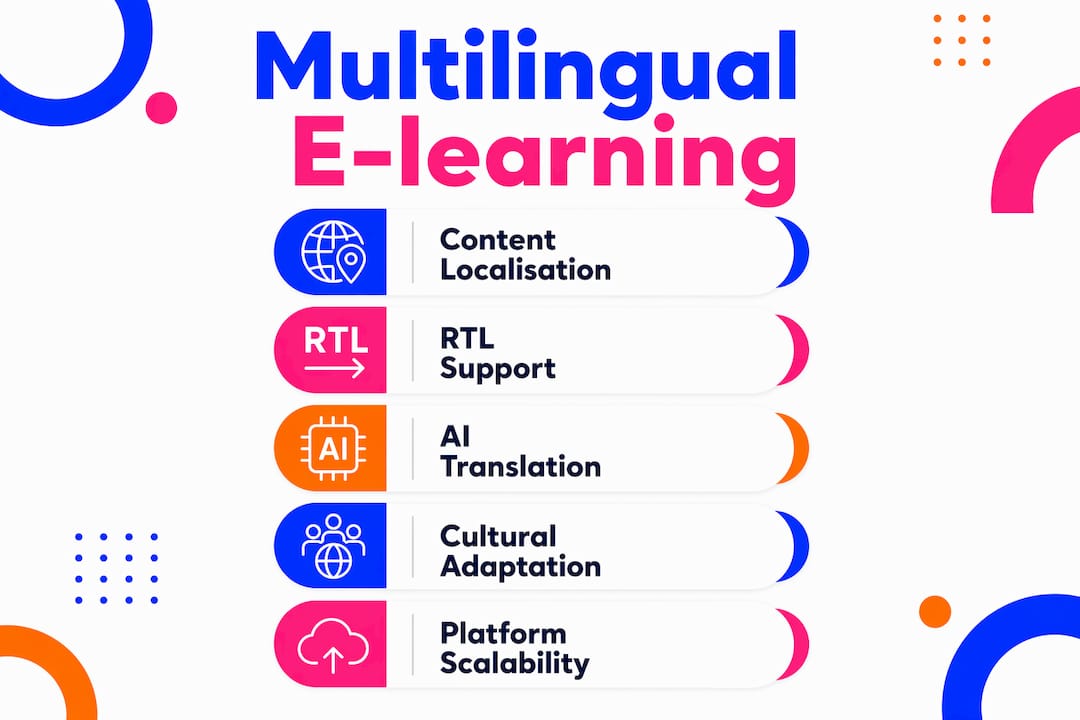
RTL and complex script support is a detail many platforms get wrong. If your LMS cannot handle Arabic or Hebrew correctly, a significant portion of your global audience receives a broken experience.
Pro Tip: When evaluating a multilingual LMS, test it with a right-to-left language sample before committing. A platform that looks polished in English can fall apart the moment Arabic text enters the equation.
AI tools accelerate the translation workflow considerably. Glocco’s guide to AI in translation explains how these technologies work alongside human reviewers to maintain quality at scale.
What is the difference between translation and localisation in e-learning?
Translation converts words from one language to another. Localisation adapts the entire learning experience to fit a specific culture and context. The distinction matters enormously in e-learning, and confusing the two is one of the most common and costly mistakes training professionals make.
Effective localisation adapts cultural nuances such as date and time formats, currency, imagery, and language tone to match learner expectations. A course built for a UK audience that uses pound sterling, DD/MM/YYYY date formats, and British workplace examples will confuse a learner in the United States or Japan if only the words are translated.
| Approach | What changes | What stays the same |
|---|---|---|
| Translation only | Words and phrases | Dates, currency, images, tone, examples |
| Full localisation | Words, dates, currency, imagery, tone, cultural references | Core learning objectives |
A fully localised course covers videos, quizzes, assessments, and certificates. Not just the navigation menu. Translating only the interface while leaving course content in English is the equivalent of putting a French label on an English book. It looks right from the outside and confuses everyone on the inside.
Common localisation elements to adapt:
- Date and time formats
- Currency and measurement units
- Imagery and visual representation of people
- Tone (formal versus informal varies significantly by culture)
- Region-specific examples and case studies
How can educators implement multilingual e-learning effectively?
Effective implementation follows a clear sequence. Rushing any step produces a course that feels foreign to the very learners it is meant to serve.
- Choose a platform with end-to-end localisation. Your LMS must localise content, reports, and certificates, not just menus. Confirm this before signing any contract.
- Engage native speakers from the start. Localisation experts recommend involving native translators and cultural consultants during content creation, not as an afterthought at the end.
- Build and maintain a glossary. Consistent terminology across all language versions prevents confusion. A glossary also speeds up future updates significantly.
- Use AI tools alongside human review. AI accelerates first drafts. Human reviewers catch cultural missteps that a machine will miss every time. The benefits of localisation are only realised when both work together.
- Collect learner feedback by region. A course that tests well in Germany may still confuse learners in Brazil. Regional feedback loops catch problems early.
Pro Tip: Build your source course in a neutral, culturally generic style from day one. Avoid idioms, region-specific humour, and local slang. This makes every subsequent localisation faster and cheaper.
Additional considerations for training professionals:
- Allocate budget for ongoing updates, not just initial translation.
- Confirm your LMS supports multilingual video content, including subtitles and dubbed audio.
- Test every language version with a small learner group before full rollout.
The honest truth about multilingual e-learning that most guides skip
At Glocco, we have worked on localisation projects across Europe, the Middle East, North America, and Asia since 2014. The single most common mistake we see? Organisations treat translation as the finish line. They translate the interface, tick the box, and wonder why their global learners still struggle.
True multilingual e-learning is not a translation project. It is a cultural design project that happens to involve translation. The technology is genuinely impressive now. AI-assisted workflows can handle 120+ languages at speed. But technology alone is not enough. The organisations that get the best results combine AI tools with native speaker expertise and genuine cultural curiosity.
The other thing worth saying plainly: language accessibility is not a cost. It is an asset. A workforce that learns in its own language retains more, makes fewer errors, and feels more connected to the organisation. That is a return on investment that shows up in productivity, safety records, and staff retention. Viewing it as an expense to minimise is the most expensive mistake you can make.
— glocco®
How Glocco supports multilingual training programmes
Glocco has been helping organisations communicate across languages since 2014, working with clients in education, corporate training, legal, and professional sectors across four continents. Whether you need document translation for training materials or full e-learning localisation support, Glocco brings together AI-assisted workflows and native language experts to deliver quality at scale. The team covers over 120 languages, including complex scripts and RTL languages, so no learner gets left behind. If you are building or expanding a multilingual training programme, Glocco’s e-learning localisation services are a practical starting point.
FAQ
What is multilingual e-learning in simple terms?
Multilingual e-learning is digital training delivered fully in multiple languages, including course content, assessments, and certificates, so learners can study in their native tongue.
Is multilingual e-learning effective?
Yes. Organisations report a 25% increase in productivity and a 30% improvement in retention rates when training is delivered in learners’ native languages.
What is the difference between translation and localisation in e-learning?
Translation converts words between languages. Localisation adapts the full learning experience, including dates, currency, imagery, and cultural tone, to match the learner’s context.
How many languages can a multilingual LMS support?
Advanced multilingual LMS platforms support over 120 languages, including right-to-left scripts such as Arabic and Hebrew, with AI-assisted translation and native-reviewer workflows.
What is the biggest mistake in multilingual e-learning?
The most common mistake is translating only the user interface while leaving course content, videos, and assessments in the original language. Effective multilingual e-learning localises all content types, not just menus.


