


Back translation is defined as the process of translating a target language text back into the original source language to verify accuracy and meaning preservation. Think of it as a linguistic double-check. You translate a document from English into French, then have a separate translator render that French version back into English, without ever seeing the original. The two English versions are then compared. Any meaningful gaps reveal where the first translation drifted. This technique sits at the heart of professional quality assurance (QA) in translation and localisation workflows, and Glocco applies it as part of a broader commitment to accuracy across every language pair it handles.
What is back translation and how does it work?
Back translation follows a clear, repeatable process. Understanding each step helps you apply it correctly and interpret the results without jumping to the wrong conclusions.
- Translate the source text. A qualified translator converts the original document into the target language. This is the standard forward translation.
- Back-translate independently. A second translator, who has not seen the source text, translates the target language version back into the original language. Independence is non-negotiable here. If the back-translator sees the original, the whole exercise is compromised.
- Compare the two source versions. The original text and the back-translated text are placed side by side. The comparison focuses on meaning, tone, and intent rather than word-for-word matches.
- Identify discrepancies. Reviewers flag shifts in meaning, changes in register, or losses of idiomatic intent. Subtle shifts in meaning, tone, or idiomatic intent are often missed by other methods, which is precisely why this step matters.
- Revise the forward translation. Where genuine problems are found, the original translation is corrected and the cycle may repeat.
The process works best when both translators are native speakers of their respective target languages. Using pseudo-language folders or separate file structures also prevents the back-translator from accidentally overwriting the original content during file handling.
Pro Tip: Never assign the back translation to the same person who produced the forward translation. Cognitive bias will cause them to reproduce the same errors, defeating the purpose entirely.

Common challenges and limitations of back translation
Back translation is a powerful tool, but it has real limits. Knowing them prevents you from over-relying on it or misreading its results.
- Perfect matches are unrealistic. Major meaning shifts are the target, not identical wording. Synonyms, word order, and grammatical structure all vary between languages, so surface differences are expected and acceptable.
- Cultural and idiomatic nuance can slip through. A phrase may back-translate cleanly in terms of literal meaning but still carry the wrong cultural register in the target language. Back translation catches semantic drift but does not always flag pragmatic failure.
- Automated tools accelerate the process but introduce risk. Automated back translation tools speed up QA workflows but require human oversight for accurate evaluation. Machine output can mask errors rather than expose them.
- Not all differences signal a problem. Context determines quality. A difference between the original and back-translated text may reflect a legitimate stylistic choice rather than a translation error.
- Human expertise remains irreplaceable. Back translation reveals semantic drift, idiomatic loss, and pragmatic failure, but interpreting those findings still requires a skilled linguist.
Pro Tip: Build a brief discrepancy log when comparing texts. Categorise each difference as critical, minor, or acceptable. This turns a subjective review into a structured, repeatable QA record.
How does back translation compare to other QA methods?
Back translation is one tool in a wider QA toolkit. Knowing where it fits helps you choose the right combination for each project.
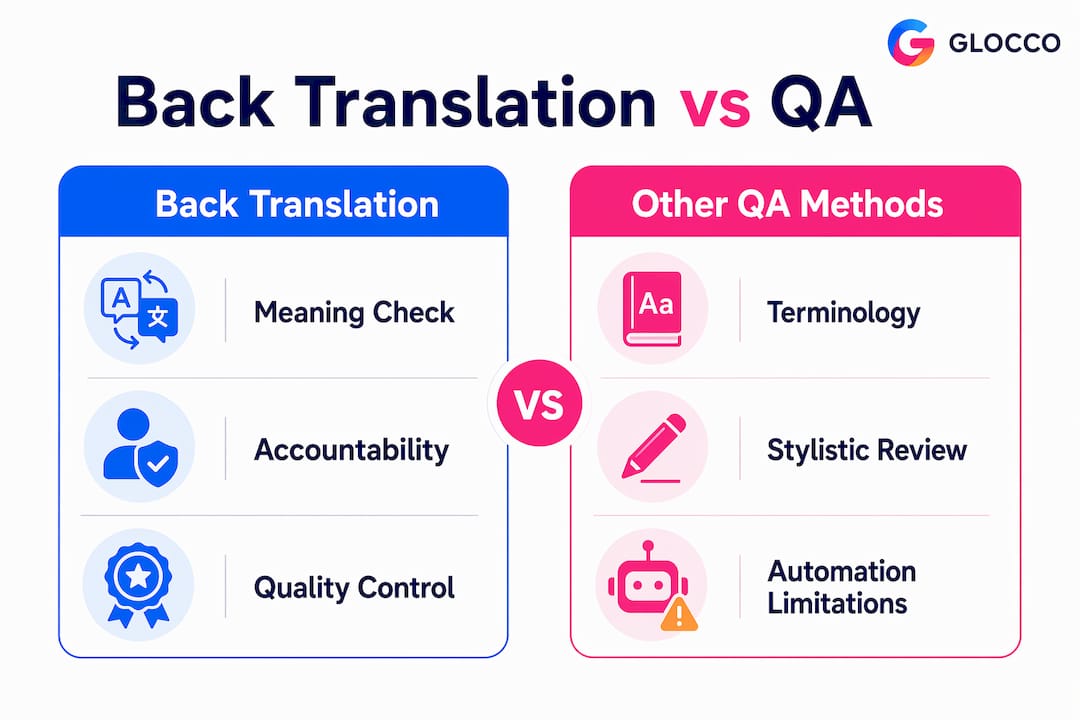
| QA method | What it checks | Best suited for | Key limitation |
|---|---|---|---|
| Back translation | Meaning and tone preservation | Medical, legal, technical content | Misses cultural register issues |
| Human review and editing | Overall quality, fluency, consistency | All content types | Time-intensive |
| Glossary and style guide checks | Terminology and brand consistency | Marketing, product content | Does not check meaning accuracy |
| Linguistic QA testing | Functional accuracy in software/UI | Localisation of apps and platforms | Requires technical setup |
| Round-trip translation | Automated meaning check | Quick machine translation sanity checks | Low reliability for nuanced content |
Round-trip translation is often confused with back translation, but the two are distinct. Round-trip translation uses machine translation for both legs of the journey and is best described as a high-speed smoke test for machine translation models. Back translation uses human translators for at least one leg and is a genuine QA method. For legal translation quality, back translation combined with human review is the standard professional approach.
The strongest QA workflows combine back translation with human editing and terminology management. No single method covers every risk on its own.
Practical applications of back translation in professional settings
Back translation is not a theoretical exercise. It has direct, measurable value across several industries and content types.
- Medical and clinical content. Patient information leaflets, informed consent forms, and clinical trial materials all carry serious risk if meaning shifts. Back translation is a standard requirement in many clinical research protocols precisely because accuracy affects patient safety. Glocco applies this approach to medical translation projects where regulatory compliance and patient comprehension are both at stake.
- Legal documents. Contracts, court submissions, and regulatory filings leave no room for ambiguity. Back translation helps verify that obligations, rights, and conditions survive the translation process intact. The role of translation in legal compliance makes this a non-negotiable step for many EU-facing businesses.
- Marketing and advertising copy. Tone and cultural resonance matter as much as literal meaning in marketing. Back translation exposes where a slogan has lost its punch or, worse, acquired an unintended meaning in the target language.
- AI-assisted translation workflows. Back translation acts as a sanity check on machine translation output. When AI tools for translators produce a first draft, back translation quickly surfaces the most significant errors before human post-editing begins.
- Certified and sworn translations. Semantic accuracy and cultural equivalence in multilingual content are vital for certified translations, where a single misrendered term can invalidate a document.
The common thread across all these applications is risk. The higher the consequence of a translation error, the more valuable back translation becomes as a verification step.
Glocco’s perspective on back translation in 2026
Back translation is one of the most misunderstood tools in the profession. The most common misconception is that a clean back translation means a perfect forward translation. It does not. It means no catastrophic meaning shifts were detected. That is a very different thing.
What back translation actually does well is force accountability. When translators know their work will be back-translated by an independent colleague, the standard of the initial translation tends to rise. The process creates a feedback loop that benefits the whole workflow, not just the final document.
The rise of AI translation has made back translation more relevant, not less. Machine translation can produce fluent output that is semantically wrong in ways that are hard to spot without a structured check. Back translation catches those errors quickly. At Glocco, the view is that automation and human QA are partners, not rivals. The best workflows use both deliberately.
For professionals building or refining their QA processes, back translation deserves a fixed place in the toolkit. Not as a replacement for expert human review, but as a structured first filter that makes that review faster and more focused.
— glocco®
Glocco’s approach to translation quality assurance
Glocco has provided professional translation and localisation services since 2014, working across legal, medical, technical, and marketing sectors in Europe, the Middle East, North America, and Asia. Quality assurance is built into every project, not added as an afterthought. That includes back translation where the content demands it, alongside human review, terminology management, and linguistic testing. If you are working on documents that require verified accuracy and cultural equivalence, Glocco’s document translation services for EU businesses offer a structured, expert-led process from brief to delivery. Get in touch to discuss your project requirements.
FAQ
What is the definition of back translation?
Back translation is the process of translating a target language text back into the original source language, without reference to the original, to check for accuracy and meaning preservation.
Is back translation the same as round-trip translation?
No. Back translation uses human translators and is a genuine QA method. Round-trip translation relies on machine translation for both legs and functions only as a quick automated check.
When should back translation be used?
Back translation is most valuable for high-stakes content such as medical, legal, and clinical documents, where a shift in meaning carries serious consequences.
Does a matching back translation guarantee a correct forward translation?
No. A clean back translation confirms no major meaning shifts were detected. It does not guarantee stylistic quality, cultural appropriateness, or terminological accuracy.
Can automated tools replace human back translation?
Automated tools accelerate the process but cannot replace human judgement. Accurate evaluation of discrepancies still requires a skilled linguist to distinguish critical errors from acceptable variation.


