


Technology is the defining force behind modern language services, reshaping translation, localisation, and interpretation from the ground up. The role of technology in language services now extends far beyond simple word substitution. It governs entire workflows, redefines professional roles, and determines how quickly businesses can reach global audiences. 75% of organisations now prioritise AI strategies and automation, with 69% embedding AI across global operations. That is not a trend. That is a new baseline. Glocco has been watching this shift since 2014, and the pace in 2026 is genuinely remarkable.
What role does technology play in language services today?
Technology in language services is the collective application of AI, automation, and digital tools to produce, manage, and quality-assure translated and localised content at scale. The industry term most professionals use is language technology, which covers everything from machine translation engines to computer-assisted translation (CAT) tools and automated quality estimation systems.
The impact of technology on translation is most visible in speed and volume. Tasks that once took days now take hours. Neural machine translation has reached near-human performance on high-resource language pairs such as English, French, and German. That performance gap narrows further when human post-editors review and refine the output.
Current AI applications include automated quality estimation and large language models trained specifically for translation tasks. These tools do not just translate. They flag errors, suggest alternatives, and learn from corrections over time.
Which technologies are shaping language services today?
The technology stack in a modern language services operation typically combines three layers: machine translation, AI-powered review, and workflow automation.

| Technology type | Primary function | Key limitation |
|---|---|---|
| Neural machine translation (NMT) | High-speed draft translation | Struggles with low-resource languages and specialist domains |
| Large language models (LLMs) | Contextual translation and post-editing | Requires careful prompt design and human oversight |
| CAT tools | Translation memory and terminology management | Dependent on quality of existing translation assets |
| Automated quality estimation | Flags errors before human review | Cannot replace domain expert judgement |
| Workflow automation | Routes content through approval stages | Needs governance rules to function reliably |
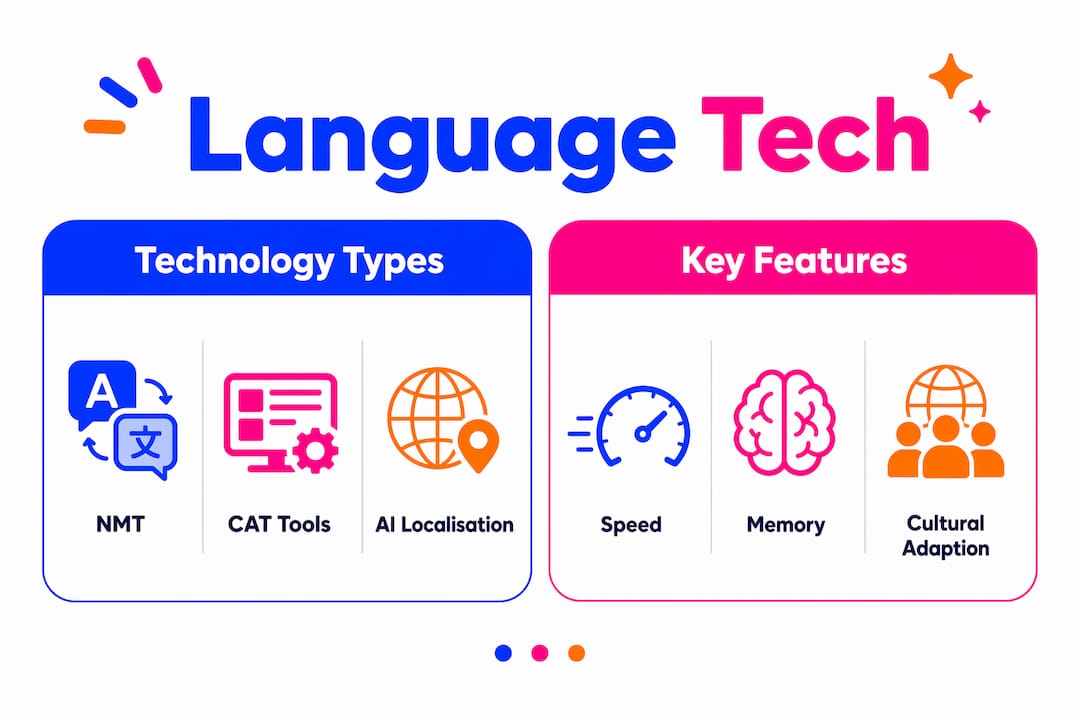
Neural machine translation uses transformer architectures that enable zero-shot and few-shot translation. That means the system can handle language pairs it has seen little training data for, though accuracy drops noticeably in those cases.
CAT tools remain the backbone of professional translation workflows. They store previously approved translations in a translation memory, which reduces repetition and keeps terminology consistent across large projects. Paired with NMT, they give translators a strong starting point rather than a blank page.
Pro Tip: If you are evaluating digital tools for language services, check whether the platform integrates translation memory with machine translation output. Tools that combine both cut post-editing time significantly compared to those that treat them as separate processes.
The role of AI in localisation goes beyond translation. AI now handles cultural adaptation checks, format localisation, and even SEO keyword mapping across languages.
How is technology reshaping workflows and professional roles?
The translator’s role has shifted dramatically. Language professionals now act as system architects and project managers, spending more time on upstream and downstream tasks than on text production itself. That is a profound change in what the job actually involves.
The new competency set for language professionals in 2026 includes:
- Data governance: managing training data quality for AI systems
- Quality estimation: reviewing and scoring machine translation output
- Project management: coordinating multi-tool, multi-vendor workflows
- Prompt engineering: writing effective instructions for large language models
- Intercultural analysis: catching cultural errors that AI consistently misses
Language professionals manage complex language-mediated communication systems requiring linguistic, technological, and intercultural competencies. This is not a narrowing of the profession. It is an expansion into territory that requires more skill, not less.
Workflow automation handles the routing, version control, and approval stages that used to consume hours of administrative time. That frees professionals to focus on the judgement calls that AI cannot make reliably.
Pro Tip: If your team is transitioning into post-editing roles, invest in quality estimation training first. Knowing how to score machine translation output accurately is the skill that underpins every other part of the new workflow.
What are the challenges of integrating technology into language services?
Technology adoption in language services is not without friction. The challenges are real, and ignoring them is expensive.
The most significant ethical concern is that AI systems recycle translational decisions embedded in training data while erasing the original context and authorship. This creates an asymmetry in responsibility. The AI produces output, but no single human owns the decision behind it. That is a governance problem, not just a philosophical one.
Domain adaptation is another persistent challenge. Neural machine translation performs well on general content but struggles with specialist fields such as legal, medical, and engineering. A system trained on news articles will produce unreliable output for a pharmaceutical patent without significant fine-tuning.
Budget pressure compounds these challenges. 40% of organisations expect localisation budgets to remain flat even as demand for higher throughput grows. Flat budgets and rising output demands create a clear mandate to do more with less, which increases the temptation to reduce human oversight.
| Challenge | Impact | Mitigation |
|---|---|---|
| AI recycling decisions without context | Accountability gaps | Active human governance frameworks |
| Domain adaptation failures | Quality errors in specialist content | Fine-tuned models and expert post-editors |
| Flat budgets vs. rising demand | Pressure to cut human review | Prioritise high-risk content for human oversight |
| Low-resource language gaps | Unreliable output for minority languages | Hybrid human-AI workflows |
Research published in june 2026 confirms that corpus linguistics and AI methods are converging, with linguistic expertise and data science reinforcing each other rather than competing. That fusion is the direction the field is heading.
Pro Tip: Before deploying AI on specialist content, run a domain adaptation audit. Compare machine translation output against a sample of expert-translated text in your specific field. The gap you find will tell you exactly how much human post-editing your workflow needs.
How can businesses and language professionals get the most from language technology?
The businesses achieving the best results in 2026 follow a clear pattern. Successful companies centralise workflows, combine AI with human expertise, and build governance frameworks to scale confidently under flat budgets.
Here is what that looks like in practice:
- Centralise your translation assets: one translation memory, one termbase, one style guide. Fragmented assets produce inconsistent output regardless of how good your AI is.
- Pair AI with human review on high-stakes content: legal, medical, and regulatory content should always have a qualified human in the loop.
- Build a governance framework before scaling: define who owns quality decisions, how errors are logged, and how training data is updated.
- Measure what matters: track post-editing time per word, error rates by content type, and cost per word across human and machine workflows.
- Customise for your domain: a generic machine translation engine will underperform a fine-tuned one in your specific field. Invest in customisation early.
For businesses working across multiple markets, localisation best practices extend well beyond translation. Format, currency, date conventions, and cultural references all require attention that AI alone cannot provide reliably.
The essential AI tools for translators available in 2026 cover everything from translation memory integration to real-time quality scoring. Choosing the right combination for your content type and language pairs is the decision that determines your output quality.
Glocco’s perspective: technology is a tool, not a replacement
Working with language technology since 2014 has taught Glocco one thing above all else: the teams that get the best results are the ones that treat AI as a capable colleague, not an infallible oracle.
The uncomfortable truth is that a lot of businesses adopt AI in language services because it feels like the obvious move, not because they have thought through the governance implications. AI restoring a previously approved translation without flagging that the source text has changed is not a time-saver. It is a liability.
The fusion of corpus linguistics and AI methodologies is genuinely exciting. It points toward a future where linguistic expertise and data science produce better outcomes together than either could alone. But that future requires professionals who understand both sides of the equation.
Glocco’s view is that the human factor in language services is not a cost to be minimised. It is the quality control layer that makes everything else trustworthy. The technology handles volume. The people handle judgement. Get that balance right, and the results speak for themselves.
— glocco®
How Glocco can support your language technology goals
Glocco combines AI-powered workflows with expert human oversight across translation, interpretation, and localisation. Whether you are scaling content across European markets or managing specialist legal and medical translations, Glocco’s approach pairs the right technology with the right people for your specific content type.
If you are ready to put a proper framework around your language technology use, the language localisation checklist is a practical starting point. For businesses looking to get more from AI in their translation process, Glocco’s AI-powered translation services are built around governance, quality, and measurable results. Get in touch to see how it works in practice!
FAQ
What is the role of technology in language services?
Technology in language services covers AI, machine translation, CAT tools, and workflow automation used to produce and quality-assure translated content at scale. It increases speed and volume while requiring human oversight to maintain accuracy and accountability.
How does AI improve translation quality?
AI tools such as large language models and automated quality estimation flag errors, suggest contextual alternatives, and learn from corrections. They perform best when paired with human post-editors, particularly for specialist or high-stakes content.
What are the biggest challenges of using AI in translation?
Domain adaptation and ethical governance are the two main challenges. Neural machine translation struggles with specialist fields and low-resource languages, and AI systems can recycle outdated translational decisions without flagging the change to human reviewers.
How are translator roles changing because of technology?
Translators now function as project managers and system architects, focusing on data governance, quality estimation, and workflow oversight rather than text production alone.
What budget pressures do language teams face with technology adoption?
40% of organisations expect localisation budgets to stay flat while output demands rise. The solution is centralised workflows and governance frameworks that make AI investment go further without sacrificing quality.


