


Localisation in defence is defined as the deliberate shift from foreign procurement to domestic production of military equipment, technology, and services. Its core purpose is to reduce dependence on foreign suppliers and build sovereign operational capacity. Saudi Arabia’s General Authority for Military Industries (GAMI) reports the country reached 24.89% localisation by end of 2024, targeting over 50% by 2030. India is pushing indigenous content thresholds to 60% in defence products. These are not abstract policy goals. They reflect a global recognition that the role of localisation in defence is to protect strategic autonomy, secure supply chains, and sustain military readiness when geopolitical conditions turn hostile.
How does localisation enhance operational effectiveness in defence?
Domestic production cuts the time between a fault occurring and a fix being deployed. When spare parts, technical expertise, and maintenance capacity sit within national borders, repair cycles shrink. When they sit overseas, a diplomatic dispute or export restriction can ground an entire fleet.
The capability ladder approach offers the clearest framework for building this capacity sustainably. It combines licensed production, co-development, and indigenous design in a calibrated progression. Nations do not jump from importing a fighter jet to building one. They climb: first assembling under licence, then co-developing subsystems, then designing independently. Each rung builds the engineering and manufacturing muscle needed for the next.
Supply chain security is the other critical dimension. Dependence on foreign defence technology risks turning a nation into a technology colony, eroding the critical engineering and software skills that sovereign defence requires. That erosion is slow and almost invisible until a crisis makes it obvious.
The smartest localisation programmes do not try to domesticate everything. They target supply chain chokepoints with low substitutability and high wartime significance. Localising a bolt is not the same as localising a guidance chip. Prioritise the inputs that cannot be replaced quickly under pressure.
- Maintenance and repair cycles: Domestic capacity means faster turnaround and no export-licence delays.
- Supply chain resilience: Reducing single-source foreign dependencies limits exposure to geopolitical disruption.
- Technology retention: Sovereign manufacturing keeps critical engineering skills inside the national workforce.
- Chokepoint focus: Targeting irreplaceable, high-risk inputs delivers more resilience per pound spent than blanket localisation.
Pro Tip: Map your supply chain beyond first-tier suppliers. The critical vulnerability is usually a second or third-tier component that nobody tracks until it disappears.
What are the strategic benefits and challenges of localisation in multinational defence collaboration?
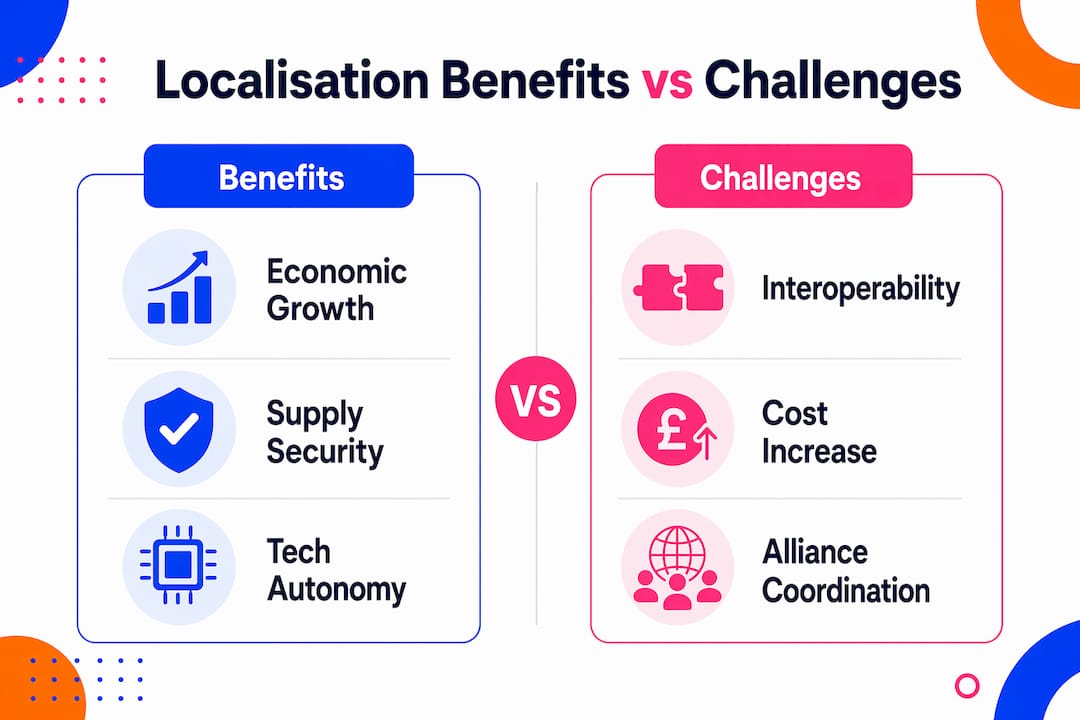
Localisation and alliance capability are not opposites, but managing both simultaneously requires discipline. Saudi Arabia’s Vision 2030 defence programme illustrates the scale of ambition: the Saudi Arabian Military Industries (SAMI) entity manages joint ventures and technology transfer to shift localisation from under 2% to a 50% target by 2030. That is a structural transformation, not an incremental adjustment.
Joint ventures are the primary vehicle for technology transfer in this context. SAMI uses equity structures of 50/50 or 51/49 (local majority) to formalise partnerships with foreign original equipment manufacturers. The equity split matters less than what gets transferred. A joint venture that produces locally assembled components without transferring design knowledge delivers localisation on paper, not in practice.
The challenges are substantial. Successful localisation requires ecosystem building beyond capital investment: workforce training, engineering capability, and programme management discipline. Many programmes underestimate this. They secure the joint venture, build the factory, and then discover the workforce cannot yet sustain production at the required quality.
- Establish clear technology transfer terms before signing any joint venture agreement. Vague commitments produce vague results.
- Invest in workforce development from day one. Engineering skills take years to build and cannot be imported on demand.
- Define interoperability requirements with alliance partners early. Localised equipment must still communicate with allied systems.
- Separate economic and operational objectives. Political pressure to maximise local content can conflict with the operational need for the best available capability.
- Build programme management capacity domestically. Foreign partners will not manage your localisation programme for you indefinitely.
Economic diversification is a genuine benefit of localisation programmes, but it is a secondary one. The primary driver must remain operational effectiveness. Programmes that prioritise job creation over capability development tend to produce factories that cannot sustain themselves once foreign support withdraws.
What are the types of defence sector localisation?
Defence localisation takes several distinct forms, and understanding the differences matters for anyone designing or evaluating a programme.
| Localisation type | Description | Example |
|---|---|---|
| IDDM (Indigenously Designed, Developed, and Manufactured) | Highest tier; excludes foreign OEMs; minimum 50% indigenous content required | India’s Buy IDDM procurement category |
| Licensed production | Foreign design manufactured domestically under licence | Assembly of foreign-designed platforms in-country |
| Co-development | Joint design and development with a foreign partner | Subsystem co-development in Saudi JVs |
| Procurement preference policy | Domestic firms receive preferential treatment in government tenders | India’s proposed 60% indigenous content threshold |
| Targeted chokepoint localisation | Focus on specific high-risk supply chain inputs rather than full domestic production | Domestic production of guidance electronics |
India’s Buy IDDM category excludes foreign original equipment manufacturers entirely and requires a minimum of 50% indigenous content. This creates a protected domestic market that rewards firms owning intellectual property and manufacturing capability. Margins in this tier are higher precisely because competition is limited to domestic players.
The critical distinction is between indigenous content and genuine technological autonomy. Local assembly with high indigenous content can still depend on critical imported technologies at the component level. True self-reliance requires domestic research and development and access to critical materials. Hitting a 60% indigenous content figure while importing the 40% that actually makes the system work is a policy success and an operational vulnerability simultaneously.
Defence sector localisation software supports compliance tracking, supply chain visibility, and indigenous content measurement across complex programmes. These platforms help programme managers monitor supplier tiers, flag compliance gaps, and report against government thresholds. For sector-specific localisation compliance, the right software reduces the administrative burden significantly.
How does localisation affect defence communication in multinational operations?
Linguistic and cultural localisation is the dimension that defence planners most frequently underestimate. A multinational coalition can share equipment, doctrine, and objectives and still fail at the point of communication. Ambiguous operational orders, mistranslated technical manuals, and culturally misread signals create friction that degrades mission effectiveness.

Multilingual communication in joint operations requires more than translation. It requires adaptation: ensuring that a maintenance procedure written for one cultural and linguistic context is understood correctly by technicians operating in another. A word-for-word translation of a safety-critical instruction can be grammatically correct and operationally dangerous at the same time.
The practical requirements for multinational defence communication include:
- Operational orders: Translated and culturally adapted to prevent misinterpretation under pressure.
- Technical manuals: Localised for the specific language and technical literacy of the end user, not the original author.
- Training materials: Adapted to reflect local learning conventions and regulatory frameworks.
- Legal and rules of engagement documentation: Translated with precision, as misinterpretation carries legal and operational consequences.
- Liaison officer briefings: Supported by professional interpretation to maintain accuracy in real-time exchanges.
Pro Tip: Never rely on bilingual personnel for safety-critical translation in the field. Use professionally qualified translators for technical and legal documents, and trained interpreters for live operational communication. The stakes are too high for improvisation.
Effective language localisation workflows reduce errors in documentation and improve the speed of producing multilingual materials. For defence programmes operating across multiple languages and jurisdictions, a structured workflow is not optional. It is a readiness requirement.
Localisation in defence: what we have learned from the field
Glocco has worked with clients across security, defence, and government sectors long enough to have a clear view of where localisation programmes succeed and where they quietly fall apart. The honest observation is this: most programmes are better at announcing ambitions than executing them.
The gap between a localisation target and a functioning domestic capability is almost always a workforce and programme management problem, not a funding problem. Disciplined manufacturing operations define long-term success. Industrial transformation is defined by what factories can consistently deliver, not by what equity structures have been signed.
The second observation is about supply chain visibility. Programmes that track first-tier suppliers believe they understand their exposure. The real risk sits two or three tiers deeper, in components that nobody mapped until a shortage made them visible. Chokepoint analysis needs to go deep.
On the linguistic side, the underinvestment is striking. Nations spend billions on domestic manufacturing programmes and then produce operational documentation that is inadequately translated. That is a false economy. Clear, accurate multilingual communication is part of operational readiness, not a nice-to-have.
— glocco®
How glocco® supports defence localisation through language services
Defence localisation programmes generate enormous volumes of multilingual documentation: procurement contracts, technical manuals, training materials, compliance reports, and operational orders. Getting the language right across all of these is not a peripheral concern. It is central to programme success and operational safety.
Glocco’s security and defence translation services are built for exactly this environment. The team handles technically complex, security-sensitive content across multiple languages, with the accuracy and confidentiality that defence clients require. Whether you need multilingual documentation for a joint venture programme, localised training materials for a multinational exercise, or compliance support for indigenous content reporting, glocco® has the expertise to deliver. Explore Glocco’s full range of language services for global operations and find out how the right language partner strengthens your localisation programme.
FAQ
What is defence sector localisation?
Defence sector localisation is the process of shifting military procurement from foreign suppliers to domestic manufacturers, covering equipment, components, technology, and services. The goal is to build sovereign industrial capacity and reduce dependence on foreign supply chains.
Why is localisation important in military operations?
Localisation reduces supply chain vulnerability during geopolitical tensions, shortens maintenance and repair cycles, and retains critical engineering skills within the national workforce. Nations dependent on foreign defence technology risk losing the capability to sustain their own systems independently.
What are the main types of defence localisation?
The main types include indigenously designed and manufactured procurement (such as India’s Buy IDDM category), licensed production, co-development joint ventures, procurement preference policies, and targeted chokepoint localisation focused on high-risk supply chain inputs.
How does localisation affect multinational defence collaboration?
Localisation can create interoperability challenges if domestically produced equipment does not meet alliance standards. Successful programmes define interoperability requirements early and ensure that localised systems can communicate and operate alongside allied platforms.
What role does language localisation play in defence?
Language localisation ensures that operational orders, technical manuals, training materials, and legal documents are accurately translated and culturally adapted for multinational forces. Errors in safety-critical documentation carry direct operational and legal consequences.


