


Multilingual communication is defined as the practice of delivering messages in multiple languages to ensure consistent, understandable, and culturally relevant information reaches diverse audiences. It goes well beyond swapping words between languages. It means preserving intent, tone, and cultural context so your message lands the same way whether someone reads it in English, Arabic, or Mandarin. Tools like Google Translate handle the basics, but organisations serious about global engagement rely on professional language services, AI-driven platforms, and governance frameworks to get it right. UNESCO recognises multilingualism as a matter of rights and inclusion, not just a business convenience.
What is multilingual communication in a business context?
Multilingual communication in organisations means maintaining consistent messaging across every language your business operates in, whether that is internal team updates, customer-facing content, or regulated documentation. It is not a one-off translation project. It is an ongoing operational commitment.
Here is what that looks like in practice:
- Consistent terminology: Every department uses the same approved translations for product names, legal terms, and processes. No rogue translations that confuse customers or colleagues.
- Content governance: When source content changes, all language versions update in sync. Stale translations create compliance risks and erode trust.
- Cultural adaptation: A phrase that motivates staff in Brazil may fall flat or cause offence in Japan. Effective multilingual communication accounts for cultural context, not just grammar.
- Built-in multilingual systems: Platforms like CERTIFY Health integrate directly with electronic health records to automate multilingual patient communication, maintaining accuracy across every touchpoint without manual intervention.
The core challenge is semantic accuracy. Words that sound equivalent across languages often carry different meanings, and a single mistranslation can flip the intent of a critical message entirely.
Pro Tip: Build a multilingual glossary before you launch any new market. Approved terminology agreed upfront saves enormous rework later and keeps every translator, human or AI, working from the same foundation.

What are the key benefits of multilingual communication?
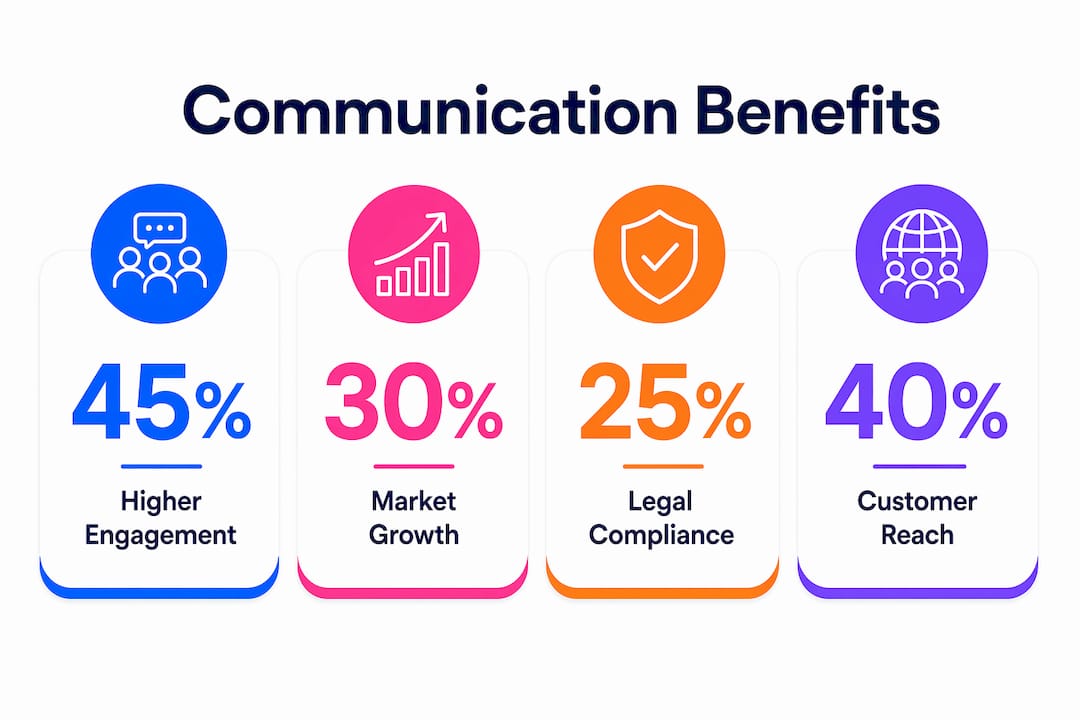
The advantages of multilingual communication are measurable and span employee experience, customer satisfaction, legal compliance, and market reach. Here are the four that matter most to businesses:
-
Improved employee engagement. Organisations that prioritise language access report stronger collaboration and higher satisfaction in diverse workforces. People perform better when they fully understand what is expected of them.
-
Greater customer accessibility. Customers buy more confidently in their own language. This is especially visible in healthcare, where multilingual patient communication directly affects safety outcomes and informed consent.
-
Legal and compliance advantages. Regulated industries in the EU, the Middle East, and North America often require documentation in specific languages. Getting this wrong is not just embarrassing. It is expensive.
-
Cultural heritage and social inclusion. UNESCO links multilingualism to the empowerment of marginalised communities and digital inclusion. For businesses, this translates to brand reputation and the ability to reach underserved markets that competitors ignore.
Multilingual and bilingual populations are rising globally, driven by globalisation and digital exposure. Businesses without a language strategy are already behind.
How do multilingual communication tools support effective engagement?
Technology has transformed what is possible, but it has also introduced a new set of decisions. Here is how the main tools compare:
| Tool type | Best use case | Key limitation |
|---|---|---|
| Google Translate | Quick, informal reference | Unreliable for technical or legal content |
| Machine translation (MT) | High-volume, low-risk content | Requires post-editing for professional use |
| AI-driven specialised tools | Healthcare, legal, technical fields | Needs domain-specific training data |
| Professional human translation | High-stakes, regulated content | Slower turnaround, higher cost |
| AI chatbots (multilingual) | Customer service, FAQs | Struggles with nuance and complex queries |
In high-stakes settings, general-purpose tools simply do not cut it. Specialised AI translation trained on ICU datasets dramatically outperforms generic tools in accuracy and patient safety. The same principle applies to legal, financial, and engineering content. Domain expertise is not optional. It is the difference between a useful translation and a dangerous one.
AI tools paired with quality assurance deliver the best results. Automation handles volume and speed. Human reviewers catch the errors that machines miss. glocco® covers both sides of that equation, which is why our clients in fintech, medical, and legal sectors trust us with their most sensitive content. For a practical breakdown of what AI can and cannot do for translators, the guide on AI tools for translators is worth your time.
Pro Tip: Never deploy machine translation for patient-facing medical content without a qualified human reviewer. The cost of a review is trivial compared to the cost of a mistranslation in a clinical setting.
What challenges do professionals face in multilingual communication?
Knowing the benefits is one thing. Knowing what can go wrong is what separates businesses that succeed globally from those that stumble publicly. The most common challenges include:
- Semantic drift. Context mismatches cause communication failures when words carry different cultural weight across languages. “Cheap” in English implies low cost. In some markets, it implies low quality. That distinction matters enormously in advertising.
- Stale translations. When source content updates and language versions do not follow, you end up with inconsistent messaging across markets. Built-in, consistently maintained translations are the only reliable solution at scale.
- Cultural nuance gaps. Humour, formality levels, and directness vary dramatically across cultures. A tone that feels friendly in one market reads as unprofessional in another.
- Resource constraints. Smaller businesses often rely entirely on free machine translation, which creates risk in regulated or client-facing contexts.
- Critical-context failures. In emergency medical or legal settings, even a minor translation error can have serious consequences. This is where multilingual clinical communication requires specialist tools, not general-purpose apps.
Managing multicultural teams adds another layer. Language barriers within internal teams slow decisions and create misalignment, even when everyone technically speaks the same working language.
How can businesses implement multilingual communication strategies?
Getting multilingual communication right requires a structured approach. Here is a practical framework to start with:
- Establish a terminology governance process. Create an approved glossary in your source language and maintain translated versions. Review it quarterly.
- Select the right translation and interpretation services. Match the tool to the context. High-stakes content needs professional human translators. High-volume, low-risk content can use machine translation with post-editing. The language services checklist from glocco® is a useful starting point.
- Integrate multilingual digital platforms. Choose platforms that automatically present content in a user’s preferred language, reducing friction and improving accuracy.
- Train staff on cross-cultural communication. Language is only part of the picture. Teams need to understand how cultural norms affect interpretation, negotiation, and collaboration.
- Build quality assurance into every workflow. Every translated piece of content should have a review step, whether that is a human editor, a back-translation check, or an automated consistency tool.
For businesses operating across the EU, multilingual legal support is not optional. Regulatory requirements in multiple member states demand accurate, legally reviewed translations.
glocco®’s take: why most businesses underestimate this
Here is something we see constantly at glocco®. Businesses invest heavily in entering new markets. They localise their website, translate their marketing materials, and then assume the job is done. It is not.
The organisations that genuinely succeed in multilingual markets treat language as an ongoing operational function, not a launch task. They build governance. They review terminology. They invest in the right tools for the right contexts. And critically, they understand that effective multilingual communication requires a combination of technology, governance, and cultural understanding working together.
The technology has never been better. Google Translate, large language models, and AI-driven platforms have made multilingual communication faster and cheaper than ever. But speed and cost savings mean nothing if the message is culturally off or semantically wrong. We have seen brands damage hard-won customer relationships with a single poorly localised campaign. The human layer is not a luxury. It is the quality control that protects everything else.
Our honest advice? Start smaller than you think you need to. Get your terminology right. Build the governance process. Then scale the technology on top of a solid foundation. That sequence works. The reverse rarely does.
— glocco®
How glocco® helps businesses communicate across languages
glocco® has been helping businesses communicate across languages since 2014, working with clients in e-commerce, fintech, legal, medical, and manufacturing sectors across Europe, the Middle East, North America, and Asia. Whether you need professional document translation for EU regulatory compliance, specialist medical translation, or a full multilingual content governance framework, glocco® brings the expertise and the technology to deliver it accurately. Our team combines professional linguists with AI-assisted workflows, so you get the speed of technology with the reliability of human expertise. If you are building or scaling a multilingual communication strategy, we would love to help you do it properly.
FAQ
What is the definition of multilingual communication?
Multilingual communication is the practice of delivering messages in more than one language to ensure consistent, culturally relevant understanding across diverse audiences. It encompasses translation, interpretation, cultural adaptation, and content governance.
What are the main benefits of multilingual communication for businesses?
The core benefits include improved employee engagement, greater customer accessibility, legal compliance in regulated markets, and expanded reach into new audiences. Organisations that prioritise language access consistently report stronger collaboration and higher satisfaction.
What is multilingual clinical communication?
Multilingual clinical communication refers to the delivery of healthcare information and patient interactions across multiple languages using specialised tools and professional translators. General-purpose translation tools are insufficient in clinical settings, where accuracy directly affects patient safety.
What are the biggest challenges in multilingual communication?
Semantic drift, cultural nuance gaps, stale translations, and resource constraints are the most common challenges. In critical contexts like healthcare or legal services, even minor translation errors carry serious consequences.
How can businesses improve their multilingual communication skills?
Businesses improve by establishing terminology governance, selecting context-appropriate translation services, integrating multilingual digital platforms, and training staff on cross-cultural communication. Pairing AI tools with human quality assurance delivers the most reliable results at scale.


