


Transkreácia sloganu (slogan transcreation) means rebuilding the effect of a slogan in another language, not translating its words. Use it whenever your line depends on wordplay, rhythm, rhyme, or a cultural reference that won’t survive a literal crossing into another market.
This isn’t a fringe technique. Academic work on international slogan adaptation confirms transcreation is routinely needed for slogans, jingles and taglines precisely because these formats live or die on emotional punch rather than word-for-word accuracy. Bodies like TAUS and publications such as L10N Journal have built entire research strands around this exact problem, and it’s one glocco® deals with weekly.
Here’s the quick version:
- Translate when the message is informational and tone barely matters.
- Transcreate when the slogan relies on sound, humour, or a cultural nerve it needs to hit.
- Localise everything in between, adjusting register and references without a full creative rebuild.
Quick gut check: if your slogan makes native speakers smile, and you can’t quite explain why, that’s your signal it needs transcreation, not translation.
What is transkreácia sloganu and how does it differ from translation?
Translation moves meaning from one language to another. Localisation adjusts that meaning for a specific market’s conventions, currencies, and idioms. Transcreation goes further: it rebuilds the persuasive effect of a line, sometimes changing every single word to keep the punch intact.
Translation studies gives us two useful shortcuts here. Dynamic equivalence asks: does this version produce the same reaction in the new audience as the original did? Skopos theory asks a blunter question: what’s this text actually for? For a slogan, the answer is nearly always “make someone feel something in three seconds or fewer,” and that purpose should dictate every creative choice.
Picture the same phrase run through three lenses:
- Literal translation: grammatically correct, culturally flat, often forgettable.
- Marketing translation: adjusted tone and phrasing, but structurally faithful to the source.
- Transcreation: same brand promise, entirely new wording, rhythm, or imagery if that’s what lands.
Research into slogan adaptation across Ukrainian and Polish markets found that successful transcreation demands deep analysis of the target market’s cultural norms and linguistic habits so the result sounds native rather than imported. That’s the whole game: nobody should be able to tell the slogan was ever anything else.
When does a slogan actually need transcreation?
Run your slogan through this checklist before briefing anyone:
- Does it rely on wordplay, rhyme, or alliteration that only works in the source language?
- Does it reference something culturally specific (a saying, a holiday, a sporting moment)?
- Is there tonal risk, where a joke in one market reads as offensive or bizarre in another?
- Will it appear across multiple channels (TV, out-of-home, packaging) where consistent wording across media really matters?
- Is the brand’s reputation on the line if the line falls flat or gets mocked online?
Three or more “yes” answers means you need proper transcreation, not a quick translation pass. If none apply, a solid marketing translation will do the job faster and cheaper.
Localising a slogan well means it should sound as though it were written natively in the target market in the first place, and that rarely happens overnight. Build in extra time and budget for creative rounds. It’s not a one-and-done job.
Pro Tip: If your slogan needs a footnote to explain the joke, it needs transcreation. Full stop.
How do you brief and run a slogan transcreation project?
A messy brief produces messy slogans. Here’s what actually needs to go in yours:
- Core intent: what should the reader feel in the first two seconds?
- Desired emotion: confidence, warmth, cheekiness, urgency? Pick one, not five.
- Non-negotiables: brand name placement, legal terms, trademarked phrases.
- Must-keep meanings: the one idea that cannot be lost, even if every word changes.
- Tone examples: two or three lines (in any language) that capture the vibe you’re after.
Getting stakeholders involved early matters more than most teams realise. Bringing in localisation experts before marketing falls in love with the original line saves you from defending a slogan that simply won’t travel.
From there, the creative process usually runs like this:
- Draft five to ten candidate lines with a native creative copywriter, not a generalist translator.
- Preserve the original rhythm where possible, or deliberately rebuild a new one that scans naturally.
- Run an in-market linguistic review to catch anything a monolingual brief writer would miss.
- Do a cultural screen for unintended meanings, slang collisions, or religious/political sensitivities.
- Loop in legal for trademark and claims clearance.
- Consider a small micro-test with real consumers to confirm memorability and emotional fit before rollout.
Delivery should include usage notes, alternative lines for shorter channels (like social captions), and guardrails so nobody “improves” the line into something off-brand six months later.
Pro Tip: Ask for two backup lines alongside the winner. Campaigns change, and having options on file beats rebriefing from scratch.
What techniques make a transcreated slogan actually work?
A handful of creative moves show up again and again in strong slogan transcreation. Knowing their names means you can actually ask for them.
Rhyme and meter. Short, rhythmic lines stick in memory far better than flat statements. If the original slogan rhymed, a good transcreator will hunt for an equivalent rhyme in the target language, even if it means abandoning the literal meaning entirely.
Inversion. Flipping word order or the logical structure of a sentence can create punch that a direct translation loses. Academic analysis of English-to-Slovak slogan adaptations found that techniques like inversion and rhythmic additions often boost memorability in the target language, precisely because Slovak sentence structure allows flexibility English doesn’t.

Cultural substitution. Swap a reference nobody locally understands for one that hits the same emotional note. A joke about baseball means nothing in a country obsessed with ice hockey; swap the sport, keep the joke.
Idiom swap. Translate the feeling of an idiom, not its literal image. “Piece of cake” becoming a literal cake reference abroad is exactly the kind of embarrassing miss cultural screening should catch.
Here’s a quick anonymised example of the difference in practice:
| Approach | Result |
|---|---|
| Literal translation | Grammatically correct, but the wordplay disappears and the line reads like an instruction manual. |
| Transcreated version | New local idiom, same brand promise (“effortless, reliable, quick”), rhythm rebuilt to match natural speech patterns. |
Measuring success afterwards doesn’t need to be complicated. Ask three questions: Is it memorable after one read? Does it feel emotionally right for the brand? Is it consistent with everything else the brand says elsewhere? If all three check out, you’ve got a transcreation that’s doing its job.
What are the most common slogan transcreation mistakes?
The biggest failures are painfully predictable, and mostly avoidable.
- Literalism: translating word-for-word and losing all the wordplay or punch.
- Tone mismatch: a playful original becomes stiff and corporate, or vice versa.
- Untested idioms: a phrase that sounds fine to one translator but odd to a wider audience.
- Legal or cultural traps: unintended double meanings, trademark clashes, or references that land badly.
Literal renderings can produce genuinely embarrassing or nonsensical outcomes, and the fix is boringly simple: cultural screening and a native creative rewrite, every single time, no shortcuts.
Before launch, check: has more than one in-market reviewer signed off? Has legal cleared the wording? Has anyone outside the project team heard it cold and reacted the way you hoped?
Pro Tip: Show the finished slogan to someone with zero context. If they laugh at the wrong moment, or don’t laugh at all, go back to the drawing board.
How does glocco® handle slogan transcreation projects?
Glocco® pairs native creative copywriters with in-market linguistic reviewers, so every candidate line gets checked for sound, sense, and cultural fit before it reaches you. AI-assisted workflows speed up early drafting and terminology consistency checks, but the actual creative calls stay firmly with people who write in that language every day.
The work fits inside broader campaign and localisation projects rather than sitting off to one side, using the same localisation checklist and QA process that runs across an entire market launch.
A slogan that needs a footnote to make sense has already failed at its one job: landing instantly, in any language, without explanation.
What this looks like in practice:
- Native creative copywriters draft multiple candidate lines, not just one “safe” option.
- In-market reviewers stress-test tone, idiom, and cultural fit before anything ships.
- AI tools handle terminology consistency and speed, freeing humans for the creative decisions that actually matter.
What actually matters more than perfect wording?
Most advice on slogan transcreation obsesses over finding the “perfect” clever line. That’s the wrong priority. The brief matters more than the wordsmithing that follows it. A vague brief produces five brilliant-sounding options that all miss the brand’s actual intent, and you’ll spend weeks arguing about which flawed line to pick.
Get specific about the emotional target before anyone writes a word. “Confident but approachable” beats “make it pop” every time, and a detailed brief with two tone examples genuinely cuts down rework.
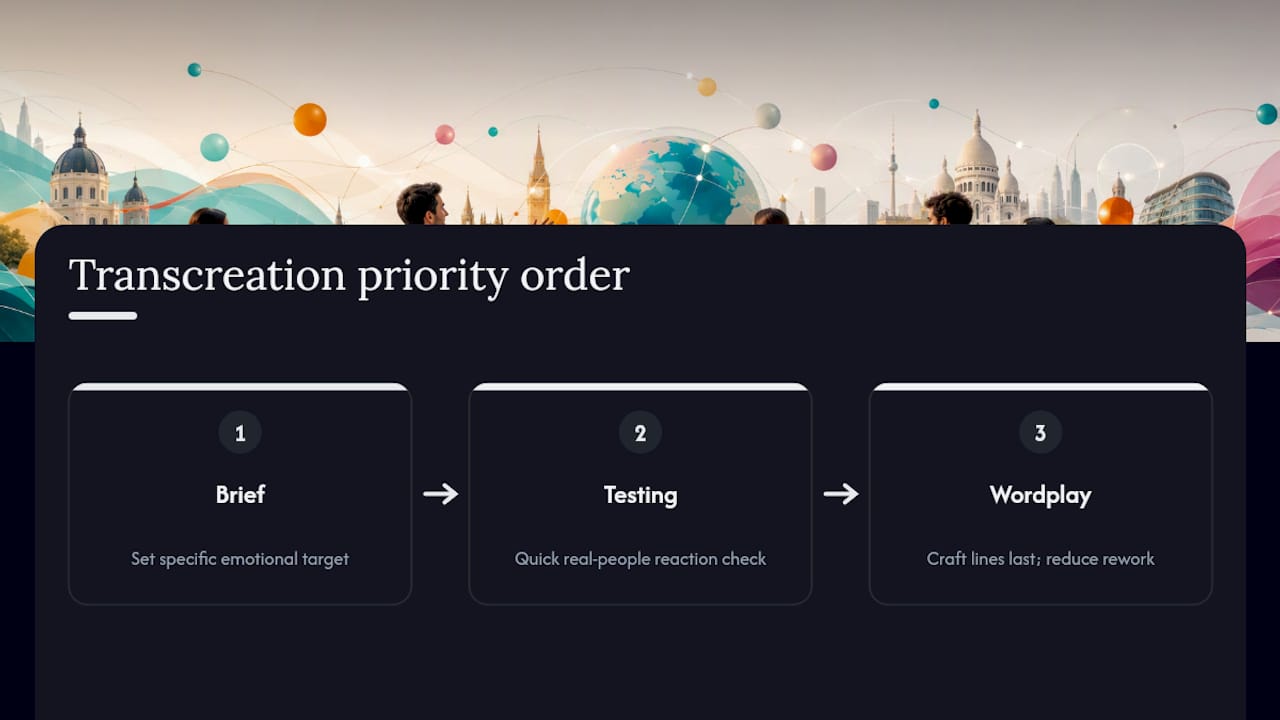
The other overlooked point: testing shouldn’t be an afterthought bolted onto the end. A quick reaction check with real people, even an informal one, catches problems no amount of internal debate ever will. Teams that skip this step aren’t saving time. They’re just moving the delay to after launch, when it’s far more expensive to fix.
Prioritise the brief, then the testing, then the wordplay. Most teams do it backwards.
— glocco®
Ready to transcreate your slogan properly?
Right, so you’ve read all this and you’re thinking “great, now what?” Fair question. Start by pulling together four things: your brand brief, the original slogan, a couple of lines that capture your tone of voice, and the markets you’re targeting. That’s genuinely all we need to get moving.
From there, the smart move is a short consultation or a pilot transcreation on one slogan, rather than committing to a full campaign rebrand blind. See the work, see the process, then decide. Glocco® runs this exactly the way we’ve described above: native creative copywriters, in-market reviewers, and AI tools doing the boring bits so humans can focus on the clever bits.
Check out our localisation checklist for the full brief template, or get in touch to talk through your slogan and your target markets. Worth a conversation before your slogan goes anywhere near a billboard abroad.
Sources
- Methods of Adaptation of Advertising Slogans of International Brands: Linguistic Analysis in the Context of Ukraine and Poland
- The transcreation of advertisements (L10N Journal)
- Why localizing slogans matters more than translating them – POEditor Blog


