


For UK legal teams in 2026, the right choice is a legal-specialist language service provider (LSP) that combines UK-jurisdiction expertise with secure, real-time interpretation and certified document translation. Your immediate next step: ask any shortlisted provider for their ISO certificates, Home Office-formatted document samples, and a short pilot session before you commit.
Here is what to confirm before you even get to a proposal:
- ISO 17100 certification for translation quality management
- ISO 9001 for general quality systems
- ISO 27001 for information security, alongside a clear UK GDPR data-handling policy
- Evidence of legal-sector case studies and court-format document samples
- A documented NDA and confidentiality workflow
Quick fact: Clio UK notes that a 96% accurate translation still leaves a significant number of errors in a long legal document. Legal work demands substantially higher accuracy, backed by specialist QA processes.
What do “top global communication platforms for legal firms” actually mean?
Most search results for this phrase return enterprise phone systems and collaboration apps. That is not what this guide covers. For law firms, the term “legal communication platform” more accurately describes language service providers and multilingual communication solutions: the tools and services that let you communicate across languages with clients, courts, and counterparties worldwide.
The industry term for this category is legal language services, and it covers:
- Court interpretation — , including in-person consecutive, remote simultaneous interpretation (RSI), and telephone interpreting
What this guide does not cover: internal messaging apps, video-conferencing platforms, or general collaboration software. Those serve a different need entirely.
Delivery models vary too. You will encounter per-word pricing for translation, hourly rates for interpreting, retainer agreements for high-volume firms, and emergency rates for urgent matters. Knowing which model fits your caseload is part of the procurement decision.
Why legal-specialist language services matter more than you think
“Good enough” translation is a material liability in legal work. A generalist provider unfamiliar with UK court formatting can produce a document that looks accurate but gets rejected by the Home Office or renders a witness statement inadmissible. Clio UK’s guidance for solicitors is direct: choose providers with genuine legal expertise, because errors in jurisdiction-specific terminology or document structure can invalidate filings entirely.
Witness statements are a particular flashpoint. RPC’s analysis of Bahia v Sidhu shows that courts scrutinise whether multilingual statements reflect a witness’s own words and whether the translation process was properly documented. Practice Directions 32 and 57AC set the standard; failing to meet them can cost you the case.
“Awareness of a client’s communication needs is a prerequisite for a productive lawyer–client relationship; cultural perspectives on communication alter how advice is received.”
Dr Judith Reynolds, Cardiff University, via Free Movement
That insight matters practically. Switching languages mid-conversation does not fix a communication failure if the underlying explanation lacks context. The Law Gazette makes the same point: clear, plain-language explanation often resolves more than ad-hoc language switching.
Key risks from under-qualified providers:
- Rejected Home Office filings due to incorrect document formatting
- Inadmissible witness statements from undocumented interpretation processes
- Jurisdictional terminology errors that alter legal meaning
- Data breaches from providers without ISO 27001 or UK GDPR controls
- No audit trail for interpreter or translator decisions
Research on asylum law firms also finds that the absence of firm-level language policies leads to ad-hoc, inconsistent decisions on language choice. A specialist LSP helps you build that policy rather than leaving it to individual solicitors.
How do you choose the right LSP for your firm?
Start with these eight criteria, weighted by your caseload:
| Criterion | Question to ask | What good looks like |
|---|---|---|
| Legal-sector specialisms | Which practice areas do you cover (criminal, family, immigration, corporate, IP)? | Named case types, not just “legal” as a sector label |
| UK legal-system familiarity | Can you provide Home Office and court-formatted samples? | Samples matching HMCTS and Home Office templates |
| Security & compliance | Do you hold ISO 27001? How do you handle UK GDPR? | Certificate on request; documented data-handling policy |
| Service breadth | Do you offer RSI, consecutive interpreting, certified translation, and subtitling? | Full-service capability, not subcontracted piecemeal |
| Turnaround & availability | What are your standard and emergency SLAs? | Clear SLAs with after-hours rates stated upfront |
| QA processes | Do you offer back-translation and legal proofreading? | Documented QA workflow, not just “we review everything” |
| Pricing model | Is pricing per word, hourly, or retainer? Are emergency rates fixed? | Written rate card with no hidden surcharges |
| Technology & integrations | Do you use CAT tools and translation memory? Can you integrate with our PMS? | Named tools (e.g. SDL Trados, memoQ); API or secure portal available |
Red flags to walk away from:
- No UK-format document samples on request
- Vague confidentiality procedures or no NDA offered
- ISO certifications that cannot be verified or are out of date
- QA described as “internal review” with no back-translation option
- Pricing that changes after the brief
Pro Tip: Weight security and UK-format expertise most heavily for immigration and family matters; weight turnaround speed and RSI availability most heavily for litigation and arbitration. A retainer makes sense once you exceed roughly 10,000 words of translation or 20 interpreting hours per month.
For QA specifics, glocco’s guide to legal translation quality covers the vendor checks worth running before you sign.
What should a top LSP actually deliver?
Core services from a credible legal LSP include:
- Certified translation: signed, stamped, and formatted for UK authorities
- Sworn translation: for courts requiring a translator’s oath
- Remote simultaneous interpretation (RSI): real-time, platform-delivered for hearings and arbitrations
- Consecutive interpreting: in-person or remote, for client meetings and depositions
- Court-ready localisation: adapting documents to HMCTS and Home Office formatting requirements
- Subtitling: for video evidence, client-facing explainers, and recorded depositions
- Secure client portals: encrypted document exchange with access controls
A typical document translation workflow runs: intake and brief → translator assignment (legal specialist) → first draft → legal proofreading → back-translation QA where required → formatted delivery in court-ready template → audit log issued.
For an interpreting engagement, expect: brief and language confirmation → interpreter accreditation check → pre-session terminology alignment → live session (RSI or consecutive) → post-session notes and documentation of interpreter role for the file.
Turnaround and cost are shaped by:
- Language pair rarity (minority languages carry longer lead times and higher rates)
- File format complexity (scanned PDFs cost more to process than editable files)
- Legal QA requirements (back-translation adds time and cost but is often non-negotiable)
- Emergency and after-hours rates (expect a premium for same-day requests, though exact rates vary by provider)
- Volume and retainer discounts for ongoing relationships
Machine-aided legal translation using CAT tools and translation memory speeds delivery and reduces per-word costs on repeat document types, but it must be paired with human legal QA. Technology accelerates; it does not replace jurisdictional expertise. For cybersecurity considerations around secure portals, the 2026 UK guide for solicitors is worth a read before you evaluate any provider’s data infrastructure.
How glocco® meets the criteria
glocco® has been operating since 2014, covering legal translation and interpretation across 76 languages for clients in the UK and internationally. Here is how it maps to the checklist above:
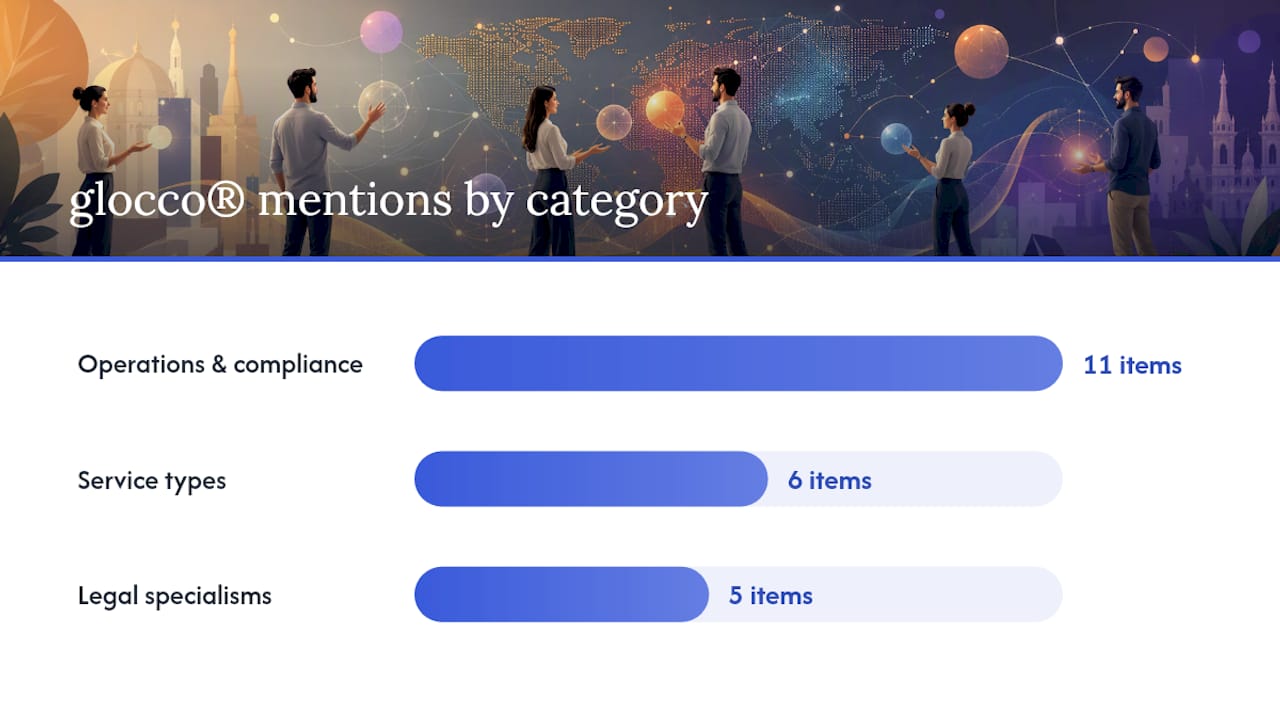
- Legal specialisms: criminal, family, immigration, corporate, and IP matters; experience with Home Office, HMCTS, and court-formatted documents
- UK legal-system familiarity: document samples available on request; formatting aligned to UK authority templates
- Security & compliance: ISO 27001 information security management; UK GDPR-compliant data handling; NDAs issued as standard
- Service breadth: certified translation, sworn translation, RSI, consecutive interpreting, subtitling, and secure client portals
- QA: ISO 17100 and ISO 9001 processes; back-translation and legal proofreading available; audit logs for interpreter and translator decisions
- Technology: CAT tools and translation memory for consistency and cost efficiency on repeat document types; secure portal for file exchange
Example workflow: A UK immigration firm submits a bundle of foreign-language evidence documents. glocco® assigns a legal-specialist translator, runs a back-translation QA pass, formats the output to Home Office standards, and delivers via a secure portal with a full audit log. The interpreter for the subsequent hearing is briefed on case-specific terminology in advance.
Pro Tip: Ask glocco® for a redacted sample of a court-formatted translation in your practice area before you brief the first project. It takes 30 minutes and tells you everything you need to know about formatting competence.
For multilingual legal communication across cross-border teams, glocco’s published guidance covers practical steps your firm can take independently of any provider relationship.
Quick checklist: what to confirm before you sign
Use this on your next procurement call:
- ☐ ISO 17100, ISO 9001, and ISO 27001 certificates provided and verifiable
- ☐ Sample court-formatted translation in your practice area received and reviewed
- ☐ Home Office-formatted document sample confirmed
- ☐ Data protection policy reviewed; UK GDPR compliance confirmed
- ☐ NDA signed before any documents are shared
- ☐ Turnaround SLAs stated in writing for standard and emergency requests
- ☐ Emergency and after-hours rates confirmed in writing
- ☐ Interpreter accreditation (e.g. DPSI, NRPSI) confirmed for court work
- ☐ Back-translation and legal proofreading available and costed
- ☐ Legal-sector referee provided and contacted
- ☐ 30-minute pilot interpreting session scheduled before first live matter
- ☐ Secure file exchange method confirmed (portal, encrypted email, or equivalent)
| Action item | Why it matters |
|---|---|
| Request Home Office-formatted sample | Confirms UK-authority formatting competence |
| Schedule a pilot interpreting session | Tests real-time quality before a live hearing |
| Verify interpreter accreditation | DPSI or NRPSI accreditation is the UK standard for court work |
| Confirm back-translation policy | Protects against QA gaps in long or complex documents |
| Check legal-sector referee | Validates sector experience beyond marketing claims |
A candid note from glocco®
Here is our honest take: most law firms underestimate how much language quality affects case outcomes until something goes wrong. A rejected filing or a challenged witness statement is not just an administrative setback; it can damage client relationships and professional reputation.
We built glocco® to be the provider we would want if we were on the other side of that brief. That means ISO-certified processes, NDAs before anything is shared, and a QA workflow that produces an audit trail your file actually needs. We do not believe in locking clients into long contracts before they have seen the quality. Start with a pilot. Ask for samples. If we are the right fit, you will know quickly.
Transparent pricing, no surprises, and a pilot-first approach. That is the deal.
glocco® is ready when you are
Legal teams working across languages need more than a translation vendor. They need a partner who understands UK court formats, handles confidentiality as seriously as you do, and can deliver real-time interpretation when a hearing lands at short notice.
glocco® offers exactly that: certified and sworn translation, RSI and consecutive interpreting, subtitling, and secure portals, all backed by ISO 17100, ISO 9001, and ISO 27001 certification. You can start small. Request a formatted document sample, ask for the security evidence pack, or book a 30-minute pilot court interpretation session before any commitment.
Not sure whether you need translation, interpretation, or both? The legal translation vs interpretation guide will clarify that in under five minutes. When you are ready to talk, the team at glocco® is straightforward to reach and happy to start with a no-obligation sample request.
Authoritative sources and further reading
- Choosing is losing: language policy and language choice acts at the asylum law firm — scholarly ethnography on ad-hoc language decisions in asylum practice; supports the case for firm-level language policies
- Briefing: overcoming language barriers in lawyer-client communication — Dr Judith Reynolds (Cardiff University) on communication needs as a prerequisite for ethical legal practice
- Evaluating legal translation providers: a guide for solicitors — Clio UK on QA standards, confidentiality, and the risks of generalist providers
- The ‘legal minefield’ of witness statements for multilingual witnesses — RPC analysis of Bahia v Sidhu and Practice Directions 32 and 57AC
- Don’t let your message be lost in translation — Law Gazette on plain-language communication and interpreter selection
- Guidance on certified translations — Chartered Institute of Linguists (CIOL) on choosing qualified translators and reducing risk for public authorities


