


Spanish, French, Portuguese, Italian, German, Dutch, Polish, Romanian, Swedish and Danish top our list of the easiest target languages for businesses to add. We ranked these on translator supply, script compatibility, tooling maturity, and how quickly they turn revenue, not on how easy they are to pick up as a hobby.
Here’s the ranked shortlist, business logic attached to every entry:
- Spanish — huge translator pool, cheap per word, works across 20+ markets. Ecommerce and fintech love it.
- French — deep CAT tool support, strong MT quality, standard for EU compliance documents.
- Portuguese — covers Brazil and Portugal in one language pair, though the two variants diverge more than people expect.
- Italian — mature linguist supply, Latin script, low technical friction.
- German — brilliant tooling and translator availability, but expect UI strings to expand by roughly 35%, according to XTM’s SaaS localisation guide.
- Dutch — small market, but low-friction script and fast turnaround for Benelux fintech and SaaS.
- Polish — growing linguist base, solid for ecommerce expansion into Central Europe.
- Romanian — often overlooked, but cost-effective and increasingly used for EU-facing customer support.
- Swedish — tiny population, big spending power, and a translator market that’s easy to tap.
- Danish — similar profile to Swedish: small, wealthy, low-risk to localise into.
Notice what’s missing? Japanese, Arabic and Mandarin. Not because they’re unimportant. Because they demand more script engineering, pricier linguists, and often heavier compliance work, according to Lokalise’s pricing data. If your product is regulated (think fintech or medical), that ranking can flip fast. More on that below.
How we rank the easiest languages for business localisation
“Easiest” isn’t a vibe. We scored each language against seven criteria, then weighted them so the list actually means something for a procurement decision.
- Translator supply (25%) — how many qualified linguists exist for that pair.
- Script and technical friction (20%) — Latin script versus right-to-left layouts, string expansion, Unicode handling.
- MT/CAT tool quality (15%) — how well machine translation and CAT platforms handle the pair.
- Cost tier (15%) — relative per-word and per-project pricing.
- Turnaround time (10%) — how fast a typical UI or marketing batch comes back.
- Regulatory and compliance risk (10%) — GDPR, sector rules, data residency.
- Market size and business value (5%) — how much revenue that language realistically unlocks.
Common pairs like English to Spanish or English to French sit in the low-cost, fast-turnaround tier because supply is abundant. Rarer pairs, English to Japanese for instance, land in the high tier simply because there are fewer specialist linguists to go around, as Lokalise’s cost breakdown shows.
Three rough tiers help you budget:
- Low tier: short UI strings and marketing pages in Spanish, French, or Italian. Fast, cheap, forgiving.
- Medium tier: longer marketing content or partial legal text in German, Dutch, or Polish, where expansion and formatting need more QA.
- High tier: full legal or medical documentation in any language, where internationalisation groundwork like Unicode and flexible layouts becomes non-negotiable.
One caveat that trips up a lot of teams: your source language changes everything. Translating from German into Polish behaves differently than English into Polish, purely because of grammatical structure. And sector compliance can override the whole ranking. A “hard” language for casual localisation might become mandatory the moment a regulator says so.
What glocco® sees in enterprise localisation (and where teams get surprised)
Here’s the thing nobody tells you upfront: the easiest language on paper is sometimes the wrong first move. We’ve been doing this since 2014, across ecommerce, fintech, legal, medical and gaming, and the pattern repeats constantly. Compliance beats convenience, every single time.
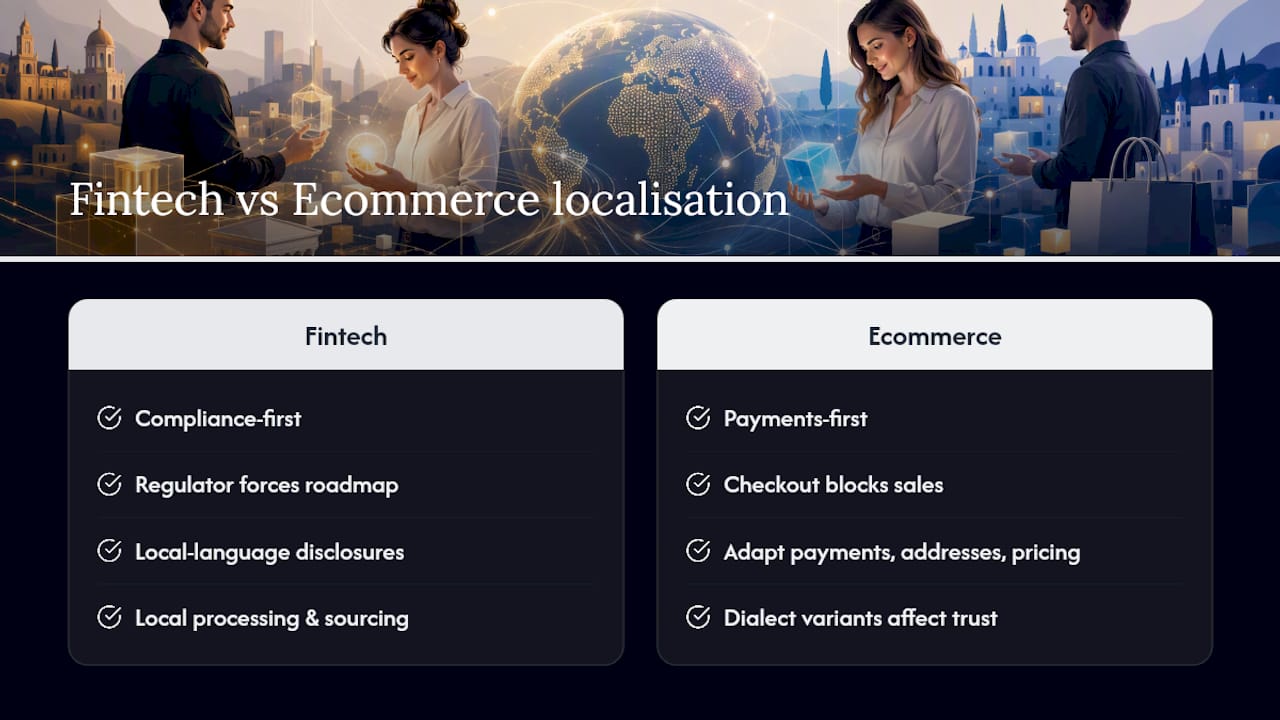
Take fintech. A company might rank German as “easy” based on translator supply and tooling. Then a regulator requires local-language disclosures for a specific market, and suddenly that “easy” language jumps to the top of the roadmap regardless of cost. Trade and data laws are pushing more of this behaviour, with HBR reporting that governments increasingly demand local processing and sourcing, not just translated interfaces.
The other surprise? In ecommerce, payments matter more than copy. You can nail the Spanish translation perfectly, but if checkout doesn’t support local payment expectations, the sale still dies. Shopify’s enterprise research backs this up: full localisation means adapting payments, addresses and pricing display, not just words on a page.
Pro Tip: Don’t treat “neutral” Spanish or Portuguese as a shortcut. Mexican, Peninsular and Rioplatense Spanish genuinely differ in tone and vocabulary, and using one flat version in a regulated sector can quietly erode trust with local customers.
How glocco® helps you add these languages faster and safer
Right, let’s talk about making this actually happen. Adding a new language shouldn’t mean six months of chaos and a spreadsheet nobody understands.
Here’s what actually shortens the timeline:
- Document translation with built-in compliance QA for regulated content.
- Localisation testing that catches layout and expansion issues before launch, not after.
- Real-time language support for customer service teams going multilingual overnight.
- Interpretation services for legal and medical teams handling live, high-stakes conversations.
Our own compliance workflow data shows a properly managed LSP process can cut compliance errors by 35% compared to ad hoc, in-house handling. That’s not a small number when a single mistranslated clause can trigger a regulatory headache.
So when should you go LSP versus MT-first? If you’re testing demand in a low-stakes market, machine translation with light editing gets you there fast and cheap. The moment legal, medical or fintech content enters the picture, or a regulator starts asking questions, bring in a proper LSP. Cutting corners there rarely ends well.

Ready to figure out which languages actually make sense for your roadmap? Get your localisation strategy sorted with a team that’s been doing this since 2014.
Sources
- For multinational companies, localisation matters more than ever
- Ecommerce localisation — Shopify enterprise blog


