


Get the language wrong on a clinical trial, and you don’t just annoy a reviewer. You risk consent nobody truly understood and a submission that bounces back from ŠÚKL. The fix isn’t complicated: participant-facing documents go into clear, ŠÚKL-compliant Slovak, and every spoken interaction runs through a qualified medical interpreter who back-translates and validates the language before anyone signs anything.
What needs tlmočenie pre klinické skúšania (translation and interpreting) in a clinical trial?
Every clinical trial produces two very different categories of language work, and mixing them up is where sponsors get into trouble. One is written, static, and destined for a regulator’s desk. The other is spoken, live, and happens in a room with a real person deciding whether to join a study.
On the written side, you’re looking at a fairly predictable list:
- Information for the participant and the Informed Consent Form (ICF)
- Patient Information Leaflet (PIL) and SmPC summaries
- Recruitment leaflets and site advertising material
- Protocol summaries used for ethics committee review
- Patient diaries and patient-reported outcome (PRO) instruments
- Case Report Forms (CRFs), where the local language is required
- Site training packs for local staff
- Safety and pharmacovigilance reports, including SAE documentation
Each of these has a different audience, and that changes the register you write in. A PIL has to speak to someone with no medical background, ideally at the reading level of a national newspaper. A CRF or SAE report, by contrast, is written for clinicians and needs precise, unambiguous clinical terminology, not simplification.
Then there’s the spoken side. Consent conversations typically call for consecutive interpreting, where the interpreter renders each segment after the speaker pauses, giving the participant time to ask questions. More complex, multi-party discussions (investigator meetings, adverse event reviews) sometimes need simultaneous or whispered interpreting instead. Remote video or telephone interpreting has become a normal fallback for smaller sites, and sign language interpreting matters more than most sponsors plan for, particularly for informed consent, where comprehension has to be demonstrable, not assumed.
Get the audience and register right for each item, and you’ve already solved half the compliance puzzle.
What are Slovakia’s regulatory rules for clinical trial translations?
ŠÚKL, Slovakia’s state medicines agency, doesn’t leave much to interpretation (no pun intended) when it comes to patient-facing text. Its guidance is explicit: information for the participant and the informed consent form must be in Slovak, written in plain, non-technical language a layperson can actually follow.
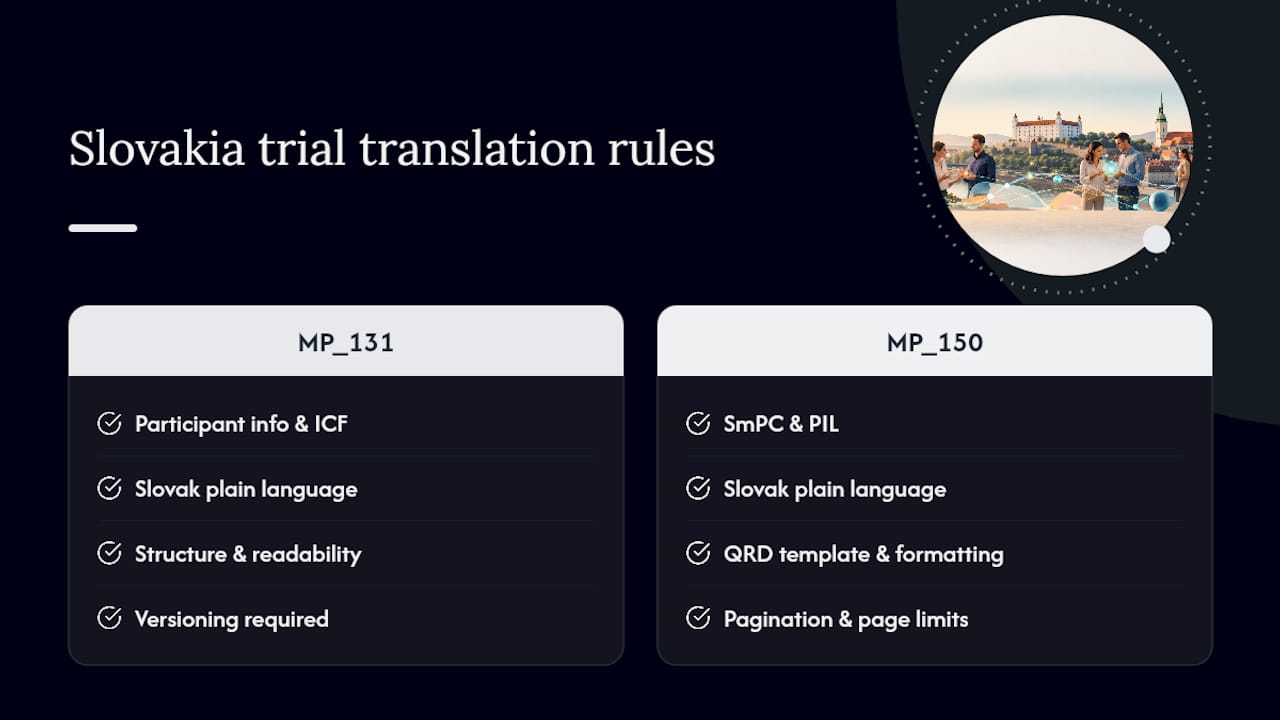
The detail lives in two documents you’ll want bookmarked. MP_131 sets out exactly what must appear in participant information and the ICF, including structure, readability expectations, and mandatory metadata like the protocol number, version, and date. Miss the versioning convention, and your submission can get kicked back on a technicality that has nothing to do with the science.
MP_150 covers the SmPC and PIL side, and it’s specific about QRD template conventions, font and formatting rules, page limits, and pagination. It also flags something a lot of sponsors overlook: national translations often need to come from qualified subject-matter translators rather than a generic agency job, and machine translation alone won’t cut it for these documents.
Pro Tip: Build your version control into the file name from day one. Something like ICF_v3_2026-03-14 saves you an afternoon of confusion when three amendments land in the same week.
There’s a genuinely useful requirement buried in MP_150 too: user testing for PILs, where a sample of real readers works through the document to confirm it’s genuinely understandable, not just grammatically correct. Skip this step and you’re gambling on whether your “plain language” actually reads as plain to someone outside the industry.
How do you validate clinical trial translations for accuracy?
Accuracy in clinical translation isn’t a single checkpoint. It’s a chain, and every link matters.
Start with back-translation: an independent translator, who’s never seen the original source text, translates your Slovak document back into English (or the source language). Reconciliation then compares that back-translation against the original to flag any drift in meaning. Ethics committees and ŠÚKL increasingly expect this for critical participant documents, so budget it in as a real deliverable, not an optional extra you cut when the timeline gets tight.
Linguistic validation goes a step further for PILs and PRO instruments. Cognitive debriefing interviews with target-language speakers confirm the document doesn’t just translate correctly, it lands the way it’s meant to. This matters most when a symptom scale or diary entry has to capture a precise clinical concept without losing patient comprehension.
Terminology control ties the whole thing together. Working from standardised references like MedDRA and EDQM, paired with a bilingual glossary built specifically for the trial, keeps every translator and reviewer using the same word for the same concept across hundreds of pages.
A workable checklist looks like this:
- Confirm source text is final and version-locked.
- Assign translation to a subject-matter qualified linguist.
- Run independent back-translation.
- Reconcile discrepancies with a clinical reviewer.
- Conduct linguistic validation or user testing where required.
- Finalise DTP-ready files with version, date, and protocol number visible.
Skip step four and you’ll find out about the gap the hard way, usually from a reviewer’s comment, not your own QA process.
How do you hire the right translation or interpreting provider?
Briefing a provider properly saves you weeks later. Here’s what your RFP actually needs to spell out:
- Full document list, languages, and estimated volumes
- Turnaround expectations for each document type
- Desktop publishing (DTP) requirements for submission-ready formatting
- Whether back-translation and user testing are in scope
- Pharmacovigilance and SAE translation needs, including urgent-turnaround protocols
On credentials, ask for evidence, not just claims. Request samples of comparable clinical work, references from other sponsors or CROs, and clear confidentiality terms (an NDA plus GDPR-compliant data handling, given how much personal health information passes through this work).
Contract clauses matter more than people expect here. Nail down:
- Version control procedures for amendments mid-trial.
- Named reviewer roles and sign-off responsibilities.
- Formatting deliverables that match ŠÚKL’s template requirements exactly.
- A defined process for handling protocol amendments without restarting the whole translation cycle.
On timing, build in more slack than feels necessary. A straightforward ICF translation with back-translation and reconciliation typically needs more lead time than a single-pass job, and rushing linguistic validation is the single fastest way to end up resubmitting.
Why glocco®’s clinical translation workflow gets trial documents approved faster
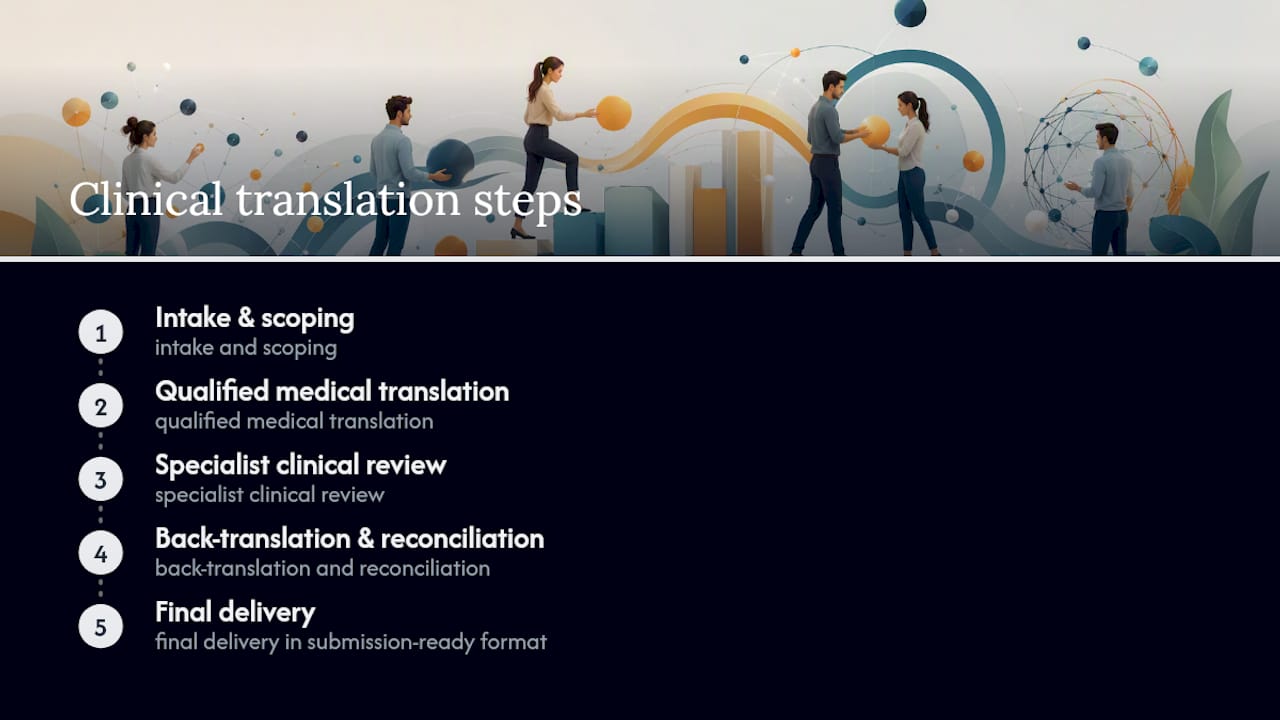
We built our Five Step Clinical Study Translation process around exactly the chain described above: intake and scoping, qualified medical translation, specialist clinical review, back-translation and reconciliation, then final delivery in submission-ready format.
For SmPC and PIL work specifically, our Five Stage SmPC workflow bakes in QRD formatting and user testing from the start, rather than bolting it on when a reviewer asks for it. And because pharmacovigilance translation carries its own urgency, our PV document translation process is built to handle SAE reporting timelines without cutting corners on terminology control.
None of this is theory. It’s the same sequence sponsors and CROs run through when they’re trying to avoid a ŠÚKL resubmission cycle.
— glocco®
Get your trial documents translation ready with glocco®
One provider can handle text, interpreting, and PV documents, simplifying your workflow. One provider handles your ICF and PIL translation, back-translation, linguistic validation, on-site and video remote interpreting, and pharmacovigilance translation, all under the same version control system.
Here’s what that actually covers:
- ICF, PIL, and SmPC translation with QRD formatting built in
- Back-translation and reconciliation for critical participant documents
- Linguistic validation and user testing for readability
- On-site, video remote, and consecutive interpreting for consent visits
- PV and SAE document translation with urgent-turnaround handling
Get in touch and you’ll typically start with a sample review on a short extract, so you can see translator quality before committing to the full document set, followed by a timeline built around your ethics submission date. If informed consent translation is your immediate priority, our guide to certified consent translation is a good next stop, or head straight to HumanPro to request a quote for your trial documents.
Where to find the primary regulatory guidance
Start with ŠÚKL’s own site for the authoritative national position, then read MP_131 and MP_150 for document-level detail. For interpreting results in plain language, the PMC clinical trial reading guide and this practitioner primer on RCT results are worth bookmarking. For broader professional context on medical translation practice, this practical guide for physicians is a useful companion read.
This article is general information, not a substitute for advice from a qualified doctor. Consult a qualified healthcare professional about your own circumstances before acting on anything here.
Sources
- How to read a published clinical trial: a practical guide for clinicians
- Štátny ústav pre kontrolu liečiv (ŠÚKL)
FAQ
Does every clinical trial document need translating into Slovak?
Not every document, but all participant-facing materials do. ŠÚKL requires the information for the participant and the informed consent form to be in clear Slovak, while internal clinical documents like CRFs may stay in the trial’s working language depending on site agreements.
What’s the difference between translation and interpreting in a trial?
Translation covers written documents like the ICF, PIL, and SmPC, while interpreting covers live spoken conversations, most commonly during consent discussions and clinical visits. Both need to run through the same terminology and quality process so the message stays consistent across formats.
Is back-translation always required?
Not legally mandatory in every case, but ethics committees and ŠÚKL commonly expect it for critical participant documents like the ICF. Treat it as a standard budgeted step rather than something you add only if asked.
How long does ICF translation usually take?
Timelines vary by document length and whether back-translation and user testing are included, so there’s no fixed industry figure. Building in extra time for reconciliation and linguistic validation, rather than a single-pass translation, avoids the most common cause of resubmission delays.
Does glocco® handle pharmacovigilance translation?
Yes, glocco® runs dedicated PV document translation workflows built around SAE reporting timelines and ŠÚKL-specific formatting expectations. For current pricing details, please check the provider’s website.


