


TL;DR:
- Sector-specific localisation involves industry-specific cultural, regulatory, and technical adaptations beyond translation.
- Proper processes include content audits, glossaries, hybrid translation workflows, and phased market rollouts.
- Human expertise remains essential for compliance-critical content, especially in regulated industries like healthcare and legal.
A single mistranslated clause in a medical device manual or a payment flow that ignores local currency preferences can cost your business far more than a contract. It can cost you the market. Most EU businesses treat localisation as a translation exercise, yet sector-specific localisation extends far beyond translation, involving tailored cultural, regulatory, and technical adaptation for each industry. Whether you operate in e-commerce, fintech, legal, or healthcare, the differences between getting it right and getting it wrong are measurable in compliance fines, lost conversions, and blocked market access. This guide covers what sector-specific localisation truly means, how to build robust processes, and which pitfalls to avoid.
Key Takeaways
| Point | Details |
|---|---|
| Deeper than translation | Sector-specific localisation ensures content, services, and products meet industry-specific cultural and regulatory needs. |
| Hybrid workflows cut errors | Blending AI and human expertise can reduce localisation errors to nearly zero and support compliance for EU sectors. |
| Compliance and risk management | Proper localisation safeguards against regulatory breaches and cultural missteps that can block EU market entry. |
| Custom approach by industry | E-commerce, fintech, legal, and healthcare each require unique localisation strategies to succeed across EU markets. |
What sector-specific localisation really means
Now that we’ve established the high stakes for EU businesses, let us clarify exactly what sector-specific localisation encompasses.
Sector-specific localisation is the adaptation of products, content, and services beyond mere translation to include cultural, regulatory, technical, and market-specific adjustments tailored to individual industries like e-commerce, fintech, legal, and healthcare. That definition carries real weight. It means that two businesses selling into Germany might need entirely different localisation strategies depending on whether they sell software or medical consumables.
Many teams conflate sector-specific localisation with data localisation, but these are distinct concepts. Data localisation refers to data localisation regulations that require personal data to be stored within specific geographic boundaries. Sector-specific localisation, by contrast, is about how your content, product experience, and communications are shaped for a particular industry audience in a particular market.
For regulated industries in the EU, localisation is intrinsic to compliance. Consider the following requirements across four core sectors:
- E-commerce: VAT display rules vary by country; product descriptions must meet consumer protection standards in each member state.
- Fintech: PSD2 compliance, regional payment API documentation, and user consent language must all be precisely adapted.
- Legal: Contract terminology must reflect the applicable jurisdiction; references to specific regulations must be accurate and current.
- Healthcare: Medical device instructions under the EU MDR must be unambiguous, verified by subject-matter experts, and translated with zero tolerance for error.
The depth of this work is why the localisation benefits for growth go well beyond language. Businesses that invest in genuine sector localisation tend to see stronger conversion rates, fewer compliance incidents, and more sustainable market positions.
“Treating localisation as a checkbox exercise is one of the most expensive mistakes a scaling EU business can make. True localisation is strategic adaptation, not word-for-word conversion.”
The regulatory layer is what separates sector-specific localisation from general marketing translation. GDPR consent language must be precise and legally sound. MDR documentation must be traceable and reviewed by qualified personnel. When these standards are not met, the consequences are not just reputational. They are legal.
Key processes and frameworks for successful localisation
With the importance of sector nuance clear, let us examine the underlying processes and frameworks that make localisation robust and compliant.
Effective sector-specific localisation follows a structured sequence. Here is a practical numbered process used by leading language service providers:
- Content audit: Identify all content requiring localisation, segment by sector relevance, and flag regulatory-sensitive material.
- Terminology setup: Build sector-specific glossaries and style guides aligned to industry standards and client brand voice.
- Adaptation and translation: Apply a hybrid approach using AI-assisted translation followed by qualified human post-editing.
- Quality assurance (QA): Run multi-step QA including Translation, Editing, and Proofreading (TEP) plus Linguistic Quality Assessment (LQA).
- Phased rollout: Launch in priority markets first, gather feedback, and refine before scaling to secondary markets.
The hybrid AI and human model is where quality is genuinely won. Hybrid AI-human localisation workflows, with ISO 17100/18587 certifications, drive industry-leading error reduction to just 1-2%, compared to 15-25% for pure machine translation. That difference is critical when localising a pharmaceutical product label or a financial services agreement.
Sector-specific style guides and terminology databases are not optional extras. They are the infrastructure that ensures consistency across large-scale projects, particularly when multiple linguists are working in parallel. Consulting AI translator tools that integrate with translation memory systems can accelerate this without sacrificing accuracy.
| Approach | Error rate | ISO certified | Best for |
|---|---|---|---|
| Pure machine translation | 15-25% | No | Low-risk, high-volume content |
| Human-only translation | 2-5% | Yes | Complex regulatory documents |
| Hybrid AI + human (TEP/LQA) | 1-2% | Yes | All regulated sectors |
Phased rollouts are particularly valuable when regulatory deadlines differ across markets. Launching into the UK and Germany simultaneously, for instance, requires managing two distinct legal frameworks. A phased approach allows compliance verification at each stage. Use the localisation checklist to structure each rollout phase and avoid gaps.
Pro Tip: Build your terminology database before content creation begins, not after. Retrofitting terminology across thousands of localised assets is costly and introduces inconsistency.
For businesses new to international e-commerce, understanding the interplay between regulatory requirements and localisation workflows is the single most important starting point.
Sector spotlights: requirements and strategies by industry
Building on the process foundation, this section brings the theory to life with concrete sector-by-sector examples.
Each of the four core EU sectors presents unique localisation demands. Understanding these differences helps you allocate resources accurately and avoid costly assumptions.
E-commerce
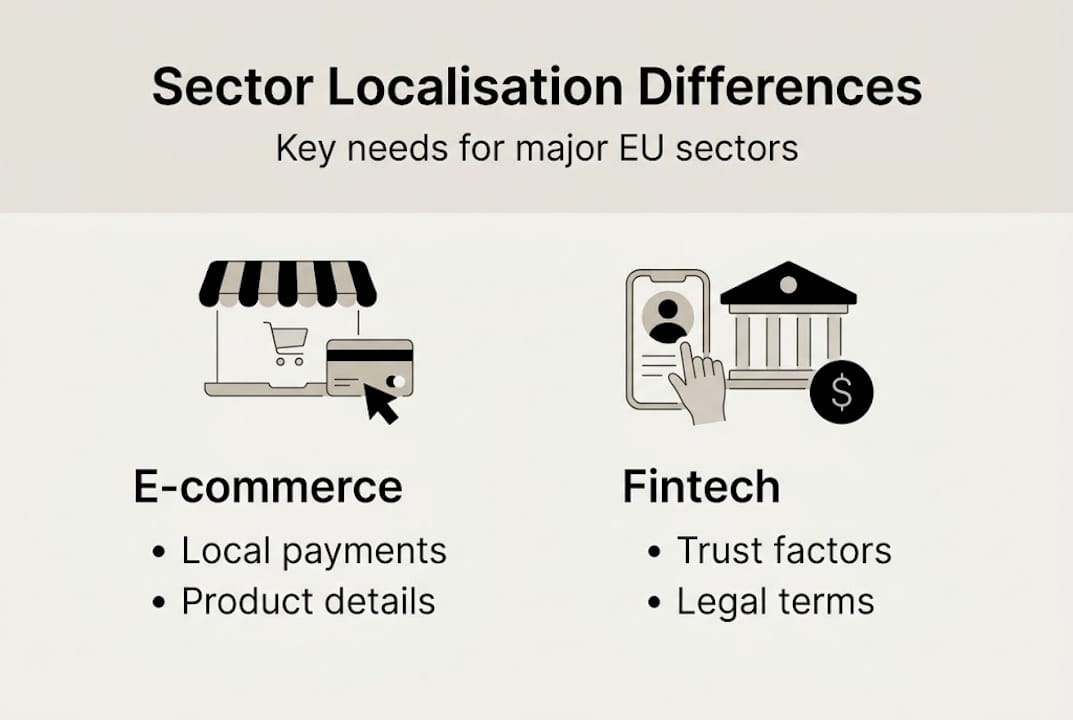
Localising for EU e-commerce means far more than translating product descriptions. Local payments and currencies must reflect regional preferences, from iDEAL in the Netherlands to Klarna in Sweden. Returns policies must comply with local law. In Germany, consumers are legally entitled to a 14-day return window, and the wording of your returns policy must reflect this precisely or you risk regulatory action.

Fintech
Trust is the currency of fintech. Regional trust variations are stark: German consumers, for example, show fintech trust ratings of only 41%, making transparency in localised content absolutely critical. Payment API documentation, consent flows, and risk disclosures must all be adapted to meet PSD2 requirements and local consumer expectations.
Legal
Legal localisation demands exact terminology. A mistranslated clause is not a stylistic issue. It is a liability. Jurisdiction-specific language, accurate references to local legislation, and consistency across all contract versions are non-negotiable. Using a language service provider for compliance with legal specialisation significantly reduces this risk.
Healthcare
Medical device user interfaces and patient-facing documentation carry the highest localisation stakes of any sector. Ambiguity in a dosage instruction or a contraindication notice is a patient safety issue. The EU MDR mandates that Instructions for Use (IFU) are localised into all official languages of the markets where the device is sold. AI-generated content in medical UIs is a growing risk area that requires expert human review at every stage.
- ✔ E-commerce: currency display, returns policy, payment method localisation
- ✔ Fintech: PSD2 consent language, trust-building copy, API documentation
- ✔ Legal: jurisdiction adaptation, terminology precision, version control
- ✔ Healthcare: IFU compliance, patient safety review, MDR-aligned QA
Review the full range of EU localisation strategies to see how these sector approaches are applied in practice across different market entry scenarios.
Edge cases, common pitfalls, and how to avoid them
Having explored practical sector-specific strategies, it is vital to recognise and plan for risks and frequent pitfalls.
Cultural missteps, regulatory surprises, and AI-misapplied content can derail EU market entry even for well-resourced organisations. The good news is that most of these risks are preventable with the right processes in place.
Here are the most common pitfalls and how to address them:
- Over-reliance on machine translation for regulated content: AI is powerful but error-prone with cultural nuance and regulatory language. Human review is not optional for compliance-critical content.
- Skipping jurisdiction-specific legal adaptation: Generic returns policies or consent forms copied across markets expose businesses to enforcement action from local regulators.
- Poor version control in large projects: When multiple translators work across thousands of assets simultaneously, version conflicts and terminology drift are real risks. Centralised translation memory tools mitigate this.
- Launching into multiple markets simultaneously without validation: Testing in high-barrier markets like Germany or France first allows you to identify localisation gaps before a broader rollout amplifies them.
“The most expensive localisation mistakes are the ones discovered by regulators, not by your QA team.”
Pro Tip: Run a dedicated localisation testing phase before any public launch in a new EU market. This includes functional, linguistic, and regulatory review to catch errors that automated checks miss.
For teams new to this process, the language localisation guide offers a solid grounding in avoiding the most common structural mistakes. Phased market launches remain one of the most reliable risk mitigation strategies available, particularly when entering markets with distinct legal frameworks.
Why human expertise is irreplaceable in sector localisation
AI has genuinely transformed localisation workflows, and we are enthusiastic advocates of its capabilities at Glocco®. But there is an uncomfortable truth that many technology vendors prefer not to highlight: AI is a productivity booster, not a judgement replacement.
For template content, low-risk copy, and high-volume repetitive material, machine translation with light post-editing delivers excellent results. But for the content that actually determines regulatory compliance or patient safety, the stakes are too high to rely on probabilistic outputs. AI tools for translators work best when experienced linguists are setting the parameters, reviewing outputs, and applying sector-specific knowledge that no model currently holds reliably.
The businesses that scale most successfully in high-barrier EU markets are those that validate their localisation in demanding markets first, with expert human oversight built into every critical content tier. Germany is a useful litmus test: if your localisation passes regulatory, cultural, and linguistic scrutiny there, you are well positioned to replicate that quality across the region. Human expertise is not a legacy cost. It is a strategic asset.
Take the next step with expert sector localisation
You have seen the pitfalls and the value of a human-led, detail-rich localisation process. The next step is applying this expertise to your own business. Whether you are scaling an e-commerce operation into new EU markets or ensuring your fintech platform meets PSD2 standards, professional sector localisation is what separates compliant, trusted brands from those that stall at the border.
Explore how localisation drives business growth for regulated industries, and discover the full range of language services for global business that Glocco® provides. Our team of sector-specialist linguists, compliance reviewers, and localisation engineers is ready to help you enter new markets with confidence, accuracy, and full regulatory alignment.
Frequently asked questions
How is sector-specific localisation different from standard translation?
Sector-specific localisation adapts content for industry-specific compliance, terminology, and cultural needs, going well beyond the word-for-word conversion that standard translation provides.
Which industries benefit most from sector-specific localisation in the EU?
E-commerce, fintech, legal, and healthcare sectors see the greatest impact, with EU compliance needs in each industry demanding precise, specialist adaptation rather than generic language services.
What is the main risk if sector-specific localisation is neglected?
Neglecting sector-specific localisation can lead to regulatory breaches and reduced trust, with consequences ranging from enforcement fines to complete loss of market access in specific EU member states.
How can AI-powered localisation workflows ensure accuracy?
By combining machine translation with human review under ISO standards, hybrid AI-human workflows cut errors to as low as 1-2%, compared to 15-25% for machine-only processes, making them suitable for regulated sector content.


