


Here’s a surprise: the riskiest word in your export file is rarely the exotic one. It’s the ordinary term translated three different ways across three documents. If you need export compliance papers translated for Slovakia or the wider EU, the job is less about “swapping languages” and more about keeping legal meaning, terminology and list references identical everywhere. That’s exactly the kind of work glocco® does with legal and technical translators for regulated sectors.
This guide is for in-house counsel, compliance leads and export managers in law firms, pharma, defence, tech, e-commerce and finance. No theory tour. Just what to translate, what trips people up and how to keep it all current.
Know the vocabulary before you translate it
Export compliance sounds like one thing. In practice, it’s a stack of regimes. The EU’s own professional code describes it as a multidisciplinary framework covering goods, services, software and technology, tangible or intangible, under dual-use, sanctions and other export-control rules. Note the word “item”: it covers a product, a service, software or technology.
Slovak has its own fixed vocabulary. The Ministry of Economy (MHSR) uses „položky s dvojakým použitím“, „vývozná licencia“, „technická pomoc“, „tranzit“ and „doklad o konečnom použití“. Use those forms. A filing that says “dual-purpose goods” in one paragraph and “položky s dvojakým použitím” in the next invites questions from the authority and from your own auditors.
Quick starter glossary for your term base:
- Dual-use items: položky s dvojakým použitím
- Export licence: vývozná licencia
- Technical assistance: technická pomoc
- End-use certificate: doklad o konečnom použití
- Transit: tranzit
Build this list once, approve it internally, and hand it to every translator. Boring? Yes. Life-saving? Also yes.
Which documents actually need a Slovak translation
The EU rule is short. Article 12(2) of Regulation (EU) 2021/821 says an exporter may be required to provide a translation of proof documents into an official language of the Member State where the export declaration is presented. In Slovakia, the MHSR spells it out: any foreign-language document in a dual-use licence application needs a Slovak translation, and you must also attach the original end-use certificate confirmed by the destination country’s authority.
In practice, that usually means:
- end-use statements and certificates
- foreign purchase orders, contracts and technical specifications
- invoices and transport documents kept as export records
- internal compliance procedures and training material for Slovak staff
- customer due diligence files and sanctions screening results
The record-keeping side matters too. EUR-Lex’s summary notes that exporters must keep detailed records, including invoices and transport documents, for five years. If the file is ever reviewed, the translations are part of it.
Timing is worth planning around. The Ministry decides on a licence within 90 days of a complete application, and an incomplete one (say, a missing translation) doesn’t start that clock. Order translations before you file, not after the first query.
For contracts around the export, such as confidentiality terms with foreign partners, see our guide to NDA translation in Slovakia. And if you’re unsure what makes a translated legal text count, Preklad zákonov Slovensko covers it.
Handling EAR, ITAR and OFAC in Slovak texts
US acronyms are the classic trap. Slovak readers meet EAR, ITAR and OFAC in supplier contracts and flow-down clauses, yet none of them has an official Slovak name that a regulator would expect.
Our practical approach, as translation craft rather than law:
- Keep the acronym and the US legal name in English.
- Add a short Slovak explanation in brackets on first use only.
- Never translate a US list name or an ECCN or USML category number. Reference codes stay exactly as published.
- Use the same rendering in every document of the file.
Carefully done, a Slovak reader understands the clause and a US counterpart recognises the reference. For defence-adjacent work, our dedicated page on ITAR document translation from Slovakia goes deeper.
One more warning. The US Commercial Service notes that chatbot translations should be verified, because they may struggle with acronyms, abbreviations and language nuances outside English. Export documents are packed with exactly those.
Lists change. Your translations must keep up
The EU dual-use list (Annex I) isn’t static. Delegated Regulation (EU) 2025/2003 of 8 September 2025 replaced Annex I to reflect updated international control lists. It was published on 14 November 2025, entered into force the next day, and exists in Slovak. Czech authorities flagged the change quickly, noting the list was updated with effect from 15 November 2025. That is a neat reminder that any translated classification table or internal manual can age overnight.
A sensible routine:
- Keep control-list numbers (such as 1C002a) in a separate, version-dated table, not buried in running text.
- Note which version of Annex I each translated document refers to.
- When the list changes, retranslate only the affected rows and references.
- For Slovak exporters, the Taric SK application, launched on 1 January 2025, flags whether a nomenclature code needs a dual-use export authorisation, so match your translated classifications against it.
Sanctions regimes move even faster than export lists, and the knock-on effects reach engineering teams too, as this piece on sanctions risks for engineers shows. Translated policies need an owner who watches for these changes.
Why a wrong word costs real money
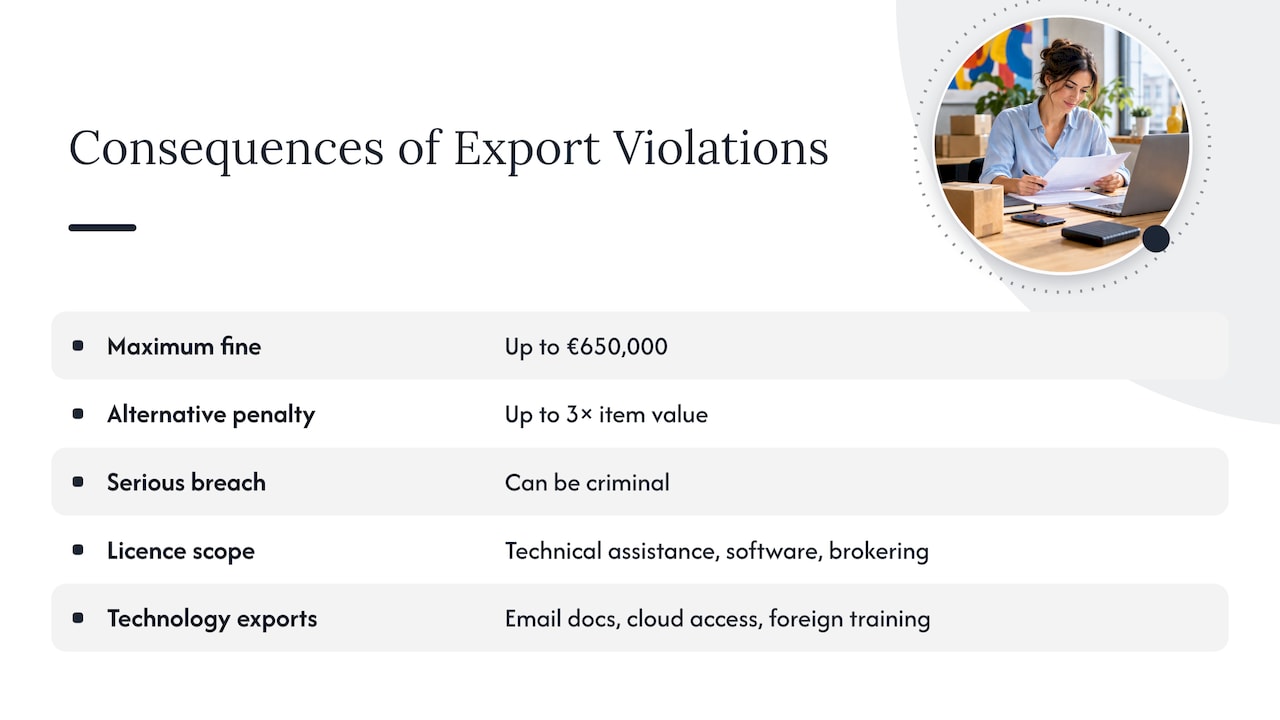
This isn’t a typo-level problem. Deloitte Slovensko states that exporting dual-use goods without meeting legal conditions is an administrative offence, punishable by fines of up to €650,000 or up to three times the value of the items where that value is higher, and serious intentional breaches can be criminal. It also notes that a licence may be needed for technical assistance, software and brokering.
That last point catches software and IT teams. A Slovak customs broker explains that emailing technical documentation, giving cloud access to software or training foreign technicians can itself count as an export of technology. So your translated internal guidance must say “technology” and “technická pomoc” clearly. A vague rendering could lead a developer to think a code share is harmless.
The same broker’s glossary describes vetting customers and end users through KYC, sanctions screening and end-use statements. If you screen suppliers and buyers, a clear supplier qualification process with consistently translated forms makes the evidence trail much easier to defend.
A review routine that protects meaning
What does a safe workflow look like? Here’s the short version:
- Approved term base first. Slovak official terms, your product names, US acronyms and their treatment.
- Specialist translator. Someone who knows legal and technical language, not just one of them.
- Independent legal-technical review. A second linguist checks references, numbers, list codes and defined terms against the source.
- Compliance sign-off. Your own export compliance officer confirms the document still says what your procedures intend.
- Version log. Date, source version, Annex I version, who reviewed.
Deloitte’s advice to exporters is to assess before any export whether goods fall under controls, since correcting mistakes later is difficult. The same logic applies to translation: get it right before it goes into a file.
How glocco® fits in
glocco® is a language services provider founded in 2014, working with legal, pharma, defence, IT, fintech and e-commerce clients across Europe and beyond. For export compliance papers, HumanLegal is the natural starting point for contracts, licence applications and end-use documents. For a wider view of how document translation works for EU businesses, see our document translation guide, and our piece on the role of translation in legal compliance explains why this is a compliance topic, not just a language one.
Our perspective
Most export files we would want to help with fail in the same way: the content is right, but the language isn’t consistent. One person writes “end-use certificate”, another “final user declaration”, and a third leaves the English term untouched.
Our view is simple. Export compliance translation is terminology management plus human review. We like to agree on a term base with you first, use specialist linguists for legal and technical material, and add a second human check before delivery. Technology helps us move faster, but people decide what a licence condition means.
Your compliance officer owns the regulatory judgement. We make sure the Slovak, English and any other language versions all say the same thing, so nobody has to guess.
glocco®
FAQ
Do I need a sworn translation for a dual-use licence application?
The MHSR page we checked requires a Slovak translation of foreign-language documents, but it doesn’t describe a sworn format. Confirm the exact requirement for your case with the Ministry of Economy before filing. We can then prepare the translation to that standard.
Should I translate EAR, ITAR and OFAC into Slovak?
No. Keep the acronyms and the official US names, and add a short Slovak explanation on first use. Reference numbers and list categories stay untouched.
How often should translated compliance documents be updated?
Whenever the underlying list or rule changes. Annex I was replaced by Delegated Regulation (EU) 2025/2003, which entered into force on 15 November 2025. Keep control-list references in a dated table so updates stay small.
Can machine translation handle export compliance texts?
The US Commercial Service advises verifying chatbot output because acronyms and nuance can be missed. For documents that go into a licence file, we recommend specialist human translation with a second review.
Sources
- Dual use: tovar a technológie dvojakého použitia, MHSR
- EU Code of Export Compliance, EIFEC
- Slovakia: Customs Laws and Regulations, Trade.gov
- Mezinárodní kontrolní režimy, MPO
- Kontroly vývozu, Deloitte Slovensko
- Dual-use goods glossary, YDV


