Localising defence software is a security project first, not a translation job with extra paperwork. Get it right and you need five things locked down together: internationalisation (i18n) that doesn’t fight your codebase, security built in from day one, GDPR and export compliance sorted before a single string moves, vetted defence linguists who understand NATO interoperability, and QA that tests in the field, not just on a screen.
Here’s your first-move checklist:
- Freeze the current build and appoint a named security lead for the localisation project.
- Scope a small pilot module rather than localising the whole system at once.
- Confirm which languages need NATO STANAG alignment versus purely national requirements.
- Map every string, image and legal disclosure that touches personal or classified data.
- Line up vetted linguists (like the ones glocco® works with) before translation starts, not after.
Get these five right and everything downstream, from QA to rollout, gets a lot easier.
How to scope a lokalizácia obranného softvéru project: teams, timeline and costs
Before anyone writes a line of translated code, get the right people in a room. That means a security architect, a legal or compliance officer, a product owner, a localisation lead, and someone from operations who actually uses the software in the field. Skip one of these and you’ll find out the hard way, usually during acceptance testing.
Most defence localisation projects run through five phases:
- Discovery and audit – mapping every string, asset and data flow (2 to 4 weeks).
- i18n retrofit – restructuring the codebase to separate language from logic (4 to 12 weeks, depending on legacy debt).
- Translation and adaptation – the actual localisation of software work, done by vetted linguists.
- QA and interoperability testing – linguistic, functional and field checks together.
- Certification and acceptance – sign-off against security and procurement gates.
Cost drivers worth flagging early:
- Greenfield builds with i18n baked in from the start cost far less than retrofitting a legacy system with hardcoded strings.
- Security clearance requirements for linguists add lead time and fees.
- On-premise translation infrastructure costs more upfront than cloud tools but often becomes mandatory for classified content.
- Procurement and accreditation cycles (especially anything touching NATO interoperability standards) can add months, so build that into your timeline before anyone promises a launch date.
Embedding security and compliance into defence localisation
Bolting a language pack onto a build that hasn’t been hardened is how vulnerabilities sneak in. Security research is blunt about this: cryptography alone doesn’t fix systemic issues, and treating software security as a late-stage patch rather than a continuous practice is exactly how defence systems get compromised. Localisation has to be part of the security conversation from the design phase, not an afterthought squeezed in before launch.
Practically, that means:
- Choose on-premise translation engines or accredited secure cloud platforms, never open consumer tools.
- Encrypt everything in transit and at rest, and lock down access with role-based permissions.
- Get NDAs signed before any linguist sees a single string.
- Treat names, ranks, service numbers and location data in UI strings as personal data under GDPR, and anonymise or minimise wherever the content allows it.
- Restrict anything touching classified material to accredited, on-site teams only. No exceptions, no “just this once” cloud uploads.
Pro Tip: If your build hasn’t passed a security audit, don’t add language packs to it yet. Fix the foundation first. A translated vulnerability is still a vulnerability, just in more languages.
What i18n and architecture changes does the codebase need?
Engineers, this is your section. Get the architecture right and localisation becomes a manageable release process rather than a recurring fire drill. Get it wrong and every new language adds risk.
Start by pulling every user-facing string out of the codebase and into external resource files (think XLIFF, JSON or ARB formats), because hardcoded text is the single biggest cause of localisation delays and bugs down the line. Once strings live separately, translation teams can work without touching application logic at all.
From there:
- Build in locale-aware date, time, number and unit formatting rather than assuming one format fits every deployment.
- Plan for text expansion: strings in some languages can run significantly longer than English, and cramped military UI panels have zero tolerance for overflow.
- Use UTF-8 encoding throughout to avoid character corruption in non-Latin alphabets.
- Separate language packs from core binaries using feature flags, so you can roll out or roll back a language without touching the underlying system.
- Keep a full audit trail in your CI/CD pipeline for every language asset build. Defence procurement teams will ask for it.
Building the localisation workflow: linguists, glossaries and QA
Who actually does the translation matters more here than almost anywhere else. Defence linguists need security clearances matched to the classification level of the content, plus real domain experience: someone who’s never touched military terminology will mistranslate “engagement” or “asset” in ways that matter.
The workflow that works:
- Vet and clear linguists before onboarding, matching clearance level to content sensitivity.
- Build a shared glossary and style guide covering ranks, equipment names, protocols and abbreviations, then lock it down as the single source of truth.
- Maintain a translation memory so terminology stays consistent across every module and every future update.
- Run a QA matrix covering linguistic accuracy, functional testing, pseudo-localisation to catch layout breaks before real translation lands, and interoperability checks against coalition systems.
- Set clear acceptance criteria and a sign-off chain that separates classified and unclassified artefacts.
A defence exercise involving embedded translation tools reported chat translation deployed within days and a sharp jump in document translation throughput once the tooling sat inside the existing communications workflow rather than bolted on separately.
Pro Tip: Never let a linguist work from a glossary you haven’t reviewed with an operational subject-matter expert. “Engagement” means something very different in a dating app and a fire-control system.
How do you keep multilingual defence systems secure after launch?
Shipping is not the finish line. Roll out language packs in stages, starting with a canary group, so a bad translation or a broken layout gets caught before it reaches the whole fleet.
- Version language assets alongside software releases, never separately, or you’ll get drift between what the UI says and what the system actually does.
- Keep rollback plans ready for every language pack, the same way you’d roll back a code release.
- Log every localisation-related incident and review it with the same rigour as a security incident, because sometimes it is one.
- Pick on-premise engines when content is classified, and accredited cloud vendors only when contracts and clearances explicitly allow it.
glocco®’s track record with defence-grade localisation
Glocco has been building secure, sector-specific language workflows since 2014, and defence is one of the industries where that experience actually shows. Coverage spans legal, fintech, medical and IT sectors too, but the discipline required for defence work, vetted linguists, GDPR-first processes, secure delivery, carries across all of it.
A recent case study on secure multilingual communication for the defence sector shows what this looks like in practice: sensitive content handled through controlled workflows, with clearance-matched linguists and compliance built into every stage rather than checked at the end.
What that translates to for you:
- Secure, on-premise or accredited-cloud translation workflows depending on classification level.
- Vetted linguists with domain experience, not generalists guessing at military terminology.
- AI-assisted tooling for speed, without cutting corners on human review of sensitive content.
- A GDPR compliance approach built around minimisation and anonymisation, not bolted on afterwards.
Defence teams embedding secure translation into tactical communications have seen dramatic gains in document throughput once the process was properly integrated rather than handled ad hoc.
Managing cryptographic elements and key material localisation
Here’s something most localisation checklists skip entirely: your cryptographic strings and key material need their own rulebook. Error messages referencing cipher suites, key exchange protocols or certificate names often get treated as ordinary UI text, and that’s a mistake. Translate a cryptographic error message badly and a field operator might misread a genuine security alert as a routine glitch, or worse, ignore it.
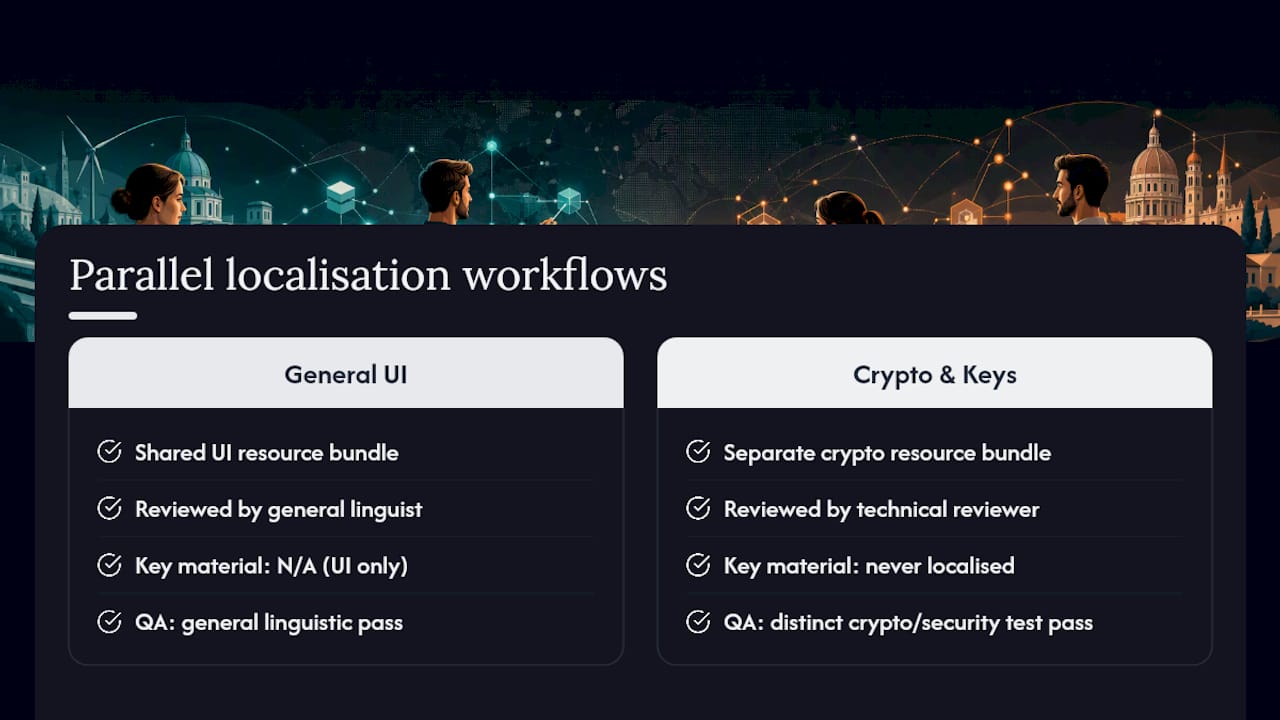
The safer approach separates cryptographic and security-critical strings into their own resource bundle, reviewed by someone who understands both the language and the underlying protocol. Never let a general-purpose linguist rewrite key exchange terminology without a technical reviewer checking the output. Terms like “nonce”, “handshake” or “root of trust” have precise technical meanings that don’t always map cleanly across languages, and a loose translation can quietly change what an operator understands about system state.
Key material itself (actual cryptographic keys, certificates, credentials) should never pass through a general translation pipeline at all. Keep it entirely separate from the linguistic workflow, handled only by cleared technical staff with no localisation vendor involved. The localisation team’s job is the surrounding language: alerts, logs, configuration labels, not the keys themselves.
Build a specific test pass for cryptographic and security messaging during QA, distinct from your general linguistic QA. It’s a small addition to the test matrix that catches a category of error general reviewers usually miss.
Ensuring hardware-software compatibility with local defence infrastructure
Software doesn’t localise in a vacuum. It runs on hardware, and defence hardware varies wildly between allied nations, older field terminals, ruggedised tablets, legacy radio systems, each with its own display constraints, input methods and processing limits.

Text expansion is the first casualty. Test every translated string on the actual hardware it will run on, not just a developer’s monitor.
Input methods matter too. Some coalition partners use hardware with limited character sets or older firmware that doesn’t support certain diacritics cleanly. Confirm early which alphabets and special characters your target hardware can actually render, because discovering this during field testing is far more expensive than catching it during the i18n phase.
Interoperability with coalition systems adds another layer. If your software needs to exchange data with allied forces running different localised versions, character encoding mismatches or date format differences can cause silent data corruption rather than an obvious crash, which makes it far harder to catch. Building consistent encoding standards (UTF-8 throughout, standardised date and unit formats) across every localised version reduces this risk considerably, and it’s far cheaper to enforce that standard from the architecture stage than to retrofit it once ten language versions are already in the field.
Cultural and operational context beyond language
Translation is the easy part, honestly. What trips up defence localisation projects far more often is everything that isn’t language at all: military rank structures, protocol conventions, symbols and operational culture that don’t map neatly from one force to another.
Rank insignia and terminology are a good example. A rank that translates literally in one language might not correspond to an equivalent level of authority or responsibility in another force’s structure, and getting that wrong in a UI that displays chain-of-command information isn’t a cosmetic error, it’s an operational one. The same goes for symbols: colours, icons and map markings carry different meanings across different national military traditions, and a symbol meaning “friendly” in one system can look ambiguous or even hostile in another context.
Operational protocols matter just as much. Communication procedures, escalation chains and standard phrasing for alerts often follow doctrine specific to a particular force. Software localised without input from someone who understands the target force’s actual operational conventions, not just its language, tends to produce a system that’s technically translated but practically confusing to use under pressure.
This is where NATO interoperability standards genuinely earn their keep: they give you a shared reference point for symbols, protocols and terminology across coalition partners, rather than leaving every localisation decision to guesswork.
What defence teams get wrong about localisation
Most localisation advice treats defence software like any other enterprise product with a few extra compliance boxes ticked. That’s the mistake. The conventional playbook, translate the UI, run a QA pass, ship it, works fine for e-commerce. It falls apart here because the stakes of a mistranslated alert or a broken cryptographic string aren’t a bad customer review, they’re operational risk.
What the evidence actually supports is treating localisation as a continuous security discipline rather than a one-off linguistic task appended near launch. The case study data on embedded translation tools makes this clear: speed and security aren’t in tension when the workflow is built correctly from the start. Teams that bolt language packs onto unhardened builds, or hire generalist translators for cryptographic terminology, are the ones who end up firefighting after deployment.
If you’re prioritising one thing first, make it this: get your security architect and your localisation lead in the same planning meeting from week one. Not after i18n. Not after the first translation draft. Week one. Everything else on this checklist gets easier once that partnership exists, and almost every localisation failure we’ve seen traces back to those two functions working in isolation.
— glocco®
Ready to scope your defence localisation pilot?
Most agencies will translate your strings and call it done. That’s not enough for defence software, and honestly, we don’t think it should be enough for anyone handling sensitive content. Glocco builds secure, on-premise-capable translation workflows specifically for sectors where a data leak isn’t just embarrassing, it’s a genuine liability, and defence sits right at the top of that list.
If you’re weighing up a pilot, we’ll happily start with a scoped security audit plus a small localisation proof-of-concept, rather than asking you to commit to a full rollout blind. Take a look at our secure multilingual communication case study to see how this played out for another defence client, then get in touch through our contact form to arrange NDAs and a technical scoping call. If AI-assisted workflows are part of your plan, our AI tools for translators page is worth a look too. No pressure, just a proper conversation about what your project actually needs.
Sources
- Software localization guide: process, cost, and ROI
- Software localization 10 best practices & examples | Lokalise