


TL;DR:
- Accurate translation and localisation are critical to compliance and avoiding financial penalties in banking.
- Specialized language services, including translation, localisation, and interpretation, reduce errors and miscommunication risks.
- Building a strategic, board-level language framework enhances international growth and client trust.
A single mistranslated clause in a loan agreement or a misinterpreted regulatory filing can expose a bank to significant financial penalties, reputational damage, and broken client relationships. Yet language barriers remain one of the most underestimated compliance risks in international banking. Many institutions invest heavily in legal counsel and risk management frameworks, but overlook the foundational role that accurate translation, localisation, and interpretation play in every cross-border transaction, client interaction, and regulatory submission. This article sets out the key risks, the right services to address them, and practical steps banking professionals can take to build language into their compliance and communication strategy.
Key Takeaways
| Point | Details |
|---|---|
| Compliance protection | Accurate language services are the foundation of banking compliance and regulatory safety. |
| Clear international communication | Effective translation and interpretation build client trust and reduce misunderstandings. |
| Proven error reduction | Banks with structured localisation processes cut compliance errors by up to 60%. |
| Practical integration steps | Strategic planning enables smooth implementation of language solutions across banking operations. |
Why accurate language services matter in banking
Banking operates in one of the most heavily regulated environments in the world. Every document, from client contracts and Know Your Customer (KYC) forms to anti-money laundering (AML) reports and prospectuses, carries legal weight. When those documents cross language boundaries, even minor inaccuracies can have serious consequences.
Consider a cross-border merger where a key indemnity clause is translated with subtle ambiguity. In a dispute, that ambiguity could cost millions. Or consider a bank submitting multilingual regulatory reports to the European Central Bank with inconsistent terminology. Regulators notice. Fines follow. Regulators worldwide increasingly demand accurate multilingual documentation from banks, and the bar for acceptable quality is rising every year.
The most common pitfalls in banking translation include:
- Contract ambiguity: Terms that carry specific legal meanings in one jurisdiction may have no direct equivalent in another language, creating grey areas that courts interpret unpredictably.
- Missed reporting deadlines: Poor communication between multilingual compliance teams can cause critical filing windows to be missed, triggering automatic penalties.
- Reputational damage: International clients who receive poorly translated communications lose confidence quickly. In private banking and wealth management, trust is everything.
- Regulatory misalignment: Translated compliance policies that do not accurately reflect the source document can result in staff following incorrect procedures across international branches.
“A bank’s credibility in any market is only as strong as its ability to communicate clearly in that market’s language and regulatory context.”
For compliance departments managing multiple languages, the solution is not simply to hire bilingual staff. Professional language compliance in banking requires subject-matter expertise, certified translators, and structured quality assurance processes.
Pro Tip: Assign a dedicated language compliance coordinator within your compliance team. This person acts as the liaison between your internal teams and your language service provider, ensuring consistency in terminology across all regulatory submissions and client-facing documents.
Types of language services used by banks
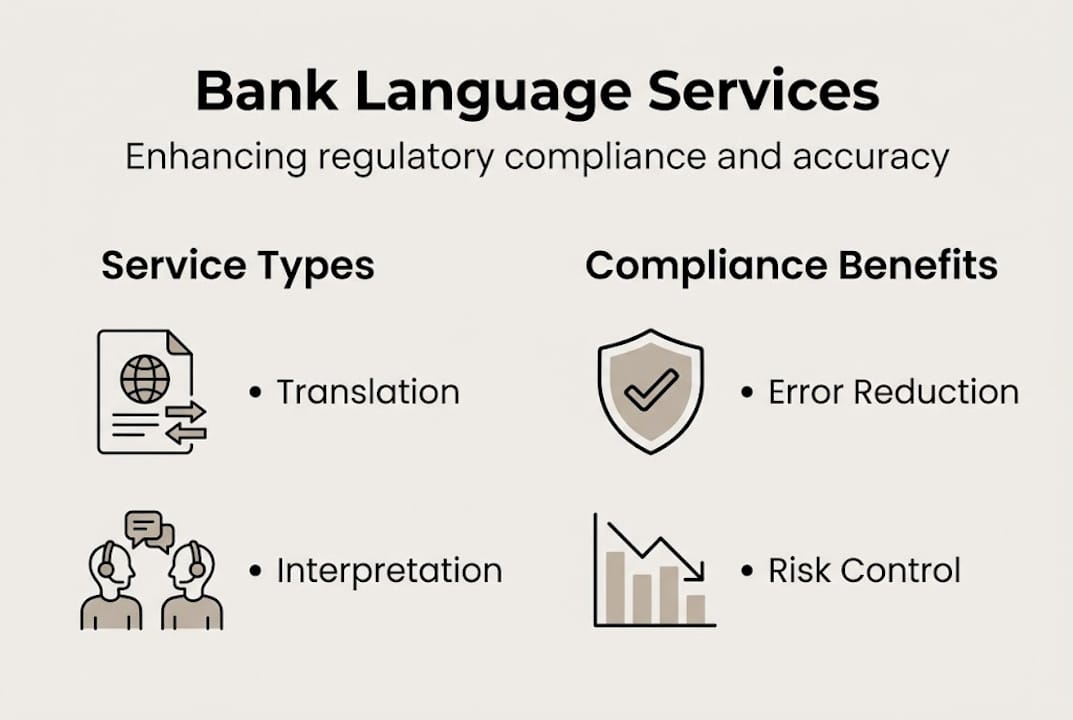
Banks rely on translation, localisation, and interpretation for cross-border transactions and client interactions, but these three services are not interchangeable. Understanding the distinction is the first step towards choosing the right solution.
| Service | What it involves | When banks use it |
|---|---|---|
| Translation | Converting written content from one language to another | Contracts, compliance reports, KYC documents, prospectuses |
| Localisation | Adapting content for cultural, legal, and regulatory context | Client portals, marketing materials, terms and conditions |
| Interpretation | Facilitating spoken communication in real time | Client meetings, regulatory hearings, negotiations |
Understanding legal translation vs interpretation is particularly important in financial contexts, where the wrong service choice can introduce risk rather than reduce it. A translated document that is not localised for the target jurisdiction may still contain terms that are legally unenforceable or culturally misaligned.
The sequential process most banks follow when selecting a language service looks like this:
- Identify the content type: Is it written or spoken? Is it for internal compliance use or external client communication?
- Assess the regulatory context: Does the target jurisdiction have specific legal requirements for document format, certified translation, or sworn interpretation?
- Determine the cultural sensitivity: Client-facing materials in wealth management or retail banking often require localisation, not just translation.
- Select a certified provider: For regulated documents, certified banking interpreters and accredited translators are not optional. They are essential.
- Establish a review process: All translated or interpreted content should be reviewed by a bilingual subject-matter expert before it is used in a regulated context.
The role of interpreters in banking is often underestimated. Live negotiations, regulatory hearings, and client onboarding meetings all demand real-time linguistic accuracy. A misinterpreted figure or a missed nuance during a compliance interview can have consequences that no amount of post-meeting clarification can fully undo.
For banks operating across multiple jurisdictions, building a clear service map, which matches each document or interaction type to the appropriate language service, is a practical and high-value exercise.
Ensuring compliance with multilingual regulation
Once the right service type is identified, banks must build the operational infrastructure to deploy it consistently. A multilingual workflow for compliance is not a luxury. It is a risk management tool.

The data is compelling. A structured translation workflow cuts errors by up to 60% in banking compliance environments. That figure reflects the difference between ad hoc translation requests and a systematic, quality-assured process with defined roles, terminology management, and audit trails.
The main compliance risks and how language services address them are summarised below:
| Compliance risk | Language service solution |
|---|---|
| Inaccurate regulatory filings | Certified translation with subject-matter review |
| Inconsistent terminology across branches | Centralised glossary and translation memory |
| Client miscommunication during onboarding | Localised documentation and interpreter support |
| Non-compliant marketing materials | Localisation with legal and regulatory review |
| Missed multilingual reporting deadlines | Structured workflow with defined turnaround times |
Practical steps for international banks to operationalise multilingual compliance include:
- Centralise your terminology: Build a master glossary of regulatory and financial terms in every operating language. This single step eliminates a significant proportion of translation inconsistencies.
- Implement translation memory tools: These systems store previously approved translations and flag inconsistencies, reducing both cost and error rates over time.
- Schedule regular language audits: Review translated compliance materials annually or when regulations change to ensure continued accuracy.
- Partner with specialists: General translation agencies are not equipped for banking. Language services for banking success require providers who understand AML regulations, Basel III frameworks, and jurisdiction-specific reporting requirements.
- Plan for multilingual talent: Sourcing multilingual talent strategically supports long-term compliance capacity across international offices.
The regulatory landscape is not static. As banks expand into new markets, the language requirements evolve. Building a scalable multilingual compliance framework now protects institutions from reactive, costly corrections later.
Best practices for implementing language services
With the compliance foundation in place, banking leaders can focus on embedding language services into day-to-day operations. Client onboarding in finance is streamlined and less error-prone with professional language support, and that improvement extends across the entire client lifecycle.
Here is a step-by-step implementation guide for banking and finance professionals:
- Conduct a language needs assessment: Map every touchpoint where language barriers could introduce risk or friction. Include client communications, internal compliance documents, regulatory submissions, and staff training materials.
- Define your provider criteria: Look for language service providers with demonstrable experience in financial services, certified translators and interpreters, ISO certification, and a structured quality assurance process.
- Establish a localisation workflow for banking: Define who approves translated content, how terminology is managed, and how updates are communicated to all relevant teams.
- Train relevant staff: Compliance officers, relationship managers, and operations teams should understand when to request professional language support and how to brief a language provider effectively.
- Monitor and measure output: Track error rates, turnaround times, and client feedback on multilingual communications. Use this data to refine your language strategy over time.
- Review vendor performance regularly: Language needs evolve. Your provider should be reviewed at least annually against agreed quality and compliance benchmarks.
Pro Tip: Align your language strategy with both your compliance objectives and your client experience goals from the outset. Banks that treat these as separate workstreams often end up with technically accurate documents that are still confusing or off-putting to international clients. The best outcomes come when legal precision and clear communication are pursued together.
Common pitfalls to avoid during implementation include relying on machine translation for regulated documents without human review, using non-certified interpreters for formal regulatory interactions, and failing to update translated materials when source regulations change. Each of these shortcuts introduces risk that far outweighs the cost savings.
Using a global reach checklist during the planning phase helps ensure no critical language touchpoint is overlooked before launching into new markets.
The overlooked role of language in shaping banking’s future
Most digital transformation strategies in banking focus on technology: artificial intelligence, open banking APIs, blockchain-based settlements. Language rarely appears on the agenda. That is a strategic blind spot.
We have seen, time and again, that banks which treat language as a core strategic pillar consistently outperform those that consider it a functional afterthought. A fintech expanding into Southeast Asia with a fully localised client experience captures market share faster than a competitor launching with a machine-translated interface. A private bank that provides genuinely localised wealth management communications builds deeper client relationships than one that sends generic translated letters.
The connection between language quality and localisation for business growth is measurable and significant. Yet language investment is still routinely cut in budget discussions, positioned as a cost rather than a growth driver.
The uncomfortable truth is that language strategy is not a translation department issue. It is a board-level conversation. Banks that want to compete internationally in 2026 and beyond need to ask not just “can we translate this?” but “does this communication build trust, meet regulatory requirements, and serve our clients in the way they expect?” Those are very different questions, and the answers require a very different approach to language.
How Glocco supports banking professionals
For banks ready to take the next step, linking industry knowledge with expert support is essential. Glocco offers language services for banks that are specifically tailored for the compliance, communication, and operational demands of financial institutions. From certified translation of regulatory filings to real-time interpretation for client meetings, Glocco’s workflows are built to integrate seamlessly with banking operations.
As a recognised provider of language providers for compliance across Europe and beyond, Glocco combines subject-matter expertise with rigorous quality assurance. Whether you need interpretation services for finance or end-to-end localisation support, Glocco’s team is ready to help your institution communicate with clarity, confidence, and full regulatory alignment. Get in touch to discuss your requirements.
Frequently asked questions
What is the difference between translation, localisation, and interpretation in banking?
Banks use all three language services for operations and regulatory communications. Translation converts written content, localisation adapts it for legal and cultural requirements, and interpretation handles spoken communication in real time.
How do language services help banks avoid compliance penalties?
Accurate multilingual documents are vital for compliance. Professional language services ensure all required documents are accurately translated and localised, reducing the risk of errors that could result in regulatory fines.
What should banks look for in a language service provider?
Banks should choose providers with expertise in financial compliance, certified interpreters who minimise risk and assure compliance, and proven localisation workflows with structured quality assurance.
Can language services streamline client onboarding for banks?
Yes. Professional localisation streamlines onboarding by providing clear multilingual documents and interpreter support, making the process faster and more accurate for international clients.


