


Managing a multilingual project without a clear framework is a risk most organisations cannot afford. A single missed specification or an unclear brief can cascade into costly revisions, missed deadlines, and damaged client relationships. Whether you are handling legal documents, product catalogues, or regulatory filings across multiple markets, the stakes are consistently high. This guide walks you through the essential preparation, structured processes, quality standards, and measurement tools that transform translation project management from a reactive scramble into a reliable, repeatable operation.
Key Takeaways
| Point | Details |
|---|---|
| Define every requirement | Success starts with explicit, standards-based project specifications and roles. |
| Follow a clear workflow | Use a structured process with feedback loops and quality gates for reliable results. |
| Embrace hybrid solutions | Blend AI and human expertise to boost project speed and maintain quality. |
| Monitor and improve | Apply recognised frameworks like MQM and ISO 5060:2024 for ongoing success tracking. |
What you need to launch a successful translation project
Having introduced the high stakes of translation management, it is essential to clarify what you must have in place before you start. Preparation is where successful projects are won or lost.
Key roles every project requires:
- Project manager — owns the timeline, budget, and stakeholder communication
- Subject-matter translators — specialists matched to the domain (legal, medical, technical)
- Editors and reviewers — independent professionals who validate accuracy and style
- Terminologist — maintains glossaries and ensures consistency across large volumes
- Client or content owner — approves final output and resolves ambiguities
Beyond people, you need the right infrastructure. Translation memory ™ systems, terminology databases, and a translation management system (TMS) form the technical backbone. Without them, consistency across large projects is nearly impossible to guarantee.
Pre-launch checklist:
- ✅ Source language files confirmed and formatted correctly
- ✅ Target language(s) and locale variants identified
- ✅ Subject-matter glossary and style guide provided
- ✅ Reference materials (previous translations, brand guidelines) shared
- ✅ Quality thresholds defined in writing
- ✅ Review rounds agreed upon with stakeholders
- ✅ Deadline milestones documented
One of the most important steps is aligning your project specifications with a recognised standard. Research into translation quality and specifications confirms that explicit specifications prevent disputes, and recommends ISO 11669:2024 for setting project parameters, covering everything from risk analysis to intended audience. For quality evaluation, ISO 5060:2024 provides the benchmarks against which output is assessed. Using both standards together creates a specification framework that is defensible, auditable, and effective.

For sectors where precision is non-negotiable, such as the legal industry, following a accurate legal translations approach from the outset prevents compliance failures downstream.
| Resource | Purpose | Recommended standard |
|---|---|---|
| Project brief | Defines scope, goals, audience | ISO 11669:2024 |
| Style guide | Ensures tone and voice consistency | Client-defined |
| Glossary or TM | Manages terminology | ISO 12616 |
| Quality evaluation criteria | Sets pass/fail thresholds | ISO 5060:2024 |
Pro Tip: Draft your project specification document as if a third party unfamiliar with your project will need to execute it from scratch. This removes ambiguity and creates a clear record if disputes arise.
Understanding the full scope of a localisation workflow essentials approach is equally valuable at this stage, particularly for teams managing multi-market rollouts.
Step-by-step process for managing translation projects
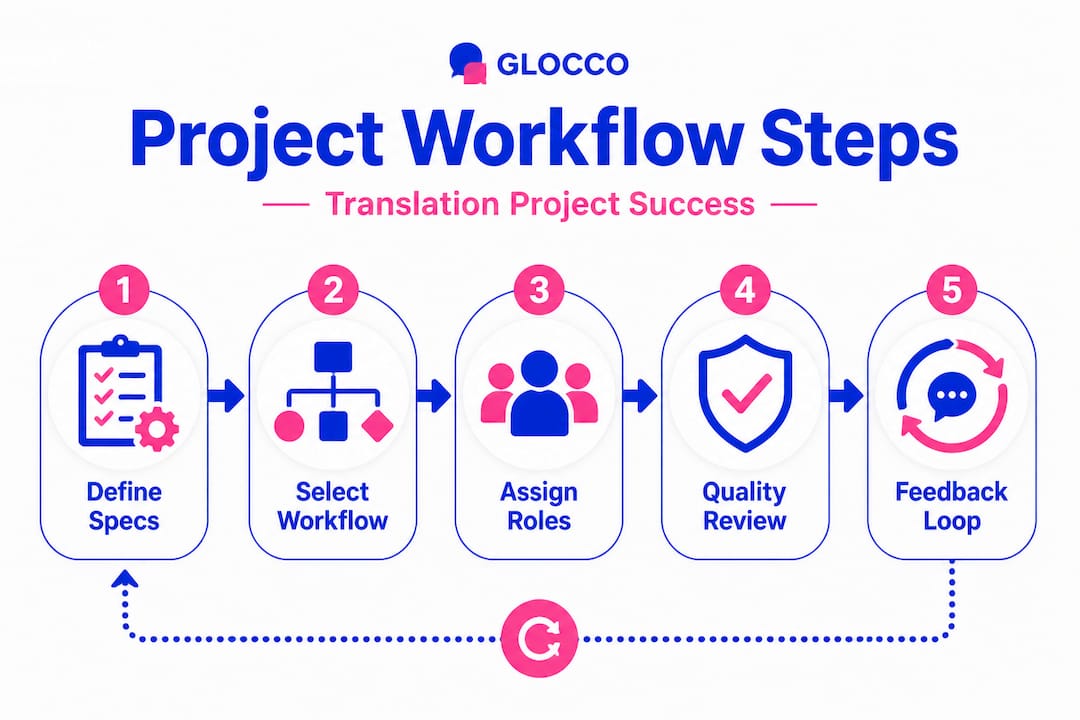
Once the foundational elements are ready, the process moves to managing the project in an orderly and communicative way.
Phase-by-phase project workflow:
- Kick-off meeting — Confirm scope, roles, tools, and communication channels with all stakeholders. Document decisions in writing.
- Source content preparation — Review source files for clarity, flag ambiguous terms, and extract content into a TMS.
- Translation — Assign content to qualified translators with access to glossaries, TM, and style guides.
- Editing and revision — An independent editor checks linguistic accuracy and adherence to specifications.
- Quality assurance (QA) gate — Apply the Multidimensional Quality Metrics (MQM) framework to evaluate errors by category and severity.
- Stakeholder review — Share output with the client or subject-matter expert for final feedback.
- Delivery and archiving — Deliver files in the agreed format, archive TM updates, and log lessons learned.
The MQM framework is a structured approach for categorising translation errors across dimensions such as accuracy, fluency, style, terminology, and locale convention. Rather than a binary pass/fail, MQM assigns weighted scores, giving project managers an objective basis for accepting, rejecting, or reworking translations. This is particularly useful when ISO 11669:2024 specifications need to be matched against a measurable quality outcome.
Hybrid AI-human workflows are now central to competitive translation management. AI handles repetitive, high-volume content efficiently, while human specialists manage nuance, cultural adaptation, and sensitive subject matter. The key is knowing where to apply each. Explore the range of AI tools for translators that integrate smoothly into existing TMS environments.
| Workflow type | Speed | Quality ceiling | Best suited for |
|---|---|---|---|
| Fully manual | Slower | Highest | Legal, medical, literary |
| Hybrid AI-human | Fast | High | Marketing, e-commerce, IT |
| Fully automated | Fastest | Variable | Internal comms, gist translation |
Pro Tip: Set a clear escalation protocol before the project begins. If an MQM score falls below the agreed threshold, define in advance who is responsible for remediation and within what timeframe.
Your language localisation checklist is an excellent companion resource for structuring each phase consistently across markets.
Common pitfalls and how to avoid them
Even with a methodical process, translation projects can derail, often for entirely preventable reasons.
The most frequent mistakes project managers make:
- Unclear or missing specifications — Without a formal brief, translators make assumptions that lead to inconsistent output.
- No defined QA benchmarks — Approvals based on subjective opinion create disputes and revision cycles.
- Over-reliance on automation — AI without human oversight fails on nuanced, culturally sensitive, or highly regulated content.
- Insufficient stakeholder involvement — Feedback that arrives late in the process is expensive to implement.
- Ignoring locale variants — Treating all Spanish-speaking markets the same, for example, causes localisation failures.
Research consistently shows that explicit specifications prevent disputes, and that the MQM framework provides an objective measure for resolving quality disagreements. Teams that skip the specification stage often find themselves negotiating scope and quality standards mid-project, which is costly and disruptive.
For industries such as healthcare, the consequences of poor translation management are severe. Understanding the principles behind medical accuracy in translation illustrates how rigorous QA frameworks protect both patients and organisations. Similarly, reviewing translation compliance tips helps project managers understand what certified and compliant translation management looks like in practice.
Critical warning: Skipping the specification or quality evaluation stage to save time almost always results in rework, missed deadlines, and damaged professional relationships. A few hours invested in preparation prevents weeks of remediation.
Training your team and educating stakeholders on what quality translation requires is not optional. Many disputes originate from misaligned expectations, not poor performance. When clients understand the standards being applied and the rationale behind each review stage, the entire project runs more smoothly.
Measuring success: quality metrics and continuous improvement
Avoiding common mistakes is just one part. Knowing how to measure and grow success completes the project lifecycle.
The two principal tools for measuring translation quality are the MQM framework and ISO 5060:2024. Together, they provide both granular error categorisation and a structured evaluation methodology. Teams that apply ISO 5060:2024 quality evaluation consistently are better placed to demonstrate return on investment and identify where processes need refinement.
Core KPIs for translation project success:
| KPI | What it measures | Target benchmark |
|---|---|---|
| MQM error rate | Weighted error density per word count | Below 3% for critical content |
| On-time delivery rate | Projects delivered within agreed deadline | 95% or above |
| Revision cycles | Number of review rounds per project | No more than 2 rounds |
| Client satisfaction score | Post-delivery feedback rating | 4.5/5 or above |
| Terminology consistency rate | Correct use of glossary terms | 98% or above |
Implementing a continuous improvement cycle:
- Collect MQM scores and error category data after every project.
- Hold a brief post-project debrief with translators, editors, and the project manager.
- Update glossaries and style guides to address recurring issues.
- Adjust workflow steps where bottlenecks or error patterns are identified.
- Set revised quality benchmarks for the next project cycle, informed by ISO 5060:2024 thresholds.
Building systematic feedback loops turns each project into a learning opportunity. Over time, this reduces revision cycles, lowers per-project costs, and strengthens your team’s capability. The language services for communication checklist provides an excellent framework for structuring these review cycles at scale.
What most translation project managers miss: specs, tech, and culture
There is a tendency in this field to treat translation management as a purely procedural challenge. Follow the right framework, adopt the right technology, hit the right scores. This view is understandable but incomplete.
The projects that genuinely succeed, the ones that land well with target audiences and hold up under regulatory scrutiny, are the ones where the project manager understood that standards and tools are enablers, not solutions in themselves. Technology will not tell you that a legal term carries different connotations in Brazilian Portuguese versus European Portuguese. A high MQM score will not catch a culturally inappropriate image paired with otherwise accurate text.
Over-reliance on automation is the single most common mistake we see in teams that are new to hybrid workflows. Human translators matter precisely because language carries meaning that goes beyond the dictionary definition of words. Cultural competence, which includes understanding social norms, regional sensitivities, and audience expectations, is a skill that requires deliberate investment.
Pro Tip: Build cultural competence into your project team by including at least one native-market specialist in each major review stage. This person does not need to be a linguist. A regional marketing professional or customer service lead from the target market brings invaluable perspective.
The project managers who consistently deliver strong results treat adaptability as a core professional skill. They negotiate scope when source content changes, escalate early when risk factors emerge, and invest in relationships with their language professionals rather than treating them as interchangeable resources. That human dimension is what no framework can replicate.
Next steps: professional translation services for global success
Now that you have a blueprint for managing translation projects, expert support can help you put these strategies into action. At Glocco®, we specialise in managed translation services that are built around ISO standards, MQM quality frameworks, and hybrid AI-human workflows tailored to your industry. Whether your team needs a structured programme for the first time or is looking to optimise an existing process, our tools and expertise are designed to deliver measurable results. Explore the AI translation tools integrated into our workflows and discover how language services for business can be aligned to your quality and compliance requirements from day one.
Frequently asked questions
What are the main industry standards for translation project management?
ISO 11669:2024 and ISO 5060:2024 are the principal standards, covering project specifications and quality evaluation respectively. Together, they provide a robust, auditable framework for managing and assessing translation work.
Why are explicit project specifications so important?
Research confirms that explicit specifications prevent disputes by aligning all stakeholders on scope, quality criteria, and deliverables before work begins. They also give project managers a clear reference point if output is challenged.
How does the MQM framework improve translation quality?
The MQM framework provides a structured, weighted system for categorising translation errors, making quality assessment objective rather than subjective. It enables consistent measurement across projects, vendors, and languages.
What is the role of AI in modern translation project management?
A hybrid AI-human workflow uses automation to increase throughput on volume tasks while retaining expert oversight for nuanced, sensitive, or regulated content. Neither approach alone delivers the right balance of speed and accuracy.


