


GxP document translation means turning regulated quality documents (SOPs, batch records, product information, validation files) into another language without changing a single obligation. In Slovakia, the rule of thumb is simple: anything that reaches patients, inspectors or ŠÚKL has to be in accurate, expert-checked Slovak. Anything internal needs a controlled, traceable process. Sounds dull? It’s where audits are won and lost!
What counts as a GxP document?
GxP is the umbrella for “good practice” rules: manufacturing (GMP), laboratory (GLP), clinical (GCP), distribution (GDP) and pharmacovigilance (GVP). So the documents are a mixed bag. In practice, the translation requests we see most often fall into three groups:
- Regulatory submissions: SmPC, package leaflets (PIL), labelling, QRD-based product information.
- Quality system documents: SOPs, work instructions, batch records, deviation and CAPA reports, training materials.
- Study and safety documents: protocols, consent forms, pharmacovigilance and safety notices.
Each group has a different tolerance for error and a different owner. Treating them as “just text” is the first mistake.
What Slovak and EU rules say about language
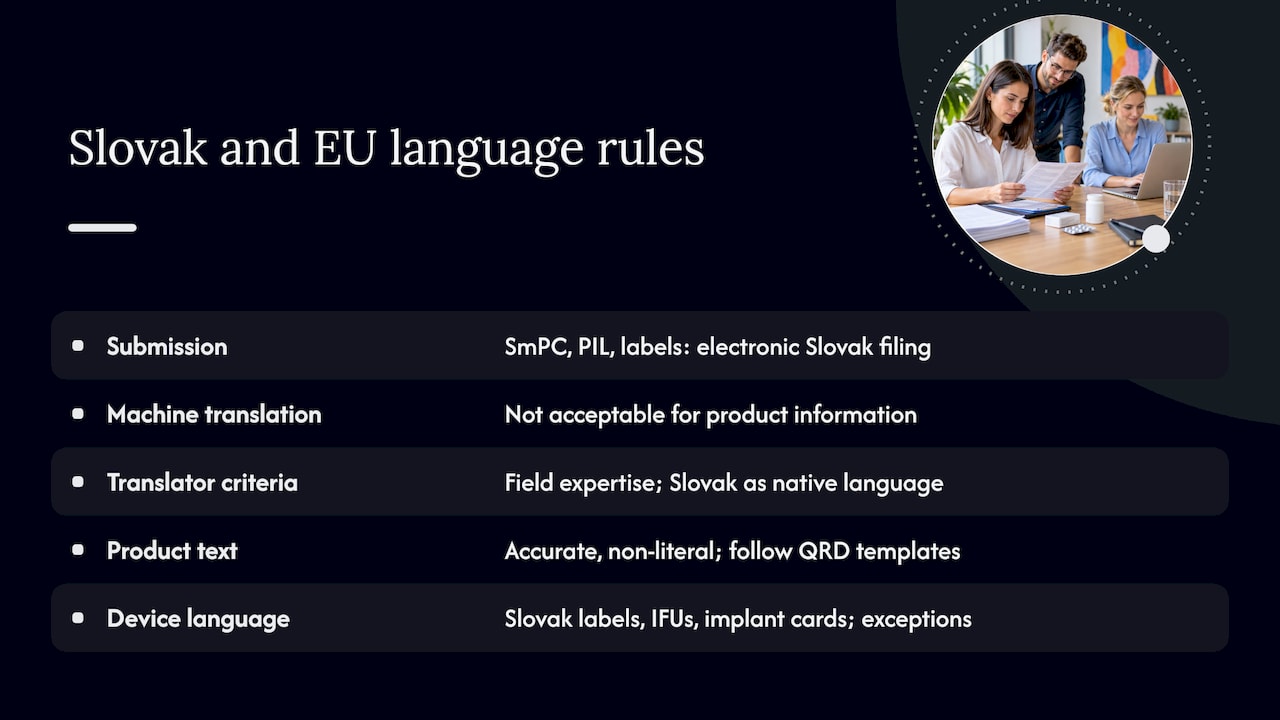
Start with the hard rule. ŠÚKL requires the proposed SmPC, PIL and labelling to be submitted electronically in Slovak under Act No. 362/2011.
Then the quality bar. ŠÚKL’s methodological guideline MP 150/2026, effective from 27 April 2026, says machine translation is not acceptable for product information. It also says translators must have expertise in the field and Slovak as their native language. Translations should be accurate but not literal, so no calques, and should follow the QRD templates. For leaflets, technical terms are replaced with lay terms or explained in brackets, because patients read them, not pharmacologists.
Medical devices follow a different table. For Slovakia, the European Commission’s language requirements for MDR manufacturers list Slovak for device labels, IFUs and implant cards, with specific exceptions for professional-use labels and some other information. We break this down in our guides to MDR translation requirements in Slovakia and IFU translation for audits.
For medicines, the EMA’s QRD Working Group supplies the templates and guidance that keep translated product information clear and consistent across languages.
Do you need a sworn translator?
Short answer: it depends on who receives the document and what they ask for. A sworn (official) translation is a formal certified document, used when an authority or court asks for one. ŠÚKL’s published guidance for product information focuses on something else: subject expertise, native Slovak and QRD experience. We found no general rule that makes every internal GxP document, such as an SOP for your Slovak site, need a sworn translation.
Our advice: ask the receiving body in writing which form it expects before you order. If it wants a certified copy, say so in the brief. If it wants expert quality, a specialist linguist plus a documented review does the job. For legal texts and official certification, see our piece on what is legally valid in Slovak translation of laws.
Controlling translations inside your quality system
A translation is a controlled document too. EU GMP Chapter 4 of EudraLex Volume 4 expects documents to be designed, prepared, reviewed and distributed with care. Instructions must be approved, signed and dated, uniquely identifiable and carry a defined effective date. Style and language must also fit the intended use, with SOPs written in an imperative, mandatory style.
So a Slovak SOP that reads like a polite suggestion is a finding waiting to happen. Here is a workflow that holds up:
- Freeze the source. Translate an approved, versioned English document, never a draft.
- Translate with a subject specialist. Pharma terminology, native Slovak, imperative voice where the SOP calls for it.
- Independent review. A second expert checks terminology against your glossary and the source.
- Final language and format check. ŠÚKL recommends a final grammar and formatting check, done by a native Slovak speaker with medical or pharmaceutical terminology knowledge and QRD experience.
- Approve and release. Sign, date, assign the document number and effective date, and link it to the source version.
- Archive the trail. Keep the source, the translated file, the review records and the approval together.
Industry guidance on multilingual documentation, such as this GMP data integrity guide, suggests a controlled strategy covering translation, review, approval, access, storage and retrieval, plus clear identification of which language version is valid. It also suggests prioritising critical records such as batch records, deviations and CAPAs for translation validation. Multilingual templates help too: they make training and consistent use much easier.
Keeping translations in step with the source
Source documents change. Translations must follow. For medicinal product information, when the English common text is updated, you update the Slovak translation and re-submit it as required. If you spot an error in the common text during national linguistic review, you alert the reference Member State so it is corrected, then update the national translation (MP 150/2026).
For internal documents, the principle is the same. Make a change to the English SOP and the Slovak version is automatically “under change” until its translation is approved. Keep a translation memory and glossary so revisions only touch what changed. Fewer words to re-review, fewer surprises.
What goes wrong when translation isn’t controlled
The risks are practical, not theoretical:
- Regulatory delay. The EMA monitors translation quality in centralised procedures, and poor-quality translations can delay transmission to the European Commission until amended versions arrive. For veterinary products, a missing QRD Form 2 can do the same.
- Inspection findings. Industry guidance warns that failing to ensure data integrity across languages can lead to non-compliance findings and affect patient safety and product quality.
- Rework. A mistranslated dose unit or an unclear instruction means redoing the document, retraining staff and re-approving everything.
Tempted by a quick AI draft? Fair, it’s fast. But for product information ŠÚKL rules out machine translation, and for internal documents you still need expert review. If you want a wider view of how quality and review fit together, this overview of AI translation tools for websites is a handy starting point for the machine-translation side of the debate.
Our perspective
Here’s what we’ve learned: nobody wants to talk about translation until an auditor does. So let’s talk about it early!
At glocco® we think of GxP translation as a quality process, not a typing job. The right specialist, a second pair of expert eyes and a clean paper trail matter more than a quick turnaround. Our HumanPro and HumanLegal workflows are designed around exactly that: human expertise first, technology where it genuinely helps, and a review step you can show to an inspector.
We work with clients in pharma, medical, legal and defence, where “close enough” is not a thing. Our advice? Build your glossary once, lock your source versions, and let the translation follow your document control, not the other way round.
glocco®
How glocco® can help
Need Slovak versions of SOPs, product information or safety documents? Our specialist teams cover regulated content in 76 languages. For legal and compliance-heavy texts, look at HumanLegal. For specialist technical and regulated content, HumanPro is the place to start. Related reading: our SmPC translation workflow, the package leaflet checklist and our guide to pharmacovigilance document translation.
FAQ
Can I use machine translation for GxP documents?
Not for product information submitted to ŠÚKL: its 2026 guideline says machine translation is not acceptable. For internal documents, any draft still needs review by a subject expert who is a native speaker, followed by formal approval in your quality system.
Which language must a package leaflet be in for Slovakia?
Slovak. ŠÚKL requires the proposed SmPC, PIL and labelling to be submitted in Slovak, and it expects leaflet wording that a patient can read, with technical terms replaced or explained.
Who should review a Slovak pharmaceutical translation?
A native Slovak speaker with medical or pharmaceutical terminology expertise and, for product information, QRD-template experience. That is the profile ŠÚKL recommends for the final check.
Do I need to retranslate everything when the source changes?
Usually only the changed parts, provided you keep a translation memory and version control. The updated Slovak text still needs review and approval, and for medicinal product information it must be re-submitted as required.
Sources
- ŠÚKL: additional requirements for dossier submission in Slovakia
- ŠÚKL: MP 150/2026, quality translations of product information
- European Commission: language requirements for MDR manufacturers
- EMA: Working Group on Quality Review of Documents
- EudraLex Volume 4, Chapter 4: Documentation
- Managing DI in multi-language documentation and forms
- EMA: practical information on translations for referral procedures
- EMA: linguistic review process for veterinary centralised procedure


