


Most people assume court interpreting is simply translating what someone says in another language. It is far more than that. What is court interpreting, really? It is a specialised legal function that guarantees every party in a courtroom, regardless of their language, can participate fully and fairly in the proceedings. Get it wrong, and you are not just losing meaning in translation. You are potentially denying someone their right to due process. This guide breaks down exactly what court interpreters do, how they work, and why the standards that govern them matter enormously.
What court interpreters actually do
The court interpreter role goes well beyond knowing two languages fluently. Court interpreting converts information between spoken languages, or between spoken and sign languages, so that non-English speakers and deaf or hard-of-hearing parties can follow proceedings as if they were conducted in their native language. That is the foundation of due process.
Here is what court interpreters are responsible for:
- Real-time spoken interpretation during hearings, trials, depositions, and witness examinations
- Sight translation of written legal documents such as court orders, affidavits, and plea agreements
- Preserving the speaker’s register, meaning if a witness sounds nervous and informal, the interpreter conveys that too, not a polished version
- Complete and unaltered output, with no omissions or edits regardless of how complex or uncomfortable the content is
What court interpreters do not do is equally significant. They do not provide legal advice, explain court procedures to parties, or assist with filing documents. Their role is strictly linguistic. The moment an interpreter steps outside that boundary, they compromise the integrity of the proceeding.
Pro Tip: If you are working with an interpreter in court, brief them on case-specific terminology in advance. Familiarity with the subject matter noticeably improves output quality, even for experienced professionals.
The three modes of court interpreting
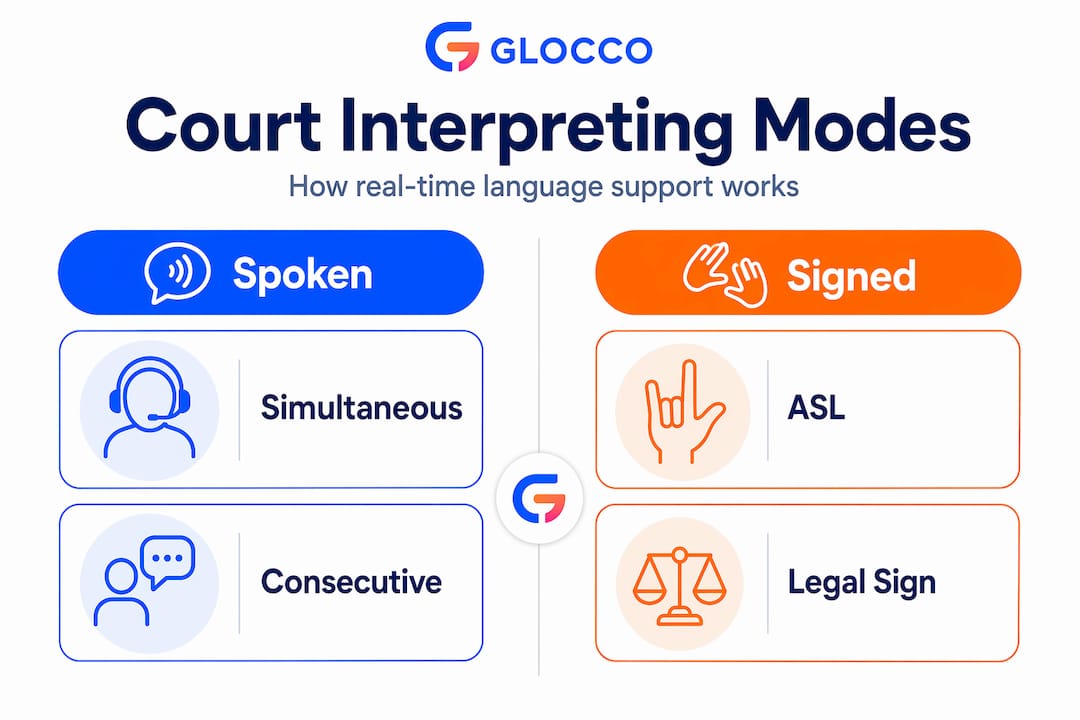
How does court interpreting work in practice? There are three distinct modes used in legal settings, each serving a different purpose and demanding a different skill set.
-
Simultaneous interpretation. The interpreter speaks at the same time as the original speaker, with only a few seconds of lag. This is the most cognitively demanding mode. In long sessions, simultaneous interpreting often requires teams of two or more interpreters who rotate every 20 to 30 minutes to manage fatigue. Technology such as headsets and soundproof booths is commonly used.
-
Consecutive interpretation. The speaker pauses after completing a thought, and the interpreter then renders the message. This mode relies heavily on structured note-taking. It is slower than simultaneous but allows for greater precision. You will often see this mode used during witness examinations and police interviews.
-
Sight translation. The interpreter reads a written document aloud in the target language, on the spot, without preparation time. This requires competence across multiple modes and a strong command of both written and spoken legal language simultaneously.
Each mode places different demands on concentration, memory, and legal knowledge. Switching between them within a single hearing is not uncommon, which is why training programmes treat each mode as a distinct discipline.
Pro Tip: For courtrooms handling lengthy trials, always plan for a two-person simultaneous interpreting team. A solo interpreter working through hours of complex testimony is a reliability risk, not a cost saving.
Ethics and professional standards
The importance of court interpreting extends directly into the ethical obligations that govern it. Accuracy, impartiality, and confidentiality are the core ethical principles that every qualified court interpreter must uphold without exception.
What does this look like in practice?
- Accuracy means rendering every word, including false starts, hesitations, and emotional inflections, without softening or improving what was said
- Impartiality means the interpreter does not advocate for any party, even if they personally disagree with what is being said
- Confidentiality covers all privileged communications between a defendant and their counsel that an interpreter is party to
“Court interpreting requires education beyond bilingualism to manage simultaneous, consecutive, and sight modes, alongside maintaining high ethical standards and ongoing learning.” — Connecticut Judicial Branch
Court interpreter qualifications reflect this complexity. Under the Court Interpreters Act (28 U.S.C. §1827), interpreters are categorised at the federal level as certified, professionally qualified, or language skilled, with certified being the highest and most rigorously tested tier. Provisional or registered statuses exist in many jurisdictions for languages where certified interpreters are scarce, but they come with additional monitoring requirements.
Being bilingual is the starting point, not the qualification. Preserving speaker register and producing real-time, complete, accurate interpretations requires years of dedicated training, not just fluency.

Accessing court interpreting services
Understanding the legal interpreting process also means knowing the practical side. Who arranges interpreters? When should they be requested? And what does it cost?
Court interpreting services are often free to parties who require them, provided through the court itself for qualifying proceedings. The court carries the responsibility of supplying qualified interpreters who meet the standards for the specific language and case type. Here is a quick overview of key practical considerations:
| Factor | Details |
|---|---|
| Who requests | Legal representatives, defendants, or witnesses via the court clerk |
| When to request | As early as possible. Late requests risk delays or unavailability |
| Cost to party | Typically free for qualifying proceedings in most jurisdictions |
| Common settings | Criminal trials, civil hearings, family court, asylum proceedings, depositions |
| Languages covered | Varies by jurisdiction; rare languages may require specialist sourcing |
One thing many people overlook: failing to request interpreters early can disrupt an entire case. Courts in busy jurisdictions often have limited availability for certain language pairs, particularly less common ones. If you are a legal professional working with a non-English-speaking client, the interpreter request should happen the same day you confirm the hearing date.
Our perspective on court interpreting
I have worked with legal interpreting projects long enough to say this plainly: the field is still badly misunderstood, even by experienced legal professionals. The assumption that any bilingual speaker can step in and handle court interpreting is one of the most persistent and damaging misconceptions I encounter.
What I have seen repeatedly is that the hardest part of the court interpreter role is not vocabulary. It is the pressure of real-time delivery in high-stakes situations, where a single omission or mistranslation can affect a verdict. The difference between a certified interpreter and an ad hoc bilingual assistant is not a technicality. It is the difference between reliable and unreliable testimony on the record.
I also think the profession deserves more credit for how much it has professionalised over the past two decades. Ethical codes, tiered certification structures, specialist training programmes for consecutive and simultaneous modes: these exist because the legal system finally acknowledged that linguistic accuracy is a rights issue, not an admin detail.
Where do I see room to grow? Remote interpreting technology has expanded access significantly, particularly for rare languages. But quality assurance in remote settings is still catching up. The standards that apply in person must apply equally when the interpreter is working via video link. That consistency is what the profession needs to protect.
— glocco®
Work with qualified legal interpreters
Understanding court interpreting is one thing. Finding professionals who genuinely meet the standard is another. glocco® works with experienced, vetted interpreters across legal settings in Europe, the Middle East, North America, and beyond. Whether you need certified court interpreters for a complex criminal trial or qualified support for civil hearings, glocco® can help you get it right.
Explore our legal interpreting services guide for a full breakdown of what to look for in a qualified legal interpreter. You can also read about the differences between legal interpreting and translation if you are trying to identify exactly what your case requires. When accuracy and compliance are non-negotiable, glocco® is ready to support you.
FAQ
What is court interpreting?
Court interpreting is the real-time conversion of spoken language, or signed language, in legal settings so that non-English speakers and deaf parties can fully participate in proceedings. It is a regulated, specialised role governed by strict ethical and accuracy standards.
What do court interpreters do exactly?
Court interpreters render spoken testimony, legal questions, and judge’s directions in the target language in real time. They also perform sight translations of written documents and must preserve the speaker’s original tone and register without any additions or omissions.
What qualifications do court interpreters need?
At the federal level in the United States, the Court Interpreters Act classifies interpreters as certified, professionally qualified, or language skilled. Certification requires passing rigorous oral and written examinations and demonstrating competence across all three interpreting modes.
How does court interpreting differ from regular translation?
Court interpreting is spoken and real-time, whereas translation deals with written text. Legal translation produces a document; court interpreting produces a live, accurate spoken rendering that becomes part of the court record.
Are court interpreting services free?
In most jurisdictions, interpreter services are free to qualifying parties for court proceedings. The court arranges and funds the service, though it is critical to submit your request as early as possible to secure availability.


